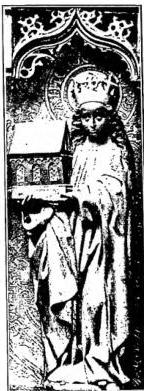
GERTRUDE the GREAT, Saint. — Great mystic, born on 6 January 1256, died in 1302 or 1303.
I. THE LIFE
The biographical information available concerning G. la G. is very scant and is for the most part contained in her works.It is not known where she was born. While still a child (1261), she entered the Cistercian Monastery of Helfta near Eisleben (Germany), where she spent her entire life. In her youth she devoted herself passionately to classical studies, which were held in high esteem in the monastery to which she belonged; this soon led her into a state of tepidity, from which she recovered after an inner crisis and a vision of the Savior experienced on 27 Jan. 1281, which she later called her “conversion.” She then began to devote herself to the study of the Fathers of the Church and of Sacred Scripture, making the fullest use of her brilliant natural gifts, especially eloquence, for the benefit of her fellow sisters at Helfta. A habitual union with God and a rich succession of interior mystical gifts (visions, revelations, the invisible stigmata, etc.) characterized her existence, so that she was called the greatest mystic of the 13th century (cf. R. Medici, Questioni critiche intorno a s. G. la G., in Rivista storica benedettina, 15 (1924), p. 256).
Her cult was approved by the Holy See, first (1606) for individual monasteries, then for the Order of St. Benedict (1647). In 1731 it was extended by Clement XII to the whole Church. Feast day: 16 Nov.
She was sometimes confused with St. Gertrude of Nivelles, but more often with St. Gertrude of Hacheborn, her contemporary (1232–92) and abbess in the same monastery.
II. THE WORKS
Of her interior mystical experiences, G. left writings of great spiritual value that exerted a powerful influence on later ascetics and mystics. She wrote in the vernacular some short treatises, now lost, on obscure passages of the Bible, and florilegia of maxims drawn from the holy Fathers. It is thought that she had a part in compiling the Liber specialis gratiae of St. Matilde di Hackeborn, sister of Gertrude di Hackeborn. Works certainly hers and handed down are the Revelationes, or Legatus divinae pietatis, and the Exercitia spiritualia. The Revelationes consist of five books, of which only the second was written in the Saint’s own hand, while the first was composed by her fellow nuns after her death, and the following ones were written under her inspiration or dictation. The work was submitted to the scrutiny of the theologians while G. was still living and was approved.III. THE SPIRITUALITY
The works of s. G. are not treatises on speculative mysticism, but expressions of her lived experience: for the most part, they are a dialogue between the soul and God. Her attitude was greatly influenced by the particular circumstances in which the monastery of Helfta found itself during the century of its foundation: first and foremost, the great influence of the Cistercian Order to which it belonged, the widespread circulation of the writings of s. Bernardo, the spread of the Franciscan spirit, and also the formation of the great German Dominican mystical school at the end of the 13th century.Gertrudian piety is essentially liturgical, bound as it is to Benedictine traditions. The entire fourth book of her Revelationes consists of meditations and elevations on the feasts of the liturgical cycle and on the mysteries of the life of the Savior. Choral liturgy provides very frequent points of inspiration throughout all the Saint’s writings.
In accordance with Cistercian traditions and the Franciscan spirit, G. cultivated a tender devotion to the humanity of Christ, and a vivid supernatural sense of nature, which she regarded with innocent eyes, finding in it a reflection of the divine perfections. In a particular way she cultivated devotion to the Sacred Heart of the Savior, as did s. Matilde di Hackeborn and Matilde di Magdeburgo (d. in 1280), who also entered the monastery of Helfta, creating there a fervent atmosphere for this devotion, which soon spread beyond the cloister throughout medieval German Christianity (see K. Richstätter, Die Herz-Jesu Verehrung des deutschen Mittelalters, 2nd ed., Paderborn 1924). A profound Eucharistic piety permeates the Revelationes of s. G., in which there is likewise a lively devotion to the Blessed Virgin.
IV. INFLUENCE
The influence exercised by s. G. is linked particularly to her writings. Yet these remained virtually unknown, in only two manuscript copies, until the sixteenth century, when the first editions were prepared and disseminated (that of G. Lansperger dates from 1536). The Benedictine Luigi da Blois (Blosius) made extensive use of them in his works, nor did s. Teresa escape their influence. An even greater revival of Gertrudian influence has occurred since the last century, owing particularly to the intensification of devotion to the S. Heart, for which so many testimonies are found in the works of s. G.; and above all to the recent edition of the Saint’s works, prepared by the Benedictines of Solesmes, who made them more readily accessible.