
PADERBORN, ARCHDIOCESE OF. - City and archdiocese in Germany. It has an area of 39,228 sq. km with a population of 9,382,323, of whom 2,345,344 are Catholics, distributed across 605 parishes, served by 1,454 diocesan priests and 464 religious; it has
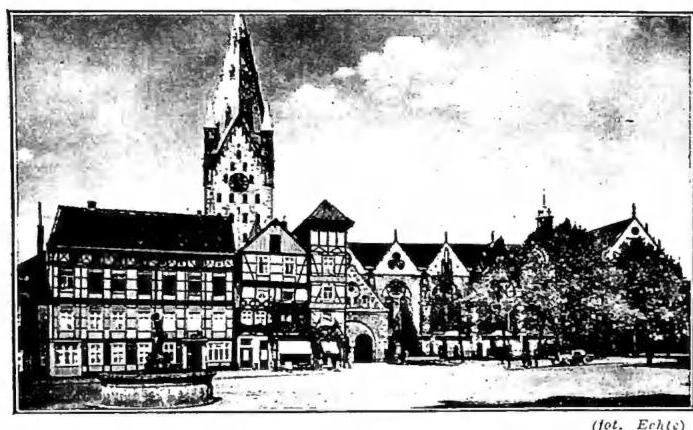
(photo Erkki)
The foundation of the Church of P. dates back to the year 772, when Charlemagne had the Irminsul destroyed and Christianity was brought to the surroundings of P. by the holy Abbot Sturmi. The foundation took place during the Synod of Maifeld in 777. The territory of P. then depended on the diocese of Würzburg. The first bishop of P. is St. Hathumar (775-815) of noble Saxon lineage. He built the cathedral of St. Mary and St. Kilian. The territory of the diocese was circumscribed by the Synod of Salz (804) and bordered the dioceses of Mainz, Cologne, Osnabrück, and Hildesheim. To the east it surpassed the Weser, to the south the Diemel, and it was a suffragan of the Archdiocese of Mainz. Although the diocese of P. did not have special tasks in the history of Germany, it nevertheless frequently saw kings and emperors—Carolingian, Saxon, and Frankish—within its walls. Of historical importance is the meeting of Pope Leo III with Charlemagne at Christmas in 799.
St. Badurad (815-52) finished the Cathedral and founded the college for the clergy, instituting common life there. In 836 he obtained from Louis the Pious the body of St. Liborius, bishop of Le Mans, who became the principal patron. During his rule, the abbeys of Corvey and Herford were founded; together with the monasteries of Boddeken, Neuen-Herse, and Geseke, they contributed to the conversion of the region to Christianity. Henry II of Werl (1090-1127) consecrated a Christian chapel on the "Externsteine" (a pagan sacred site). A friend of St. Bernard of Clairvaux was Bernard I of Ocsede (1127-60). He founded the Cistercian monastery of Hardehausen and, during a trip to Rome, obtained from Innocent II permission to use the so-called "rational" still worn by the archbishops of P. today. Upon returning to his seat, he found a large part of the Cathedral destroyed by fire. The reconstruction he ordered was carried out according to the designs of the cathedral of Poitiers and became the most important monument in all of Westphalia. The history of the diocese in the 13th century is full of guerrilla warfare with the neighboring Archdiocese of Cologne, whose archbishop Dietrich von Mörs (d. 1463) united the two dioceses (1429-44), asking Martin V for approval, but the Cathedral Chapter, which had great influence in the administration of the diocese, managed to prevent this union from becoming effective. Under Erich von Braunschweig (1508-32) Protestant doctrine entered the diocese of P. and spread, despite the apostolic zeal of Bishop John of Hoya (1568-74). In 1580 the Chapter called the Jesuits, a year after Bishop Henry of Lauenburg (1577-85) had adhered to the "Augsburg Confession." He was followed by Dietrich von Fürstenberg (1585-1618), one of the most famous bishops of the diocese, founder of a library and a seminary that bear his name. During the congress for
the Peace of Westphalia (1648), the Landgrave of Hesse, a Lutheran, attempted to secularize and annex the diocese of P. But Louis XIV and even the diocese of Le Mans, which considered itself almost the guardian of P. because of its Patron St. Liborius, opposed II. The bull De salute animarum of July 16, 1821 enlarged the diocese of P. with the annexation of the dioceses of Corvey, Magdeburg, Halberstadt, Merseburg, part of Naumburg, Cologne, Mainz, Osnabrück, Minden, Verden, Havelberg, and Brandenburg. After Breslau, P. became the largest diocese in Germany. In 1851 the Duchy of Gotha was placed under the diocese of P., and in 1868 the apostolic vicarate of Anhalt, which in 1921 was incorporated into the diocese itself, and in 1869 the Principalities of Schwarzburg-Rudolstadt and Sonderhausen. Pope Pius XI with the apostolic constitution Pastoralis officii of Aug. 13, 1930 elevated the diocese of P. to an archdiocese, giving it Fulda and Hildesheim as suffragans. The bishops of this
period were Friedrich Clemens von Ledebur (1825-1841), R. Dammers (1841-44), F. Drepper (1845-55), K. Martin (1856-79), F. C. Drobe (1882-91), H. Simar (1891-1900), W. Schneider (1900-1909), K. J. Schulte (1910-20), C. Klein (1920-40) and from 1940 to the present Lorenz Jäger. - See plate XXXIV.