
LE MANS, DIOCESE of. – City and diocese in the department of Sarthe in France.
Over an area of 6,244 sq. km. it has a population of 412,214 inhabitants, of whom 375,391 are Catholics. It has 401 parishes served by 485 diocesan priests and 120 religious, a major and a minor seminary; it has 6 male and 33 female religious communities (Ann. Pont., 1951, p. 243). It is suffragan to Tours.
It is the ancient Vindunum, capital of the Cenomanes, and subsequently a Roman city. In the ninth century an episcopal book was composed in the curia of Le M., from s. Giuliano to Alderico (832–57), under the title Actus pontificum Cenomannis in urbe degentium. There are also six episcopal catalogues: the first and third extend to Bishop Gervasio (1036–55); the second and sixth to Guido (1135); the fourth to Maurizio (1216–31); and the fifth to Guglielmo (1145–1187). The saint most venerated in the Merovingian period was s. Vitrio, bishop of Le M. (d. 490): a basilica was erected in his honour, mentioned in the seventh century, adjacent to which was the one dedicated to Bishop s. Giuliano. An imperial document of the year 832 mentions the two dependent monasteries (A. Poncelet, in Analecta Bollandiana, 22 [1903], p. 156). In the time of Bishop Aldrico, the bodies of the bishops Vittorio, Giuliano, Turibio, Pavazio, and Liborio were transferred to the cathedral. According to legend, the primitive cathedral was built on the site of the residence of the Roman defensor, then enlarged and transformed by Bishops Vittore and Innocenzo (533–59), who dedicated it to ss. Gervasio and Protasio, placing their relics beneath a new altar. Destroyed at the end of the eighth century, it was rebuilt by Bishop Francone and s. Aldrico, but was destroyed by the fire set by the invading Normans.
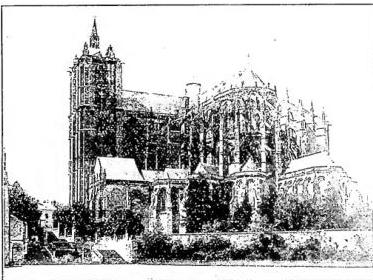
Rebuilt once more by Bishop Mainardo (951–70), it suffered further damage. New construction was begun by Bishop Vulgrino in 1060, then continued by Bishops Arnoldo and Höel, who consecrated it on 17 October 1093, transferring there the relics of s. Giuliano; in 1110 the central nave was rebuilt by Bishop Ildeberto, under the direction of the monk Giovanni of the abbey of the Most Holy Trinity of Vendôme. Twice devastated by fire, it began to be repaired by Bishop Guglielmo de Passavant (1145–87). A new choir was erected by Bishop Amelino (1217–54). The transept was resumed at the end of the fourteenth century, but was completed only in 1430. Cardinal Filippo di Lussemburgo, bishop of Le M. from 1477 to 1507 and from 1509 to 1519, had a sumptuous Lectorium erected, decorated with many statues and bas-reliefs; it was destroyed by the Huguenots in 1562. The stained-glass windows are of great importance: the oldest contain scenes from the life of Jesus Christ and the patron saints of the cathedral (twelfth century), followed by allegorical scenes with portraits of donors and benefactors (thirteenth century), such as Cardinal Fillastre, Renato I and Luigi d’Angiò, King Renato and Maria di Blois, as well as other scenes from the New Testament (fifteenth century; cf. E. Hucher, Calques des vitraux peints de la cathédrale du M., Le Mans 1864). The choir stalls, with carvings representing scenes from the life of Jesus Christ and allegories, were mutilated in 1768 and 1830; removed in 1855, they are now inside the sacristy. Also noteworthy is a large shrine for the public breviary. Among the monumental tombs inside the cathedral are the tomb of Queen Berengaria (thirteenth century), brought there in 1821 from the ancient abbey of Epau; the tomb of Carlo
d’Angiò, Count of Maine (1472), attributed to F. Laurana; and that of Guglielmo di Bellay (1557). Originally, there were two imposing towers on the exterior; Guglielmo il Conquistatore had asked Bishop Ildeberto to demolish them because they overlooked the castle. The northern one no longer exists.
The portico was erected in 1158; on the tympanum of the southern portal Jesus Christ is represented among the symbols of the Evangelists and thuriferous angels, while the vault contains scenes from the New Testament; the twelve Apostles are placed on either side of the portal. Other noteworthy churches are Notre-Dame de
(phot. Naurdrin)
The P. J. Bonvet (1665–1752), missionary in Siam and China, Guéranger (v.) were from Le M.
St Julien du M., ses évêques, son architecture, son mobilier, Mamers 1900; G. Fleury, La cathédrale du M., Parigi 1925; Guide de la France chrétienne et missionnaire, Parigi 1949, pp. 358, 595–99; Cottineau, II, cols. 1726–31. Enrico Jovi