
LECTORIUM. — A dividing wall between choir and nave in medieval churches. In French called jubé, in English rood screen or roodloft, that is, “tribune of the Crucifix,” in Flemish doxale, in German Lettner, trascoro in Spanish.
The l. appears from the second half of the 12th century, first in France, then in Italy, Germany, the Netherlands, and England, where it achieved its greatest development and widest diffusion. Its origin is debated: it might derive from a raising of the front wall of Romanesque crypts or from a further development of the union between the pergula and the ambo or pulpit. The l. is found above all in churches with choral services: cathedrals, abbey churches, collegiate churches, and rarely in parish churches, never in the churches of the Minors or the Preachers. Properly speaking, it consists of a tribune raised above a very thick wall between the choir and the nave (or naves). The wall is richly decorated with sculptures and also paintings and is almost always connected with the architectural structure of the church; the tribune or corridor above it is accessible by means of
one or more stairways. Generally, two projecting pulpits are incorporated into the l., and not infrequently the organ was placed there, hence the names doxale and odeum, thus forming a true singers’ gallery (v.), which was later placed against other walls of the church. Often, however, the l. consisted merely of a dividing wall without a gallery or pulpits. An altar, generally dedicated to the Holy Cross, is always placed against the l.; the Cross itself surmounts the l. or hangs from the vaults. The principal purpose of the l. was to maintain a separation between the presbytery, reserved for the religious who celebrate divine worship, and the naves, reserved for the people. When, in the period of the Catholic Reformation and especially in the Baroque age, a new liturgical mentality placed the sacrifice of the Mass at the center of piety, the use of the l. declined. Very many of them were demolished and often replaced by grandiose grilles which, while maintaining the prescribed separation between clergy and laity, gave the latter complete freedom to follow the solemn services. A curious reminiscence of the l. has been preserved in the Pontificale Romanum, De ordinatione lectorum, where the bishop, in his admonition, says
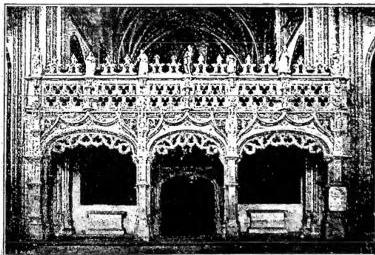
The example of an older l. in Italy is found in the abbey church of Vezzolano (Asti), dated 1189; that of Modena, older still, has disappeared; in France, l. can be noted in the cathedrals of Chartres, Bourges, Reims, and Paris, in the abbey church of Chaise-Dieu, and those surviving at Albi and Troyes (S. Maddalena), as well as others; in Germany at Naumburg, Magdeburg, Halberstadt, and Wechselsburg (surviving), and at Mainz, Meissen, and many others, destroyed; in Belgium at Tournai, Louvain, and Dixmuiden (surviving), and others; in England at Canterbury, York, and Gloucester; in Spain at Toledo, Burgos, León, Avila, and others. - Vedi tav. LXV.