TOURNAI (DOORNIJK), DIOCESE of. — Diocese and chief town of a district in the province of Hainaut in Belgium, situated on the banks of the Scheldt River.
It has an area of 3,722 sq. km and a population of 1,246,000 inhabitants; it comprises 555 parishes with 1,149 diocesan priests and 280 religious priests; it has 2 seminaries, 71 male and 450 female religious communities (Ann. Pont. 1953, p. 428). It is suffragan to Malines.
(courtesy of the General Directorate of the T.C.I., Milan)
TOURING CLUB ITALIANO - A corner of the Card-Index Office.
nio III was separated once again. Pius IV, by the bull Super universas of 12 May 1559, detached the archdeaconry of Bruges from the diocese of T. in order to transform it into a new diocese.
It is believed that the first Cathedral, dedicated to the Blessed Virgin, was erected in the Merovingian period; around 1850 it was replaced by a Carolingian building, in whose crypt the relics of St Nicaise, archbishop of Reims, were deposited. Attached to the Cathedral was the church of St Stephen, destroyed for the first time in 881, while the Cathedral, burned between 1056 and 1063, was reconsecrated in 1070. The present Romanesque church was consecrated in 1171; but the transept, with its pointed vaults, was begun in 1193-1203 under Bishop Stefano. The Romanesque Cathedral of T. is related to the finest examples of northern France, especially those of St-Remy at Reims, Moutier-en-Der, Vignory, and the Norman abbeys of Caen and Jumièges; but the transept of the Cathedral of T. is the finest Romanesque transept to have come down to us. Its Romanesque choir was erected between 1146 and 1171 and replaced between 1243 and 1255 by the pointed-arch choir under Bishop Gualtiero di Marvis (1219-51). From a Gothic vestibule one passes into a portico containing sculptures from the 14th, 16th, and 17th centuries. In the nave, the capitals display a rich variety of floral and geometric decoration, as well as birds and human figures, such as those of the falling man, Chilperic, Fredegonda, etc. On the exterior are five square bell towers, the largest being the central one; all, however, are contemporary with the transept and the Romanesque choir. The episcopal chapel was rebuilt in 1198 by Bishop Stefano in pure Gothic style. The reliquary casket of Notre-Dame at T., the work of the goldsmith Nicola di Verdun, was completed in 1205; it contains eight episodes from the life of the Madonna. The bishop’s residence dates from 1671.
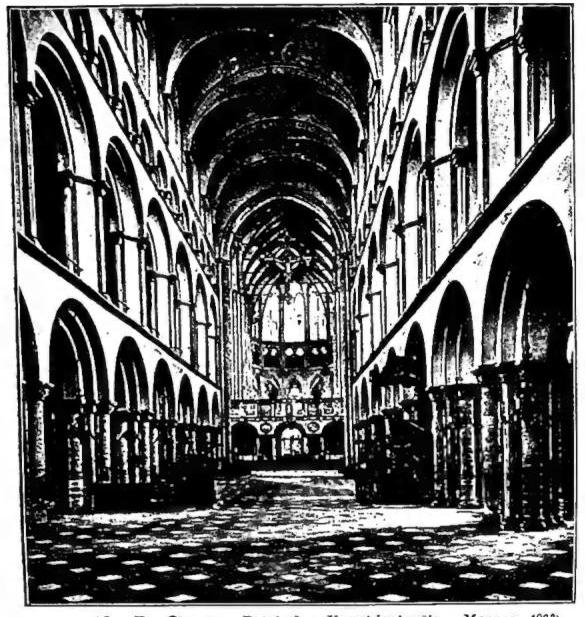
(from P. Clemen, Belgische Kunstdeukmaker, Munich 1923)
TOURNAI, DIOCESI di - Interior of the Cathedral (12th century and additions).
Tournai.
of the 12th century. St-Jacques has a tower from the 12th century and the remainder is Gothic, dating from 1209-57. St-Brice dates from around 1175; around 1225 its choir and three nearly equal-height naves were rebuilt; they were destroyed in the bombardments of May 1940 (R. Maere, St. Brice te Doormijk en de vlaamsche Hallekerk, in Mededeelingen van de vlaamsche Akademie van Wetenschappen, Klasse der Schoone Kunsten, 1940, no. 3). St-Nicolas dates from 1231. La Madeleine dates from the 13th to the 14th century. The chapel of the Seminary, in the Gothic-Renaissance style, is the work of the friar Hoeikmaker (1601-1604); that of the Athenaeum dates from 1609-23. - Vedi tav. XXXIX.