
TOURNUS. – Abbey formerly of S. Valeriano and later of S. Filiberto, in the department of Saône et Loire in France, in the diocese of Autun.
S. Valeriano at Castrum Trinorciense (Tournus) is listed on 15 September in the Gallican additions to the Hieronymian Martyrology, and the legendary Passio places him in the time of the martyrs of Lyon, Epipodius and Alexander (BHL, 5245, 8487–89). The Basilica erected over his tomb gave rise to the abbey (Gregory of Tours, In gloria martyrum, 53). In 875 the monks of Noirmoutier settled there, under threat from the Normans, bringing with them the relics of S. Filiberto; the abbey, which became collegiate in 1627, took its title from him and lost its abbey title in 1785.
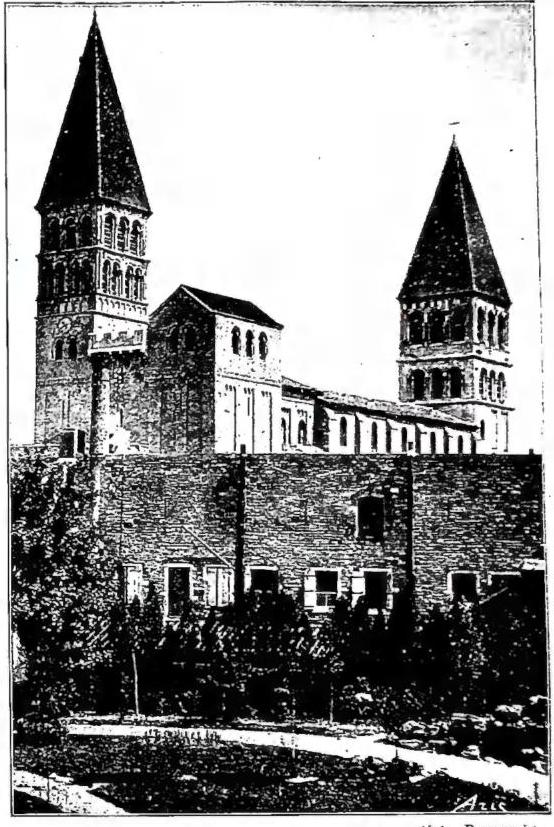
(phot. Bourgeois)
TOURNUS - The abbey church.
The relics of S. Filiberto are kept in the central chapel; beneath the choir is the columned crypt with Romanesque capitals; the tomb of S. Valeriano is venerated there; in the vault is a fresco of Christ in majesty and the Madonna with the Child.
To the right of the narthex are the chapel of S. Michele and the remains of the cloister of S. Ardagno, dating from the 11th century. The church is surrounded by the ancient monastic buildings, and in the house known as that of the treasurer the Musée bourguignon has been established, with furniture, utensils, and costumes from the regions of Mâcon and Bresse; farther on is the abbey residence (1471–98) in Flamboyant Gothic style, and the chapter house erected by Abbot Berardo (1239). At the centre of the Roman castrum is the ancient church of S. te Marie-du Châtel, erected in the 12th century and restored in the 14th and 15th centuries; it is now dedicated to the Magdalene; it preserves a Romanesque portal and the square bell tower. Characteristic is the opus spicatum construction of the ancient chapel of S. Lorenzo.
The ancient Romanesque church of S. Valeriano (1008–1028) has been converted into a festival hall.
There is also the Musée Greuze, founded in 1867, with prehistoric, Gallo-Roman, and barbarian antiquities, sculptures, and paintings; four rooms are dedicated to the artist J. B. Greuze (1725–1805). The municipal hall houses the Library, with approximately 20,000 volumes, many of which belonged to the abbey; among the notable manuscripts is that of Ermentario from the 9th century. T. has a Société des Amis des Arts et des sciences, which has published its Mémoires since 1900.
BIBBL.: Cottinesu, II, coll. 3188–89; J. Virey, L'église St. Philibert de T., Parigi 1932; Ch. Darel, Le vieux T., Tournus 1934; E. Mâle, Les voûtes de la chapelle haute de l'église abbaziale de T., in Bull. monumental, 98 (1939), p. 73 agg. Enrico Josi