
Autun, Diocese of. — In central-eastern France, in the department of Saône-et-Loire. The episcopal see is at Autun, situated on a small hill in the area between the Côte d'Or and the Morvan mountains; the city today has 14,873 inhabitants. It was founded between 15 and 10 BC by the Emperor Augustus, who gave it his name: Augustodunum. It was intended to replace Bibracte, the ancient oppidum of the Aedui, located 25 km away on the summit of Mont Beuvray. Nothing was spared to give it splendor. The Menian Schools (Scholae Menianae) were founded there, where the rector Eumenes taught. The city had the
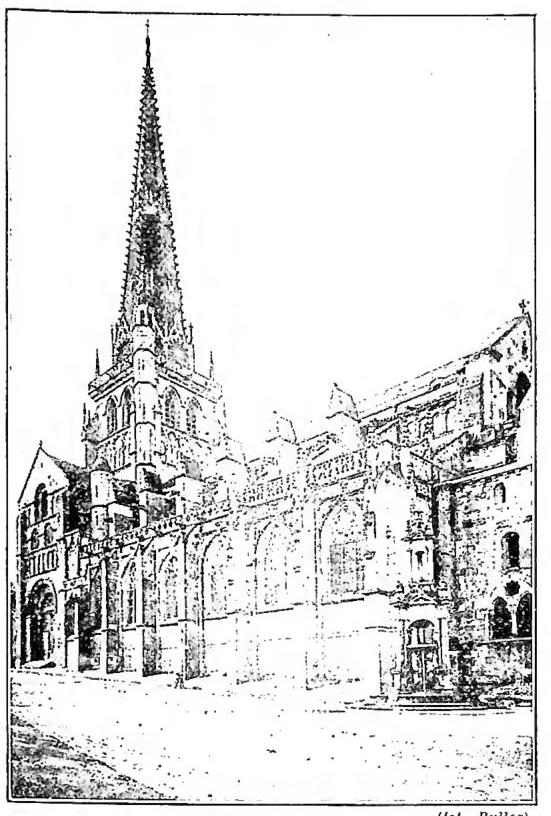
AUTUN – Cathedral of St Lazarus (14th cent.).
We possess a precious document of the faith of the early Christian Aedui PETTORIO (v.), discovered near A. in 1893.
The martyr greatly venerated in A. from antiquity is St Symphorian, commemorated on 22 Aug. in the Martyrologium Hieronymianum; his passio is not without value (BHL, 7967; W. Meyer, Fragmenta Burana, Berlin 1901, pp. 161-63).
The first historically attested bishops of A. are: Reticius, who took part in the Councils of Rome in 313 and of Arles in 314 against the Donatists, and Cassian, who was alive in 337. Around 450, Eufronius, a friend of Sidonius Apollinaris, was bishop of A. Worthy of note are also the bishops: Siagrius (v.), Leodegarius (v.), and Adalgarius, who lived towards the end of the 9th cent.
The diocese, which originally embraced the entire Civitas Aeduorum, was divided in the 5th cent. to form the diocese of Chalon and, at the beginning of the 6th, to constitute the two dioceses of Mâcon and Nevers. From then on it retained its boundaries until 1790.
Today it is the first suffragan see of the metropolitan see of Lyons and, since 19 July 1855, its bishops have borne the titles of the suppressed dioceses of Chalon and Mâcon. Its boundaries coincide with those of the department of Saône-et-Loire. Its population is 525,796, of whom 520,000 are Catholics. It comprises 551 parishes, 531 diocesan priests and 30 regular clergy. At the ancient Christian cemetery of A. there arose the basilica of St Stephen, mentioned by St Gregory of Tours (In gloria confessorum, ch. 72), which was destroyed in 1775; mention is also made of the ancient basilica of St Peter, converted into a civil building in 1792.
Among the numerous abbeys, Cluny (v.), we recall the abbey and basilica of St Symphorian, erected at the end of the 5th cent. by Euponius, later bishop of A., sacked by the Saracens in 731; the church rebuilt between the 11th and 12th cents. burned in 1570, rebuilt in 1734 and demolished in 1806, its high altar being transferred to the parish church of Notre-Dame.
The abbey of St Martin, founded by Queen Brunhilde in 589, had a three-aisled basilica with precious marble columns and an apse decorated with mosaics, traces of which still remained in 1724; it too was sacked in 731, rebuilt and reconsecrated in 870, and turned into a barracks in 1795.
The cathedral dedicated to St Lazarus, begun in 1120, was consecrated by Innocent II on 30 Dec. 1132. It is in the shape of a Latin cross, with three aisles and a transept. At the end of the 12th cent. a porch with three richly carved portals was added to the façade, representing scenes from the Old and New Testaments or from the lives of the saints (Conversion of St Eustace, St Jerome removing a thorn from a lion). In the central tympanum the Last Judgement with the characteristic psychostasy or weighing of souls; the artist has signed: Gislebertus hoc fecit.
The ancient chapel of the hospital of St Nicholas, with a fresco of a Maiestas Domini, was converted in 1861 into a lapidary museum. – See Pl. XXXIII.
To this diocese also PARAY-LE-MONIAL, SANTUARIO DI (v.).
In 1065 Hugh, abbot of Cluny, convened an assembly to put an end to the violence and depredations of Robert I, duke of Burgundy. The bishop of Autun, Agano, had grounds for complaint over the disorders provoked by the duke of Burgundy. The latter made a show of entering Autun solemnly, but refused to attend the council. Seeing this, Hugh went to find the duke and, by his words, so moved him that Robert, deeply touched, made peace with his people. In 1077, under the presidency of Hugh of Die, legate of the Pope, the Fathers of the council reached an agreement with Hugh I, duke of Burgundy and nephew of Robert I, to compensate for the damage and violence committed by the latter. There was also the case of the archdeacon of Reims, Manasse, accused of having bought his bishopric. Manasse, who had not appeared to defend himself, was deposed.
In 1094 the council, presided over by Hugh of Die, excommunicated Emperor Henry IV and the antipope Guibert. Eudes I, duke of Burgundy, who was present, undertook to restore to the church of Autun the lands that belonged to II.