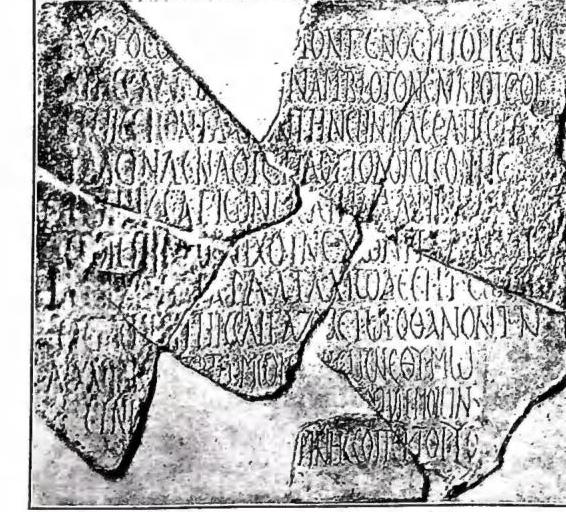
PECTORIUS. - Mutilated Greek inscription in 7 fragments found on June 24, 1839 in a polyandrion at St-Pierre-l'Estrier near Autun (Saône et Loire).
The inscription consists of two parts: the first, older (2nd century), consists of three distichs, which show that they belonged to a longer poem; because the acrostic which in the first five verses forms IXØYC, is interrupted at the sixth with the letter E (perhaps EAIIC = hope, according to G. B. De Rossi, in Inscript. Christianae, II, 1, Rome 1888, p. xx ff.); the second part, later, instead has six hexameters of a sepulchral character and ends with the name of the dedicator P. The text was first published by Abbot Pitra (v.) and immediately circulated because of its dogmatic importance; it was the subject of study and of various interpretations and reconstructions; quite convincing are the observations of Prof. M. Guarducci, which are taken into account here also in the following translation: "O divine offspring of the heavenly Fish, have a devout heart. You who received the immortal fount among mortals from the divine waters, warm again, O dear one, your soul with the eternally flowing waters of the wisdom that grants riches. Take the food sweet as honey of the Savior of the Saints, eat eagerly, holding the Fish in your hands. O my Lord and Savior, food of the fishes, may my mother Lilao sleep in peace, I beseech you, light of the dead. O Ascandius, my dear father, with the sweet mother and with the brothers in the peace of Jesus Christson of God Savior, remember your P."
Bibliography10 worksG. Secchi, Epigramma greco-crist. dei primi secoli trovato non ha guari presso l'antica Augustoduno, oggi Autun, in Francia, supplito dove e
BIBL.: G. Secchi, Epigramma greco-crist. dei primi secoli trovato non ha guari presso l'antica Augustoduno, oggi Autun, in Francia, supplito dove era d'uopo e comment., in Giorn. Arcad., 83 (1840), pp. 232-62; J. B. Pitra, De inscript. graeca et christ. in cosmetico S. Petri a via strata reperta, infra urbem Augustodunensem, illustrat. variorum notis et dissertationibus, iique partim ined., in Spicil. Solesmen., I, Paris (1852), pp. 554-64; R. Garrucci, Mélanges d'épigraph. ancienne, ibid. 1856, p. 32 ff.; O. Pohl, Das Ichthys, Monument von Autun, Berlin 1880; J. Quasten, Monum. eucharist. et liturg. vetustis., Bonn 1935; F. J. Dölger, IXØYC, Das Fisch-Symbol in frischristlicher Zeit, I, 2nd ed., Münster 1928; II and III, ibid. 1922; IV, ibid. 1927; V, ibid. 1932-40; M. Guarducci, Nuove osservaz. sull'iscriz. eucarist. di Peltorio, in Atti della Pont. Acc. rom. di arch., 3rd series, Rendic. 23-24, 1947-49, pp. 243-252.
Josi, Enrico. “Pettorio.” In Enciclopedia Cattolica, vol. IX, coll. 1306–1307. Città del Vaticano: Ente per l’Enciclopedia Cattolica e per il Libro Cattolico, 1952. https://azioneromana.com/article/pettorio.
MLA
Josi, Enrico. “Pettorio.” Enciclopedia Cattolica, vol. IX, Ente per l’Enciclopedia Cattolica e per il Libro Cattolico, 1952, coll. 1306–1307. Azione Romana, https://azioneromana.com/article/pettorio.
BibTeX
@incollection{ec9_pettorio,
  author    = {Josi, Enrico},
  title     = {Pettorio},
  booktitle = {Enciclopedia Cattolica},
  volume    = {IX},
  pages     = {1306--1307},
  note      = {Cited by column},
  publisher = {Ente per l’Enciclopedia Cattolica e per il Libro Cattolico},
  address   = {Città del Vaticano},
  year      = {1952},
  url       = {https://azioneromana.com/article/pettorio}
}
One of some 20,000 entries brought back from the twelve printed volumes (1948–54). Spotted something? Help us improve it.
Click or scroll to zoom · drag to pan · Esc to close