
FISH. – It is one of the oldest Christian symbols. In Greek, fish is called ΙΧΘΥC, and the letters composing the word form the acrostic ΙΧΟΧC ΧΡΙCΤΟC ΘΕΟΥ ΥΙΟC CΩΠΗP, that is, Jesus Christ, Son of God, Saviour (Ortato, De schismate Donatistarum, 3, 2: CSEL, 24, p. 68). S. Agostino observes that the roasted fish is a symbol of the Passion of Christ (In Johann. Tract., 123: PL 35, 1966). There are many Christian inscriptions bearing the symbol of the fish; G. B. De Rossi collected a group of them as early as 1855 (Epistola de christianis monumentis ΙΧΘΥN exhibentibus, in Spicilegium Solesmense, 3 [1855], pp. 573 ff.).
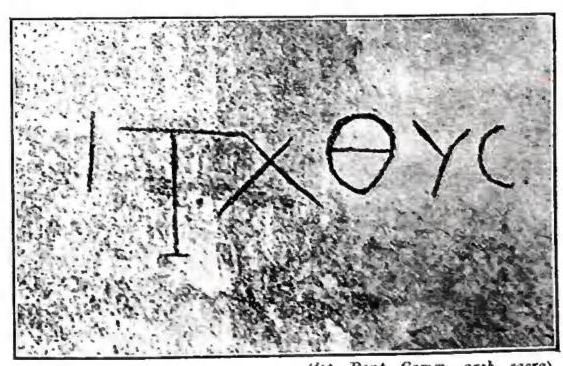
Abercio recalls the fish of the very great and pure spring, which the chaste virgin takes and offers to eat to her friends every day. In the first part of the poem inserted in the inscription of Pectorius, besides the acrostic ΙΧΘΥC, there is: divine race of the heavenly ΙΧΘΥC, which is eaten with eagerness; and Pectorius commends himself to all his dear ones who are in the peace of the ΙΧΘΥC. The word was scratched into the plaster in a mausoleum discovered beneath the basilica of S. Sebastiano, with the letter T also introduced into it (the sign of the Cross; G. Mancini, Scavi sotto la basilica di S. Sebastiano sull'Appia Antica, in Notizie degli Scavi, 1923, pp. 3–79). In an inscription from the Vatican it is called ΙΧΘΥC ΖΩΝΤΩΝ, that is, fish of the living, which gives life (G. Marchi, Monumenti delle parti primitive, Rome 1844, p. 70). The complete word also occurs in the inscriptions of Postumius Eutherion (Dölger, op. cit., I, fig. 11), of Eutychianus (loc. cit., I, fig. 13), of Colonus (loc. cit., pl. I, no. 103), of Cecilia Placidina (O. Marucchi, Monumenti del Museo cristiano Pio-Lateranense, Milan 1910, pl. 51, 13), and of Modena, where the fish is also represented and the word fish is written out in full (G. B. De Rossi, Roma sotterranea, II, Rome 1867, p. 333); as well as those of Callistus, etc. (discovered in Priscilla, Domitilla, Praetextatus, and Pamphilus; G. Wilpert, La Croce nelle catacombe, in N. Bull. arch. crist., 8 [1902], p. 10 and pl. 6, 3).
Tertullian states that we Christians are little fish: we are born in water, according to our great fish, Jesus Christ, and only by remaining in the water (that is, in the grace of Baptism) are we saved. This explains the frequency of ancient Christian epitaphs with fish facing loaves and, still more often, the anchor; with the anchor and the Good Shepherd in the inscription on the sarcophagus of Livia Primitiva (G. Wilpert, Principienfragen der christ. Archäologie, Freiburg im Breisgau 1889, pl. 1, 1). A Greek inscription from the cemetery of Priscilla, set up by Claudius Philotas for his most beloved brother Theodore, ends with the wish that we may live in God; a fish is then represented, that is, Jesus Christ, Son of God, Saviour (G. B. De Rossi in Bull. Arch. crist., 5th series, 3 [1892], p. 14). In the cemetery of Callistus, in a cubiculum dating from the end of the 2nd century, two fish are painted with two baskets containing loaves and a glass of wine before them (Wilpert, Pitture, pp. 265–66 and pls. 27, 1 and 28). In the same cemetery, in cubicula A3 and A, bread and fish are represented on a table (loc. cit., pl. 41, 1). In A2 and A3, bread and fish are represented on a table (loc. cit., pp. 267–68 and pls. 38 and 41, 1). The meal of the crowds beside the Lake of Tiberias (Io. 21, 1 ff.), with loaves and fish, is likewise represented in the same cubiculum, where two dishes containing two fish are placed before seven men (loc. cit., p. 267 and pl. 41, 3); likewise in cubiculum A2 (loc. cit., pp. 267–68, pl. 27, 2); and in cubicula A5 and A6 (loc. cit., pp. 268–69, pls. 41, 4 and 15, 2). Clement of Alexandria recommends that the faithful have the allegorical figure of the fish engraved on their rings (Poedagog., 3, 11).