FISHERMAN. - G. Christ said to the two fishermen, Peter and Andrew: "Follow me, and I will make you fishers of men" (Mt. 4:19; Mk. 1:17; Lk. 5:10).
Tertullian teaches that we "little fish, like our fish IΧΘΥΣ Jesus Christ, are born in water and are saved only by remaining in it" (De Baptismo, 1). It is evident that, by placing IΧΘΥΣ in place of "fish," the apologist intends the acronym of Jesus Christ, Son of God, Savior. In the catacomb frescoes, the fisherman with a hook is depicted in the gallery called "the hypogeum of the Flavians" in Domitilla (Wilpert, Pitture, p. 242 ff. and pl. 7, 1), in Callisto in the two cubicles A4 and A5; in the former the fisherman is near the miracle of the fountain, in the latter near the Baptism of Christ and the healing of the paralytic (ibid., p. 243 and pl. 27, 2 and 3). The fisherman with a net is in the fragmentary one from Porto Torres in Sardinia, now in the Museum of Cagliari (ibid., pp. 17 and 185, pl. 141, 2) and in the two fragments in St. Sebastian (v. Church, pl. XC). Enrico Josi.
FISHERMAN (Piscator, Fischer), Johann. - Calvinist theologian, b. in Strasbourg on March 27, 1546, d. in Herborn on July 27, 1625.
After humanistic studies in his native city, he was a student of the Lutheran Andreae in Tübingen; the reading of the
FISHERMAN. - G. Christ said to the two fishermen, Peter and Andrew: “Follow me, and I will make you fishers of men” (Mt. 4:19; Mk. 1:17; Lk. 5:10).
Tertullian teaches that we “little fish, like our fish IΧΘΥΣ Jesus Christ, are born in water and are saved only by remaining in it” (De Baptismo, 1). It is evident that, by placing IΧΘΥΣ in place of “fish,” the apologist intends the acronym of Jesus Christ, Son of God, Savior. In cemetery frescoes, the fisherman with a hook is depicted in the gallery called “of the hypogeum of the Flavians” in Domitilla (Wilpert, Pitture, p. 242 ff. and pl. 7, 1), and in Callisto in the two cubicles A4 and A5; in the former the fisherman is near the miracle of the fountain, in the latter near the Baptism of Christ and the healing of the paralytic (ibid., p. 243 and pl. 27, 2 and 3). The fisherman with a net is depicted in the fragmentary one from Porto Torres in Sardinia, now in the Museum of Cagliari (ibid., pp. 17 and 185, pl. 141, 2), and in the two fragments in S. Sebastiano (v. CHURCH, pl. XC). Enrico Josi.
FISHERMAN (Piscator, Fischer), Johann. - Calvinist theologian, b. at Strasbourg on 27 March 1546, d. at Herborn on 27 July 1626.
After humanistic studies in his native city, he went to Tübingen as a pupil of the Lutheran Andreae; the reading of the Insti-
FISHERMAN. - Our Lord Jesus Christ said to the two fishermen, Peter and Andrew: “Follow me, and I will make you fishers of men” (Mt 4:19; Mk 1:17; Lk 5:10).
Tertullian teaches that we “little fish, like our fish IXOYΣ, are born in water and are saved only by remaining in it” (De Baptismo, 1). It is clear that, by substituting IXOYΣ for “fish,” the apologist intends the acronym of Jesus Christ, Son of God, Savior. In the catacomb frescoes, the fisherman with the hook is depicted in the gallery called “of the hypogeum of the Flavians” in Domitilla (Wilpert, Pitture, pp. 242 ff. and pl. 7, 1), and in Callisto in the two cubicles A4 and A5; in the former, the fisherman is near the miracle of the fountain, in the latter near the Baptism of Christ and the healing of the paralytic (ibid., p. 243 and pl. 27, 2 and 3). The fisherman with the net appears in the fragmentary fresco from Porto Torres in Sardinia, now in the Museum of Cagliari (ibid., pp. 17 and 185, pl. 141, 2), and in two fragments in St. Sebastian (v. Church, pl. XC). Enrico Josi.
FISHERMAN (Piscator, Fischer), Johann. - Calvinist theologian, born at Strasbourg on 27 March 1546, died at Herborn on 27 July 1627.
After classical studies in his native city, he went to Tübingen as a pupil of the Lutheran Andreas: the reading of the Insti-
FISHERMAN. - G. Christ said to the two fishermen, Peter and Andrew: “Follow me, and I will make you fishers of men” (Mt. 4:19; Mk. 1:17; Lk. 5:10).
Tertullian teaches that we “little fish, like our fish IΧΘΥΣ Jesus Christ, are born in water and are saved only by remaining in it” (De Baptismo, 1). It is evident that, by substituting IΧΘΥΣ for “fish,” the apologist intends the acronym of Jesus Christ, Son of God, Savior. In the cemetery frescoes, the fisherman with a hook is depicted in the gallery called “of the hypogeum of the Flavians” in Domitilla (Wilpert, Pitture, pp. 242 ff. and pl. 7, 1), and in Callisto in the two cubicles A4 and A5; in the former the fisherman is near the miracle of the fountain, in the latter near the Baptism of Christ and the healing of the paralytic (ibid., p. 243 and pl. 27, 2 and 3). The fisherman with a net is found in the fragmentary one from Porto Torres in Sardinia, now in the Museum of Cagliari (ibid., pp. 17 and 185, pl. 141, 2), and in the two fragments in S. Sebastian (v. Church, pl. XC). Enrico Josi.
FISHERMAN (Piscator, Fischer), Johann. - Calvinist theologian, b. at Strasbourg on 27 March 1546, d. at Herborn on 27 July 1628.
After humanistic studies in his native city, he went to Tübingen as a pupil of the Lutheran Andreas: the reading of the Insti-
FISHERMAN. - G. Christ said to the two fishermen, Peter and Andrew: “Follow me, and I will make you fishers of men” (Mt. 4:19; Mk. 1:17; Lk. 5:10).
Tertullian teaches that we “little fish, made in the image of our fish IXOYC Jesus Christ, are born in water and are saved only by remaining in it” (De Baptismo, 1). It is evident that, by substituting IXOYC for fish, the apologist intends the sign of Jesus Christ, Son of God, Savior. In the catacomb frescoes the fisherman with a hook is depicted in the gallery called “of the hypogeum of the Flavians” in Domitilla (Wilpert, Pitture, pp. 242 ff. and pl. 7, 1), in Callisto in the two cubicles A4 and A5; in the former the fisherman is near the miracle of the fountain, in the latter near the Baptism of Christ and the healing of the paralytic (ibid., p. 243 and pl. 27, 2 and 3). The fisherman with a net is found in the fragmentary one from Porto Torres in Sardinia, now in the Museum of Cagliari (ibid., pp. 17 and 185, pl. 141, 2) and in the two fragments in S. Sebastian (v. Chiesa, pl. XC). Enrico Josi.
FISHERMAN (Piscator, Fischer), Johann. - Calvinist theologian, b. at Strasbourg on March 27, 1546, d. at Herborn on July 27, 1629.
After classical studies in his native city, he went to Tübingen as a pupil of the Lutheran Andreae; the reading of the Insti-
FISHERMAN. - G. Christ said to the two fishermen Peter and Andrew: “Follow me, and I will make you fishers of men” (Mt. 4:19; Mk. 1:17; Lk. 5:10).
Tertullian teaches that we “little fish, like our fish IXOYC Jesus Christ, are born in water and are saved only by remaining in it” (De Baptismo, 1). It is evident that, by substituting IXOYC for fish, the apologist intends the name of Jesus Christ, Son of God, Savior. In the catacomb frescoes the fisherman with a hook is depicted in the gallery called “of the hypogeum of the Flavians” in Domitilla (Wilpert, Pitture, pp. 242 ff. and pl. 7, 1), in Callisto in the two cubicles A4 and A5; in the former the fisherman is near the miracle of the fountain, in the latter near the Baptism of Christ and the healing of the paralytic (ibid., p. 243 and pl. 27, 2 and 3). The fisherman with a net is found in the fragmentary one from Porto Torres in Sardinia, now in the Museum of Cagliari (ibid., pp. 17 and 185, pl. 141, 2) and in the two fragments in St. Sebastian (v. Church, pl. XC).
Enrico Josi.
FISHERMAN (Piscator, Fischer), Johann. - Calvinist theologian, b. at Strasbourg on 27 March 1546, d. at Herborn on 27 July 1630.
After classical studies in his native city, he went to Tübingen as a pupil of the Lutheran Andreas: the reading of the Insti-
FISHERMAN. - Our Lord Jesus Christ said to the two fishermen, Peter and Andrew: “Follow me, and I will make you fishers of men” (Mt. 4:19; Mk. 1:17; Lk. 5:10).
Tertullian teaches that we “little fish, like our fish IΧΘΥΣ Jesus Christ, are born in water and are saved only by remaining in it” (De Baptismo, 1). It is evident that, by substituting IΧΘΥΣ for “fish,” the apologist intends the figure of Jesus Christ, Son of God and Saviour. In the catacomb frescoes, the fisherman with a hook is depicted in the gallery called “of the hypogeum of the Flavians” in Domitilla (Wilpert, Pitture, pp. 242 ff. and pl. 7, 1), and in Callisto in the two cubicles A4 and A5; in the former the fisherman is near the miracle of the spring, in the latter near the Baptism of Christ and the healing of the paralytic (ibid., p. 243 and pl. 27, 2 and 3). The fisherman with a net appears in the fragmentary fresco from Porto Torres in Sardinia, now in the Museum of Cagliari (ibid., pp. 17 and 185, pl. 141, 2), and in two fragments in St. Sebastian (v. Church, pl. XC). Enrico Josi.
FISHERMAN (Piscator, Fischer), Johann. - Calvinist theologian, b. at Strasbourg on 27 March 1546, d. at Herborn on 27 July 1631.
After classical studies in his native city, he went to Tübingen as a pupil of the Lutheran Andreas: the reading of Calvin’s
FISHERMAN. - G. Christ said to the two fishermen, Peter and Andrew: “Follow me, and I will make you fishers of men” (Mt 4:19; Mk 1:17; Lk 5:10).
Tertullian teaches that we “little fish, like our fish IXOYΣ, Jesus Christ, are born in water and are saved only by remaining in it” (De Baptismo, 1). It is evident that, by placing IXOYΣ in place of “fish,” the apologist intends the acrostic of Jesus Christ, Son of God, Savior. In the catacomb frescoes, the fisherman with the hook is depicted in the gallery called “of the hypogeum of the Flavians” in Domitilla (Wilpert, Pitture, pp. 242 ff. and pl. 7, 1), in Callisto in the two cubicles A4 and A5; in the latter, the fisherman is near the miracle of the fountain, in the other near the Baptism of Christ and the healing of the paralytic (ibid., p. 243 and pl. 27, 2 and 3). The fisherman with the net is in the fragmentary one from Porto Torres in Sardinia, now in the Museum of Cagliari (ibid., pp. 17 and 185, pl. 141, 2), and in the two fragments in S. Sebastian (v. Church, pl. XC). Enrico Josi.
FISHERMAN (Piscator, Fischer), Johann. - Calvinist theologian, b. at Strasbourg on March 27, 1546, d. at Herborn on July 27, 1632.
After humanistic studies in his native city, he went to Tübingen as a pupil of the Lutheran Andreae; the reading of the Insti-
FISHERMAN. - G. Christ said to the two fishermen, Peter and Andrew: "Follow me, and I will make you fishers of men" (Mt. 4:19; Mk. 1:17; Lk. 5:10).
Tertullian teaches that we "little fish, like our 'fish' IXOYΣ, Jesus Christ, are born in water and are saved only by remaining in it" (De Baptismo, 1). It is clear that, by placing IXOYΣ in place of "fish," the apologist intends the sign of Jesus Christ, Son of God, Savior. In the cemetery frescoes, the fisherman with a hook is depicted in the gallery called "the hypogeum of the Flavians" in Domitilla (Wilpert, Pitture, pp. 242 ff. and pl. 7, 1), in Callisto in the two cubicles A4 and A5; in the latter, the fisherman is near the miracle of the fountain, in the former near the Baptism of Christ and the healing of the paralytic (ibid., p. 243 and pl. 27, 2 and 3). The fisherman with a net is found in the fragmentary one from Porto Torres in Sardinia, now in the Museum of Cagliari (ibid., pp. 17 and 185, pl. 141, 2), and in the two fragments in St. Sebastian (v. Church, pl. XC). Enrico Josi.
FISHERMAN (Piscator, Fischer), Johann. - Calvinist theologian, b. in Strasbourg on March 27, 1546, d. in Herborn on July 27, 1633.
After humanistic studies in his native city, he was a student of the Lutheran Andreas at Tübingen: the reading of the Insti-
FISHERMAN. - G. Christ said to the two fishermen, Peter and Andrew: “Follow me, and I will make you fishers of men” (Mt. 4:19; Mk. 1:17; Lk. 5:10).
Tertullian teaches that we “little fishes, made in the image of our fish IXOYC Jesus Christ, are born in water and are saved only by remaining in it” (De Baptismo, 1). It is evident that, by substituting IXOYC for “fish,” the apologist intends the sign of Jesus Christ, Son of God, Savior. In the cemetery frescoes the fisherman with the hook is depicted in the gallery called “of the hypogeum of the Flavians” in Domitilla (Wilpert, Pitture, pp. 242 ff. and pl. 7, 1), and in Callisto in the two cubicles A4 and A5; in the former the fisherman is near the miracle of the fountain, in the latter near the Baptism of Christ and the healing of the paralytic (ibid., p. 243 and pl. 27, 2 and 3). The fisherman with the net appears in the fragmentary one from Porto Torres in Sardinia, now in the Museum of Cagliari (ibid., pp. 17 and 185, pl. 141, 2), and in the two fragments in S. Sebastian (v. CHURCH, pl. XC).
Enrico Josi.
FISHERMAN. - G. Christ said to the two fishermen, Peter and Andrew: “Follow me, and I will make you fishers of men” (Mt 4:19; Mk 1:17; Lk 5:10).
Tertullian teaches that we “little fish, resembling our fish IΧΘΥΣ, Jesus Christ, are born in the water and are saved only by remaining in it” (De Baptismo, 1). It is evident that, by substituting IΧΘΥΣ for “fish,” the apologist intends the figure of Jesus Christ, Son of God and Savior. In the catacomb frescoes, the fisherman with a hook is depicted in the gallery called “of the hypogeum of the Flavians” in Domitilla (Wilpert, Pitture, pp. 242 ff. and pl. 7, 1), and in Callisto in the two cubicles A4 and A5; in the former the fisherman is near the miracle of the fountain, in the latter near the Baptism of Christ and the healing of the paralytic (ibid., p. 243 and pl. 27, 2 and 3). The fisherman with a net appears in the fragmentary one from Porto Torres in Sardinia, now in the Museum of Cagliari (ibid., pp. 17 and 185, pl. 141, 2), and in two fragments in S. Sebastian (v. CHURCH, pl. XC).
Enrico Josi.
FISHERMAN. - G. Christ said to the two fishermen, Peter and Andrew: “Follow me, and I will make you fishers of men” (Mt 4:19; Mk 1:17; Lk 5:10).
Tertullian teaches that we “little fish, resembling our ‘fish’ IΧΘΥΣ, Jesus Christ, are born in the water and are saved only by remaining in it” (De Baptismo, 1). It is evident that, by placing IΧΘΥΣ in place of “fish,” the apologist intends the sign of Jesus Christ, Son of God, Savior. In the catacomb frescoes, the fisherman with a hook is depicted in the gallery called “of the hypogeum of the Flavians” in Domitilla (Wilpert, Pitture, pp. 242 ff. and pl. 7, 1), and in Callisto in the two cubicles A4 and A5; in the former the fisherman is near the miracle of the fountain, in the latter near the Baptism of Christ and the healing of the paralytic (ibid., p. 243 and pl. 27, 2 and 3). The fisherman with a net appears in the fragmentary fresco from Porto Torres in Sardinia, now in the Museum of Cagliari (ibid., pp. 17 and 185, pl. 141, 2), and in two fragments in St. Sebastian (v. CHURCH, pl. XC).
Enrico Josi.
FISHERMAN. - G. Christ said to the two fishermen, Peter and Andrew: “Follow me, and I will make you fishers of men” (Mt. 4:19; Mk. 1:17; Lk. 5:10).
Tertullian teaches that we “little fish, like our fish IΧΘΥΣ Jesus Christ, are born in water and are saved only by remaining in it” (De Baptismo, 1). It is clear that, by substituting IΧΘΥΣ for “fish,” the apologist intends the figure of Jesus Christ, Son of God, Savior. In the catacomb frescoes, the fisherman with a hook is depicted in the gallery called “the hypogeum of the Flavians” in Domitilla (Wilpert, Pitture, pp. 242 ff. and pl. 7, 1), and in Callisto in the two cubicles A4 and A5; in the former the fisherman is near the miracle of the fountain, in the latter near the Baptism of Christ and the healing of the paralytic (ibid., p. 243 and pl. 27, 2 and 3). The fisherman with a net appears in the fragmentary fresco from Porto Torres in Sardinia, now in the Museum of Cagliari (ibid., pp. 17 and 185, pl. 141, 2), and in two fragments in S. Sebastian (v. CHURCH, pl. XC).
Enrico Josi
PESCATORE. — G. Christ said to the two fishermen Peter and Andrew: “Follow me, and I will make you fishers of men” (Mt. 4:19; Mk. 1:17; Lk. 5:10).
Tertullian teaches that we “little fish, like our fish IΧΘΥΣ Jesus Christ, are born in water and are saved
1269 PESCATORE JOHANN — PESCH CHRISTIAN 1270
D
IΧΘΥΣ ZUNTOUN
LICINIAE AMATIBE
NAFAERENTI VIXIT
(jet. ront. Comm. arch. sacra)
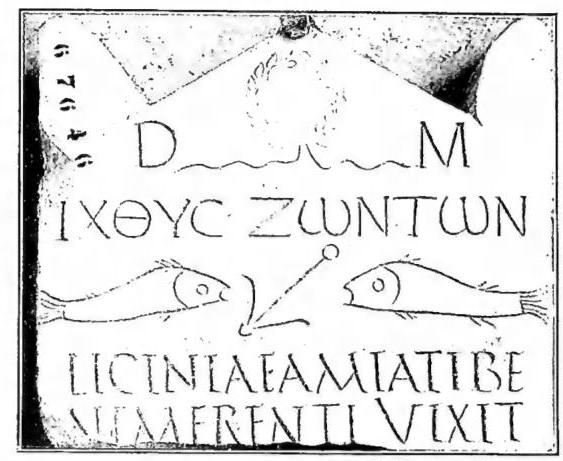
Pesce — Inscription discovered by Licinius (end of 2nd century — beginning of 3rd century) — Rome, National Museum of the Baths.
D
IXOYC ZUNTOUN
LICINIAE AMATIBE
NAFAERENTI VIXIT
(jet. ront. Comm. arch. sacra)
Pesce — Inscription discovered by Licinius (end of 2nd century — beginning of 3rd century) — Rome, National Museum of the Baths.
PESCATORE, JOHANN (PESCH, CHRISTIAN). — Born at Strasburg in 1546, he was educated in the Lutheran faith, but the influence of Calvinism led him to abandon Strasburg and later Heidelberg, which had not yet adopted Calvinism. He subsequently became director of a school in Siegen, professor of theology at the Casimirianum in Neustadt in the Palatinate, and from 1584 professor and rector at the Academy of Herborn, recently founded by the Count of Nassau. He produced a new German translation of the Bible with Calvinist tendencies (1597–1603), commented on all the sacred books, and engaged in polemics with Lutherans and Catholics. Against Cardinal R. Bellarmine he wrote: *Libri duo de iustificatione hominis coram Deo* (Herborn 1590). His *Aphorismi doctrinae christianae* (1589) is a widely read theological manual that was reprinted many times. In the Protestant milieu, his theological thesis that only the passive obedience of Christ, and not the active, would have satisfactory efficacy, provoked particularly lively reactions.