Machine translation of the 1948–1954 Italian original. The original text is authoritative.
ANDREA, JOHANN VALENTIN. — German Protestant theologian, b. at Herrenberg in 1586, d. at Stuttgart in 1654. Nephew of Jacob, he followed in his footsteps; however, whereas his grandfather was an ardent Lutheran, the nephew professed Calvinism, while nevertheless showing himself respectfully attached to Lutheranism. He too studied theology at Tübingen, then from 1607 to 1614 accompanied several young German nobles as tutor in Switzerland, Italy, and France. Ordained a deacon in 1614, he was later elected superintendent of the district of Calw and, in 1639, preacher at the court of Stuttgart; but he resigned the latter post in 1647 for reasons of health. Of a rather mystical character, he always showed himself very hostile to every dogmatic quarrel or controversy; for him, what mattered above all was honest living, the implementation, in feelings and conduct, of the doctrine professed.
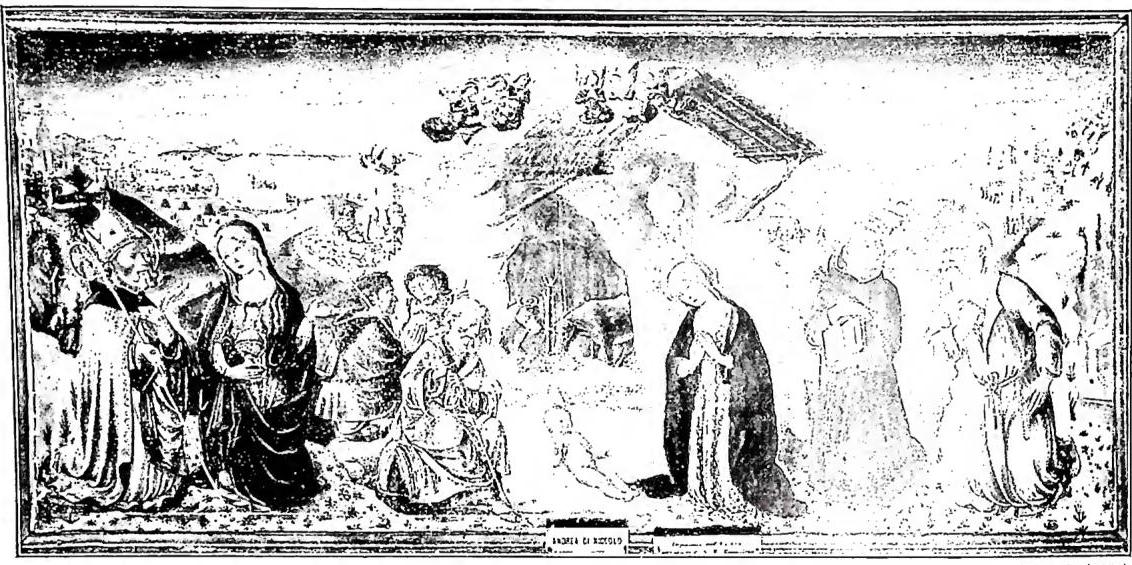
ANDREA DI NICCOLÒ di JACOPO — Nativity and Saints — Siena, Pinacoteca. (Int. Andrian)Driven by this ideal, he wrote: Reipublicae christiano-politanae descriptio (1619), in which he imagines an ideal city, governed entirely by Christian principles, to demonstrate how an association of men could be governed. It is the first evangelical novel, recalling T. More’s Utopia, T. Campanella’s The City of the Sun, and Bacon’s Atlantis. To reinforce his pacifying idea, he followed it with other works: Invitatio fraternitatis Christi ad amoris candidatos (1617); Christianae societatis idea (1620); Christiani amoris dextera porrecta (1620). Among his other writings—more than 100 published and several others in manuscript—his satirical dialogues and popular poems deserve mention.
BIBL.: C. Hüllemann, V. Andreas als Pädagog, Leipzig 1844; Vita Andreae ab ipso conscripta, ed. F. H. Rheinwald, Berlin 1849; I. P. Glückber, J. V. Andrea, Ein Lebensbild zur Erinnerung an seinem Dreijahrh. Geburtstag, Stuttgart 1886; D. Hölscher, s. V. in Realene. für prot. Theol. u. Kirche, I, 3rd ed., Leipzig 1895, pp. 906–13. Celestino Testore
Cite this article
“ANDREA, JOHANN VALENTIN.” Enciclopedia Cattolica, vol. I (1948), p. 733. Azione Romana digital edition, https://azioneromana.com/article/andrea-johann-valentin.