
BACONE, FRANCESCO. – Philosopher and politician, born on 22 January 1561 near London, son of Nicola, keeper of the queen’s seal, and nephew of the prime minister Burleigh; died at Highgate (London) on 9 April 1626. At the age of thirteen he entered the University College of Cambridge, which he left three years later, entirely imbued with that sense of profound dissatisfaction with logical and scholastic Aristotelianism which was subsequently to become the central, implicit or explicit polemical theme of his speculation. Sent to Paris by his father, he was compelled to return to his homeland on account of his father’s premature death (1580), and, pressed by economic necessities, to turn to legal studies and then to the practice of law. But this was too distasteful to him; consequently, directing his ambitions toward another goal, he attempted the path of honors. A member of parliament as early as 1584, in 1597 he was appointed extraordinary counsel to the Crown. But, having fallen out with Elizabeth, he was unable, during her reign, to rise to higher offices, despite the protection of the Earl of Essex, whom B. did not hesitate subsequently to accuse when the earl was tried as the leader of the conspiracy against the queen (1601). B. enjoyed greater political success under James I, whose service and defense he had entirely embraced, and for whose sake he did not hesitate to change his political convictions. He was successively appointed Solicitor general (1607), Attorney general (1613), Privy Councillor of the Crown (1616), Lord Keeper of the Great Seal (1617), Lord Chancellor (1618), Baron of Verulam and Viscount St. Alban (1621). But such good fortune was short-lived: in that same year, accused of corruption in his political and administrative conduct, he was tried by parliament and condemned to a fine of £40,000, imprisonment in the Tower of London, and exclusion from any political office. Regaining his freedom after a few days, following a remission of the sentence, he devoted his final years, until his death, to his preferred studies. It may well be said that in B. the strength of his will did not equal the height of his intellect; hence it is a very difficult task for the historian—as the divergence of opinions itself attests—to pronounce upon the uprightness of his moral character.
Works. – B. conceived a great encyclopedic work, the Instauratio magna, which, in his intention, was to develop a general plan for the reform of science. The design of the work comprised six parts, of which the first presented a systematic “division of the sciences,” which was in reality a radical revision of their present state; the second explained the “principles of the interpretation of nature,” that is, the new method of science; the third supplied a “natural and experimental history for the foundation of philosophy,” or, more simply, the scientific material to which the method was to be applied; the fourth (“ladder of the intellect”) showed the twofold use, inductive and deductive, of the intellect in the search for laws; the fifth put forward “anticipations” of truths, that is, discoveries achieved by the common method; and the sixth, finally, comprised the definitive organization of “active science.” Of these parts, however, B. composed only the first, under the title De dignitate et augmentis scientiarum (London 1623), and the second, represented by the celebrated Novum Organum (ibid. 1620); while of the third there remains only a confused collection of scientific material, published posthumously under the title Sylva Sylvarum. Of the De dignitate and the Novum Organum we may regard, respectively, The advancement of Learning (London 1605) and the Cogitata et visa (composed in 1607, published posthumously) as preparatory drafts.
B.’s masterpiece is undoubtedly the Novum Orga-
num, which represents the first unequivocal expression of the renewed modern scientific-philosophical consciousness and constitutes the center of gravity of the entire production of Verulam. It is composed of two books and a preface: the books set forth the new method (which is, in effect, a “new logic,” as the title says, whose polemical reference to Aristotle’s Organon is evident); the preface asserts, against skeptics and dogmatists, the possibility of a certain science founded upon a new method. Sketched out in the Cogitata et visa of 1607, the Novum Organum was begun by its author in 1608 but published only in 1620. Among B.’s writings there should also be recalled the Nova Atlantis, written in English around 1621, then translated into Latin and published posthumously in 1627; De Sapientia veterum (London 1609); Temporis partus maximus (1585); Valerius Terminus (1603); Redargutio philosophiarum (1609); Descriptio orbis intellectualis (1612): these works, published posthumously, either express still-fragmentary anticipations of future insights or possess little theoretical and historical importance.
Although many traditional moral values found no response in B.’s soul, one ideal nevertheless directed his activity as a scholar: the ideal of science and knowledge, indeed the certainty that in knowledge and science lies the sole possibility of humanity’s redemption from enslavement to nature and the only source of effective and substantial human power. B. already asserts this certainty in a well-known passage from the Cogitata et visa (“hominis imperium sola scientia constare: tantum enim potest quantum scit”), and later reiterates it in the first book of the Novum Organum (“scientia et potentia humana in idem coincidunt, quia ignoratio causae destituit effectum”). It is already apparent that B. is the spiritual son of the new science, and his admiration for the modern inventions of printing, the compass, and gunpowder is readily understandable. B. clearly grasps that a new era has now begun for human knowledge. But he also understands that the new science rests upon foundations different from those of the ancient one; that a new element (“experience”) has intervened to modify its constructive process radically; and indeed that this very process is the process of the mind, which, freeing itself from the contingency of particular sensory data, ascends inductively to the formulation of universal laws. In B., therefore, traditional metaphysical interests are replaced by a typically modern epistemological interest, directed no longer toward a world of objective essences but toward the subjective activity of the mind, which constructs its science of nature upon the solid foundations of experience. Hence his frequent polemics against the Aristotelianism of the schools and its intellectualistic degenerations, and the fundamental importance he attributes to the problem of the “method.”
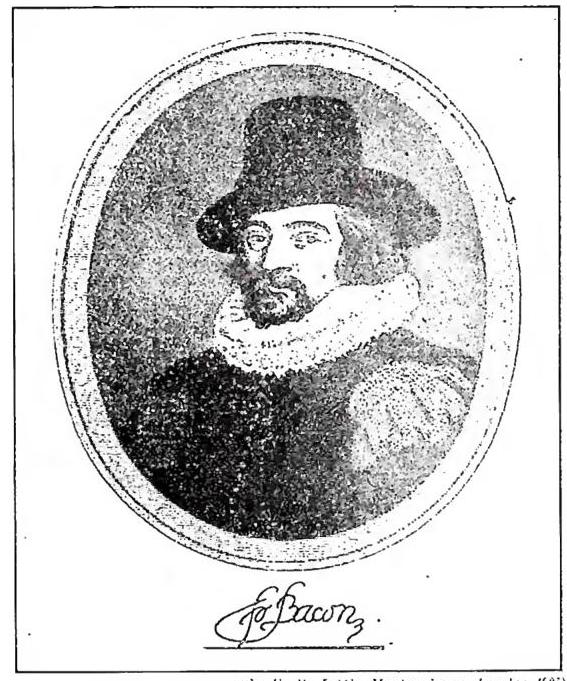
BACONE, FRANCESCO - Etched portrait.
which provides the datum and an intellect that elaborates II. Sense and intellect are precisely the terms of Baconian cognitive synthesis, and more than terms, moments of that active synthesis, and as such purified of the dross resulting from their abstract or disordered use. Sense, uncertain in itself and easily subject to error, is provided with means and instruments capable of correcting its deviations; the intellect which, when abandoned to itself («sibi permissus»), is the source of innumerable abstractions, is, so to speak, relieved of the dead weight of its idola, or arbitrary anticipations and presuppositions that lead it astray from the true pursuit of knowledge. B. identifies them minutely, gathering them into four classes: a) idola tribus, or errors deriving from our very mental constitution (and therefore innate in the human species or «tribe»), whereby knowledge of things is deformed by the mind’s active intervention; b) idola specus, or errors deriving from the individual psychic constitution or from the particular education and culture of individuals; c) idola fori, or errors arising from the reciprocal relations among human beings, and more particularly from the unreflective use of language, which often leads us to regard purely imaginary and verbal entities as real; d) idola theatri, or errors introduced into men’s minds by the various philosophical systems and traditional theories, succeeding one another like theatrical productions on the stage of human history, and capable of leading thought astray from true knowledge of nature.
With the theory of the idola, highly significant and historically important for the critical sense that inspires it, the first stage of B.’s methodological construction comes to an end. He is therefore essentially critical-negative (destruens), but implicitly prepares the vision of the constructive process of science, toward which the new logic, the «new organon», tends as its final goal. B. is extremely concerned to follow closely the various moments of that process: from the initial collection of empirical material (historia naturalis) and its arrangement in the tabulae, classifying phenomena according to their presence (tabulae praesentiae), their absence (tabulae absentiae), or their quantitative variations (tabulae graduum), up to the prerogative instances, or privileged cases, in which the phenomenon occurs under entirely new and unforeseen circumstances, or does not occur under circumstances wholly similar to those in which it usually appears.
For B., the ultimate end of this scientific reconstruction toward which the new method tends is (and in this he pays his tribute to scholastic Aristotelianism, which he so energetically opposed) knowledge of the world in itself, of the forms or formal causes of reality, through the study of the phenomenal world; that is, of the natures as they manifest themselves to us in the presence of material causes and in the action of efficient causes. Yet the dynamic motive introduced by B. into the conception of the cognitive process of science seems in a certain way to be reflected in the meaning of the Aristotelian «form», resolving its substantial nature into a principle of the actualization of the phenomenon. Pure act is thus no longer the unmoving Aristotelian first cause, but rather the infinite internal principle of the infinite actualization of forms, which is determined in the latent process of the latent structure, «latens schematismus», of phenomena. And since this process is movement, the whole variety of forms is ultimately reduced to this. But the true form of forms, the forma formarum, as the absolute and immanent principle of every phenomenal determination, lies beyond our cognitive possibilities and is known only to God, who is its author.
It should be observed at this point that the concern to guarantee the objective value of knowledge (that is, the possibility of knowing the world not ex analogia hominis, but rather ex analogia universi) ultimately brought B. back toward traditional metaphysics, at the same time that his new intuition compelled him to give it a tendentially mechanistic interpretation. In fact, B.’s thought cannot be understood without relating it to the speculative tradition in which it is rooted. And it was precisely a polemical reference to the degenerate forms of Aristotelian intellectualism that, in the name of an exceedingly fruitful inductive procedure, caused B. to lose the profound meaning of genuinely Aristotelian deduction, which nevertheless concealed within its logical-categorial procedure a demand for universality that Kant himself would once again have to take up with his epistemological criticism.
The importance of B.’s thought in the particular fields of philosophical knowledge is less significant. With Telesio, he admits an obscure form of perception diffused throughout all things; and in man, a spiritual soul: concerning the latter, however, philosophy has nothing to say, and only religion can pronounce judgment. B., who nevertheless saw atheism as a cause of degradation for man, and belief in God as a principle of elevation (his assertion is well known that, if a superficial philosophy can distract the soul from religious concerns, a deeper experience of speculation makes one aware of their vital substance), was not, however, a profoundly religious spirit. This is already demonstrated by the ethics that we can extract from his various writings, and which in him, lacking as he was in any true sense of the interiority of spiritual life and accustomed to considering «man» in his totality in the uniform light of his «science», which projects him into the external world, assumes the significance of a set of precepts or an empirical casuistry, from which every concrete reference to the absolute and divine principle of moral values is absent. It is demonstrated even more clearly by his explicit conception of God as a supreme reality, situated beyond every spiritual—and therefore rational—interference with man and an object solely of faith. B.’s theology is, ultimately, very simple, but a simplicity that is impoverishment: book IX of the De dignitate et augmentis scientiarum proves this clearly. Reason and faith are reconciled, but only through a radical separation («concludamus igitur, theologiam sacram ex verbo et oraculis Dei, non ex lumine naturae aut rationis dictamine, hauriri debere»). There is, moreover, no reason for surprise at this if we consider the then recent successes of the theory of double truth!
The importance of B. must therefore be sought elsewhere than in profound religiosity, namely in that faith in science to which we referred at the outset. This is a faith that, beyond every scheme and every didactic framework, decisively sets him on the path toward the future; and it is not superfluous to recall in this connection that B. himself, as though to crown his work, wished to celebrate in the Nuova Atlantide his fervent faith in future progress. The pansophic utopia concealed in this work beneath the fantastic design of the House of Solomon (or University of Research), and which would find a broad echo in Comenius, contains here, unlike the political utopias of a Plato or a Campanella, a pedagogical recommendation connected with the fundamental inspiration of Baconian thought: only by educating themselves in science and collaborating in the field of knowledge will human beings be able to attain the conquest of their true empire: the empire of the knowable, which is the only empire conceivable over the forces of nature itself.