
ABERCIO, saint.—Bishop of Hierapolis (or Geropolis) in Phrygia. Feast day 22 October. His Life relates that, when a decree of Marcus Aurelius and Lucius
Verus was issued ordering sacrifices to be offered everywhere, A., warned by a vision, went by night to the temple of Apollo and with a large staff smashed everything there to pieces. While the city was consequently in turmoil, he began to preach to the faithful in the Forum. When the enraged pagan multitude arrived, he healed several possessed persons before them and thereby calmed them; indeed, he converted many of them to baptism. His fame spread through the neighboring provinces. He also cured of blindness the mother of a leading citizen, Eussenianus, a friend of the emperor, and freed many possessed persons. To take revenge, the demon entered the emperor’s own daughter, protesting that he could be expelled only by A. of Hierapolis. Marcus Aurelius wrote to Eussenianus ordering him to send A. to him. Having set sail from Adalia, A. arrived at Porto Romano and, presenting himself to the empress (since M. Aurelius was in the field against the barbarians), had her daughter brought to the hippodrome. There he solemnly expelled the demon and, as a punishment for making him undertake that journey, commanded him to lift onto his shoulders a heavy marble altar that was there and carry it to Hierapolis by the southern gate. He asked the empress, as a favor, to have baths built near Hierapolis; before returning to his homeland, he traveled through Syria, Mesopotamia, and Asia Minor, benefiting everyone. He lived for several more years and wrote a book. Warned of his approaching death, he prepared his tomb and dictated the epitaph to be inscribed upon it, on that altar which he had had brought from Rome. When another A. was subsequently elected to succeed him, he himself consecrated him.
This legend was formerly regarded as entirely without authority, and the saint’s poetic epitaph, which it transmits, was likewise considered wholly fictitious. Only Halloix (Illustrium scriptorum ecclesiae orientalis vitae, II, Douai 1630, p. 137), and, more learnedly, Pitra (Spicilegium Solesmense, III, Paris 1856, p. 352), defended its substantial authenticity. Others, such as Garrucci (La Civ. Catt. [1856, 1], p. 686), detected extensive interpolations in II. But at the beginning of 1882 Ramsay discovered near ancient Hierapolis (a short distance south of Sinnada, capital of Phrygia Secunda or Salutaris) a fine metrical inscription by a certain Alexander, dated 216, in which De Rossi and Duchesne immediately recognized notable passages from A.’s epitaph. The following year Ramsay found at the same site, embedded in the walls of ancient baths, two noteworthy fragments of A.’s original epitaph, agreeing almost word for word with the text of the legend. Their script, older than that of Alexander’s stele, must date at least to the end of the second century, likewise in agreement with the period indicated by the legend. The legend, moreover, does not erroneously assign A. as his see the better-known Hierapolis ad Lycium, in Phrygia Prima or Pacatiana, since it explicitly speaks of a city near Sinnada. Thus the value of the Life cannot be denied, insofar as it is based on the epitaph, and probably also with regard to several other significant details that it provides about the saint.
We reproduce the text of the inscription (22 lines of hexameters), critically reconstructed, presenting in capitals the portions taken from Alexander’s stele and in square brackets what is attested only by the Life:
ἐΚΛΕΚΤΗΣ ΠΟ[λ]ΕΩΣ Ο ΠΟΛΕΙ[της] ΤΟΤΤ' ΕΙΟΠΗ[σε] ζῶν ἸΝ'ΕΧΩ ΦΑΝΕΡ[ῶς] ΣΩΜΑΤΟΣ ΕΝΘΑ ΘΕΣΙΝ ΟΥΝΟΜ' [Ἀβέρκιος ὧν ὁ] ΜΑΘΗΤΗΣ ΠΟΙΜΕΝΟΣ ΑΓΝΟΥ 3
[ὁς βόσκει προβάτων ἀγέλας ὄρεσιν πεδίοις τε, ὀρθαλμοὺς ὃς ἔχει μεγάλους πάντη καθοφῶντας. οὗτος γὰρ μ' ἐδίδαξε... γράμματα πιστά·] 6 εἰς Ρώμη[ν] ὃς ἔπεμψεν] ἐμὲν βασίλει' ἀναθρήσαι] καὶ βασίλισ[αν] ἰδεῖν χρυσό[το]λον χρυσό[το]λον χρυσό[το]λον χρυσό[το]λον χρυσό[το]λον χρυσό[το]λον χρυσό[το]λον χρυσό[το]λον χρυσό[το]λον χρυσό[το]λον χρυσό[το]
LA VIE
DV VENERABLE
SERVITEVR DE DIEV
VINCENT DE PAVL.
INSTITVTEVR
AND
PREMIER SVPERIEVR GENERAL
OF THE CONGREGATION OF THE MISSION.
Divided into three Books.
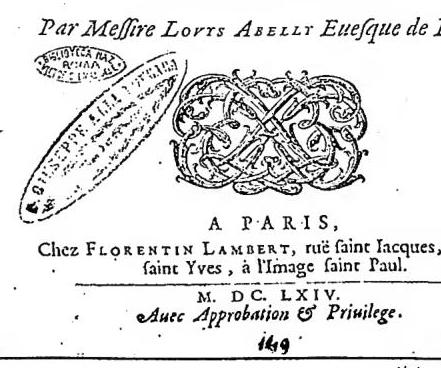
IN PARIS,
M. D.C. LXIV.
With Royal Approval and Privilege.
149
(Int. Enc. Catt.)
ABELLY — Life of St. Vincent de’ Paul. Frontispiece of the original edition (Paris 1664).
λαὸν δ'εἶδον ἐκεῖ λαμπρὰν σφραγειδαν ἐξοντα.] 9
καὶ Συρῆς πεῖδον εἶδα] καὶ ἄστεα πάν[τα, Νίσιβιν]
Εὐρᾶτην διαβ[άς· πάν[τη] δ'έσχον συνο[...]
Παῦλον ἔχων ἐπ[...]· πίστις π[άντη] δὲ προῆγε 12
καὶ παρέθηκε [τροφήν] πάντη ἰχθύν ἀπὸ πηγῆς]
πανμεγέθη, καθ[αρόν, οὐ] ἐδράξατο παρθέ[νος] ἀγνή]
καὶ τοῦτον ἐπέ[δωκε] σίβ[λος] ἐσύ[ειν] διὰ παντός. 15
οἶνον χρηστὸν ἔχουσα κέρασμα διδούσα μετ' ἄρτου.
ταῦτα παρεστῶς εἶπον Ἀβέρκιος ὧδε γραφήναι
ἐβδομηκοστὸν ἔτος καὶ δεύτερον ἦγον ἀληθῶς. 18
ταῦθ' ὁ νοῶν εὔξαστο ὑπὲρ Ἀβερκίου πᾶς ὁ συνυδός].
ΟΥ ΜΕΝΤΟΙ ΤΥΜΒΩ ΤΙΣ ΕΜΩ ΕΤΕΡΟΝ ΤΙΝΑ
ΘΗΣΕΙ
ΕΙ Δ'ΟΥΝ ΡΩΜΑΙΩΝ ΤΑΜΕΙΩ ΘΗΣΕΙ[ι]
ΔΙΣΧΕΙΑΙΑ [χ]ΡΥΣΑ 21
ΚΑΙ ΧΡΗΣΤΗ ΠΑΤΡΙΑ' ΙΕΡΟΠΟΛΕΙ ΧΕΙΛΙΑ
ΧΡΥΣΑ.
Here is the version: “Citizen of an illustrious city, I made this monument for myself while still alive, so that here my body might have a noble burial; [3] I, A. by name, disciple of the chaste shepherd who feeds flocks of sheep over mountains and plains, whose great eyes look down from above in every direction. [6] For he instructed me in trustworthy writings, ... he who sent me to Rome to behold the palace and see the queen in a golden robe and golden sandals; [9] and there I saw a people bearing a radiant seal. I also visited the plain and all the cities of Syria and, crossing the Euphrates, Nisibis, and everywhere I found companions... [12] having Paul with me... and everywhere faith led me, and he set before me as food the enormous, pure fish from the spring, which the chaste virgin takes [15] and offers to the friends to eat every day, having an excellent wine, which she mixed for us with water together with the bread. These things I, A., had written here in my presence; [18] I was truly seventy-two years old. Whoever understands what I say and shares my feeling, let him pray for A. But let no one place another person in my tomb; [21] otherwise he shall pay to the treasury of the Romans two thousand gold pieces and to my good homeland Geropoli one thousand.”
The Catholic significance of this monument was too great and evident for the rationalist scholars, once they had become certain of its authenticity, not immediately to begin casting doubt on its Christian character. Thus, in 1894 Ficker sought to demonstrate that A. was a priest of Cybele; in 1895 Harnack saw in him a pagan Gnostic; and in the following year Dieterich a priest of Attis. But these and similar attempts came to nothing, because in that epitaph all the most singular expressions are readily and naturally explained in the language of the very ancient Christian symbolism, as Dölger has especially demonstrated, whereas outside it they yield only forced and contradictory interpretations. Our A. is often identified with Abercius Marcellus, to whom an anti-Montanist treatise was addressed (Eusebius, Hist. etc., V, 16, 3), but wrongly, since, even if the identification of ’Ανίρκιος with ’Αβέρκιος—which is not easy—were accepted, he would not have omitted from the epitaph the most important part of the name, Marcellus, at a time when the nomen was often omitted, but never the cognomen. And since the author of the Life was certainly at Gerapoli (and therefore could not have confused the place with the distant Gerapoli ad Lycium) and copied the inscription there, if he had found the complete name, at least in the prose section that probably followed the poetic one, he would not have failed to mention II. Perhaps in this prose section A. was expressly called a bishop, as the Life represents him; this does not appear from the poetic epitaph.
Here the “illustrious city” must be Gerapoli and not the mystical heavenly city; Geropoli is so called by A., by another inscription, and by some coins, just as various other cities bearing the same name are now called Geropoli, now Gerapoli. The “shepherd who feeds flocks over mountains and plains” is Jesus, who has believers everywhere; “the palace and the queen of Rome” are the Church in her splendid see, but the author of the legend (like certain modern writers) understood them as the empress in her palace while the emperor was absent; the “splendid seal” is the Christian character; the “travelling companion Paul” most probably alludes to the Apostle’s Letters, just as faith is their guide; the “great fish, etc.” is clearly Jesus as Eucharistic food (ΙΧΘΥC, v.); the “chaste virgin” is the Church, which supplies us with the Eucharist every day (and the abundant use of water then made should be noted).
This inscription, as De Rossi called it, is the queen of Christian inscriptions, the oldest one that can be dated with certainty, the first Eucharistic monument to have come down to us on stone, and one of the earliest monuments of the discipline of the secret; it is a worthy precursor of the flourishing Christian Phrygian epigraphy of the third and fourth centuries. It deserves especially to be compared with the epitaph of Pettorius (v.) of Autun. — Vedi Tav. V. BIBLICA.: The legend, to be assigned to the fourth century, has come down to us in two recensions, one by Metaphrastes and the other, better and more complete, represented by cod. Parig. Greek 1240: excellent ed. by Th. Nissen, S. Abercii vita, Leipzig 1912. The two fragments of the epitaph were presented to Leo XIII in 1892 for his jubilee, the lower one by Ramsay and the upper one by the Sultan; they are now in the Lateran Sacred Museum (an excellent photograph from a cast in Römische Quartalstr., 8 (1894), pl. VI; less accurate in DACL, I, Paris 1907, col. 72; in the other editors it has been retouched or taken from the aforementioned sources); the entire vessel, in the form of a funerary altar, was altogether similar to that of Alexander (photograph in Mélanges de l'École française de Rome [1885, fasc. 1]) and was inscribed on a single face, inside and outside the central frame. A. Rocchi, in Dissert. Pontif. Accad. di arch., 9 (1907), p. 243, gives an extensive history of the studies. For the text see especially W. Lüdtke and Th. Nissen, Die Grabschrift des Abertos, ihre Überlieferung und ihr Text, Leipzig 1910; for its Christian character: G. B. De Rossi, Inscriptiones christianae, II, Rome 1888, p. XII ff.; cf. G. Wilpert, Fructio panis, Freiburg in Breisgau 1895, pp. 103–28 and pl. VII; J. Dölger, ΙΧΘΥC, I, Rome 1910, pp. 8, 87, 134, and especially II, Münster 1923, pp. 454–507; A. Abel, Étude sur l'inscription d'Abercins, in Byzantium, 3 (1926), pp. 321–411. In general J. Quasten in the Florilegium Patristicum of Bonn, fasc. VII, part I, Bonn 1935, p. 21, and H. Strathmann–Th. Klauser, in Reallex. für Antike u. Christentum, I, Leipzig 1940, col. 12; A. Ferrua, Nuove osservazioni sull'epitaffio di Abercins, in Rivista di archeologia cristiana, 20 (1943), pp. 279–305; id., Della patria e del nome di s. A., in La Civiltà Cattolica (1943, IV), pp. 39–45.