
ACCLAMATION (Lat. ad-clamatio, Gk. ἀπι-
φώνησις). – It is the clamour that rises from a moved multitude
(shouting and singing are characteristic of the soul
in a state of emotion, which needs to release
its inner feeling) as a sign of veneration,
praise, good wishes, consent, or exhortation.
1. IN NON-CHRISTIAN RELIGIONS
Hence acclamation is found in all religions, insofar as it is an appro- bation of divine action and also an invitation to it to continue its protective work.Acclamation is amply documented in texts and inscrip-
tions of the Hellenistic period and passed into the classical
world from the East, especially from Egypt. It was addressed to emperors
(and remained in the Byzantine ceremonial) with an
apotropaic meaning of good omen; cf. for Nero, Suetonius,
Nero 20, 3; for Alexander Severus, Hist. Aug., Vita Alex.
Sev., 56; for Commodus, Cassius Dio, LXXII, 20, and for
various emperors the mention in the surviving Acts of the
Arval Brothers. This acclamation could also be execratory, as
that of the Senate upon the death of Domitian (Suetonius, Dom.,
23) and of Commodus (Hist. Aug., Vita Comm., 18).
Acclamations were also made during the ceremony of
the triumph (io triumphè!) and at weddings (talassio! io hymen,
hymenae!). The good wish is frequent in pagan acclamations
(and also in Jewish and Christian ones): per omnia saecula! εἰς αἰῶνα!
and nama! in the sense of praise and honour among the
worshippers of Mithras.
Acclamations were also addressed to divinities in order to exalt their
greatness (μέγας θεός!) or their uniqueness (εἰς θεός, εἰς Ζεός
Σάραπις!): the latter being a demonstration of the syncretism
under way during the imperial period.
2. IN THE CHRISTIAN RELIGION
The use of acclamation also passed among Christians, who employed it in ancient times on public and solemn occasions: in the elec- tion of bishops, to express the approval or dis- approval of the assembled people; in councils, as may be seen from the acts of the Council of Chalcedon; in the consecration of kings and emperors in the form of litany prayers, good wishes, and praise, such as vivat rex in sempiternum, Deus illum adiuvet, Christus vincit for- titudo nostra, etc.; and finally very often in the sa- cred liturgy, both for praying and for glorifying God. The usage is still alive today, especially in the Eastern Churches; in the West there remain the accla- matory forms of the litanies and of many responses in the Mass. A characteristic example is found in the election of the suc- cessor of St Augustine: “The people acclaimed: Deo gratias, Christo laudes; it was said twenty-three times. Exaudi Christe, Augustino vita; it was said sixteen times. Te patrem, te episcopum; it was said twenty times; bene meritus, bene dignus; it was said five times. Dignus est; it was said six times, etc.” (PL, 33, cols. 966).In private form, acclamation was used equally
often, and many examples remain in early Chris-
tian epigraphy. Since the inscriptions are generally fu-
nerary, the great majority of acclamations are wishes,
praying for peace, life, and eternal happiness for the deceased:
in pace, in refrigerium vivas, in Deo, cum bonis, dormi
in pace, etc. At other times prayers are requested for
the survivors: roga, pete pro nobis, pace a te che leggi,
pace a tutti i fratelli, in mente nos habete, ricordati dei
tuoi, etc.; sometimes even those phrases were used with
which pagans greeted their dead, but certainly in a different
sense: χαίρε addio, ave, vale “be of good cheer,”
εὐφύγει, εὐφύγει, εὐφύγει, μὴ λυτοῦ οὐδὲς ἀθάνατος
“do not grieve, no one is immortal,” θάρασι “take cour-
age.” Related to these are the many formulas of ana-
thema and imprecation that occur in the clauses
of inscriptions against violators of tombs: ana-
thema sit, anathema habeat, ne renda conto a Dio, male
pereat, insepultus iaceat, non resurgat, cum Iuda par-
tem habeat, sia colpito dall'anatema dei 318 Padri
(of Nicaea).
engraved upon objects for private use, generally small
or precious items, such as rings, gems, seals, buckles, medals
of devotion, reliquaries, discs, plates, cups, and
the like: spes in Deo, vivas cum tuis, in Deo, utere felix,
in Deo vita, ἰχθός (v.), Emmanuel, si Deus pro nobis
quis contra nos, Deo gratias, and the sibylline form XMI'.
Special mention should be made of the acclamations written at the bottom
of convivial cups: pie zeses (drink and live), vivas
cum tuis feliciter and similar expressions, which, since such objects
often served for the celebration of the refrigerium for
the dead, not infrequently allude to eternal refreshment.
Another numerous and distinctive class is that of
the exorcistic acclamations and incantations, generally
superstitious in character, directed against demons, per-
sonal enemies, every kind of evil, and especially
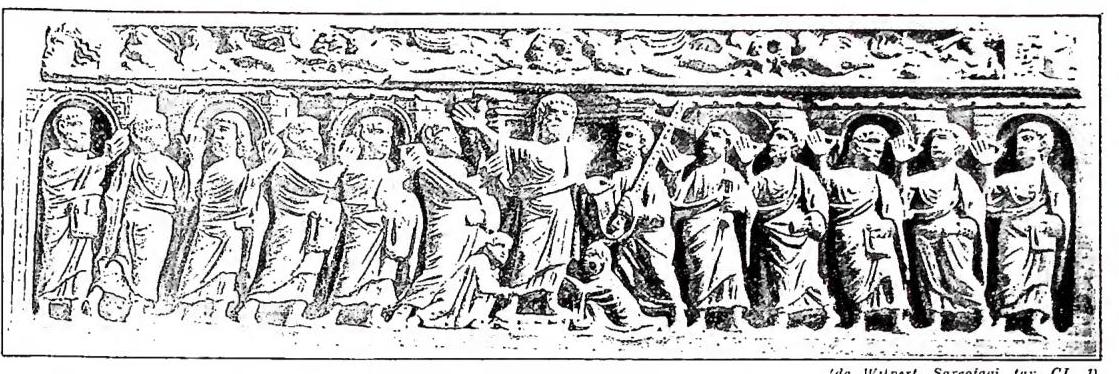
ACCLAMAZIONE - Sarcophagus of Aix (4th–5th century).
(from Witpert, Sarcofagi, pl. CL, I)
diseases, with the use of cabbalistic formulas and a great abuse of the names of angels and combinations of alphabetical letters.
Singular examples of a. are: a) That painted by Furio Dionisio Filocalo on the front of the book he wrote for a high dignitary of the 4th century: Valentine floreas in Deo; Valentine lege feliciter; Valentine vivas gaudess, intertwined with one another. b) An a. engraved several times on the columns of the theatre of Ephesus and of other Asian cities in the 7th–8th century: ὀρθοδόξων βασιλέων καὶ Πρακίνων πολλὰ τὰ ἔτη, “many years of life to the orthodox emperors and to the Greens (the circus faction and later also a political faction).” c) Among the Greeks, the formula Iesus Christus vincit enjoyed immense popularity and became something of a commonplace; it was generally
inscribed on the four arms of a cross frac{IC|XC}{NI|KA} d) The following a., partly already in use among the Jews, are scriptural formulas: amen, osanna, alleluia, Deo gratias, Dominus vobiscum, pax vobis, hyrie eleison, which became current in the liturgy and were also not uncommon in literature and epigraphic usage. The same may be said of the quintessential doxology Gloria Patri et Filio, etc., and of the so-called trisagion Sanctus deus, sanctus fortis, sanctus immortalis, miserere nobis, especially frequent among Eastern Christians. e) Two very frequent acclamations among the Greeks, especially in epigraphy, are: εἷς θεός, εἰ κύριε οὖνε θεοτόκε βοήθει, written on tombs, houses, and rings, and a little everywhere (unus [est] Deus, and Domine, or Deipara adiuva so-and-so). The first, certainly of pagan derivation, since it was already very frequently applied to Serapis, is especially widespread in Syria and Egypt and is of early Christian usage; the other, by contrast, is found in the Middle Ages and in every region.
3. IN SONG
Numerous forms of a. are also found in song, chiefly the Gloria in excelsis, the Te Deum, and the Benedicamus that conclude the Office; the Ite Missa est of the final dismissal of the Mass, which was preceded by other dismissals of the catechumens, such as recedant cathecumeni; and certain dialogues such as those we see in the Preface, Pater Noster, etc.A particular kind of a. was constituted by those called “Gallican,” from the Western Churches outside Rome, whence they passed to the mother Church itself. The Laudes, or Acclamations pueriles, used on certain solemn occasions such as Christmas, the Feast of the Holy Innocents, and Easter, were acclamations by children, proper to the “Scholae puerorum” established at basilicas and monasteries. From the solemn circumstance in which they were used, the Laudes Hincmari (from Hincmar of Reims, 806–82) became famous; in modern times they have also undergone renewed development through the influence of the occasion
for which they were composed. These are always preceded by the Christus vincit, Christus regnat, Christus imperat.
Musically, the a., whether collective or performed by a soloist, are always simple, as befits their acclamatory character. The melody of the oldest ones is always modeled on the tonic accent, and the cadences in melodic fourths are also classical and dear to Gregorian composers.