
RODEZ, DIOCESE OF. - A city and diocese in the department of Aveyron (France). The diocese extends over the ancient region of Rouergue and the present department of Aveyron. It covers an area of 8,743 sq. km. and has a Catholic population of 507,000, distributed among 650 parishes served by 908 diocesan priests and 27 regular clergy; it has a major seminary and four minor seminaries; eight male and thirty-five female religious communities (Ann. Pont. 1952, p. 240).
Rodez has been a provincial capital since Gallo-Roman times, as the chief town of the “civitas Rutenorum,” which belonged to Aquitaine. There is no doubt that its metropolitan function dates back to the Gallic period, since it was at the center of the land of the free Ruteni, who resisted Caesar even after Alesia (the provincial Ruteni,
(photo by I. Balzan)
Located in a region difficult to access, with poor external communications until the mid-19th century, Rouergue and its capital have not been the scene of any notable military events; yet they were many times a frontier, a place of passage hotly contested by the Merovingians against the Visigoths, by the Carolingians against the dukes of Aquitaine, especially during the Hundred Years’ War, before and after the cession to the English.
The borders of the county of R. (distinct from that of Rouergue, which was united with that of Toulouse) shrank as the power of the lords grew; Raymond of St-Gilles, departing for the Crusade, had promised it to Richard, Viscount of Millau, a promise that was changed into a sale in 1112. After a period of prosperity, during which it distinguished itself especially by protecting the troubadours, the first dynasty of the counts of R. became extinct with Henry II in 1304, and the county passed to the d’Armagnac family, as its heiress Cecilia had married Count Bernard. Relying on their domains, the d’Armagnacs pursued a policy of proud independence, suited to the mood of their subjects, but which left some traces in them. Count John, in 1368, placed himself at the head of the lords of Gascony to protest against the hearth tax, and the recourse to Charles V against the King of England served as a starting point for freeing the province, ceded to the English at Brétigny (1360). R. was the first city in the South to shake off the yoke, a fine title of glory for its dynasty. But the constable Bernard VII, after dominating France at the head of his “Armagnacs,” met a tragic end in 1418 when the Burgundians occupied Paris. Even sadder was the end of his family. John V died in battle during the capture of Lectoure (1442). The county passed to the d’Albret family and was reunited with the crown after the accession to the throne of Henry IV in 1607.
The feudalized domain of the last Carolingian official overlooks half of the city, namely the “bourg,” built around his comital court near the ancient suburban cemetery of St-Amans; the bishop was sovereign in the “cité,” formed around the Cathedral and the episcopal palace, certainly on the very site of the ancient Gallo-Roman city. Between the two halves, separated by walls, though both endowed by their respective leaders with communal privileges (the “bourg” in 1195, the “cité” in 1218), disputes were frequent and often bloody. The “Reformation” greatly undermined its southern part, and the wars of religion caused irreparable damage. Even the Revolution spared none of its churches and altered not only its legal and administrative regime, but also its economic and social structure.
(photo I. Balzan)
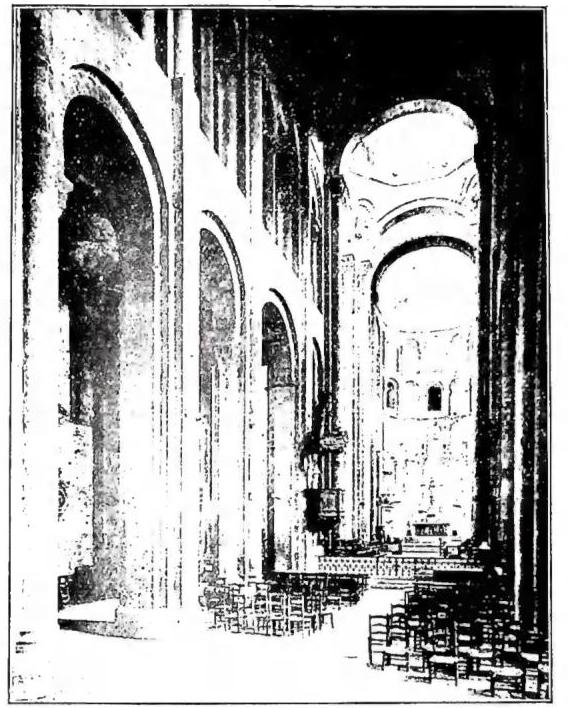
RODEZ, DIOCESE OF — Interior of the ancient church (11th century) of Conques (Aveyron).
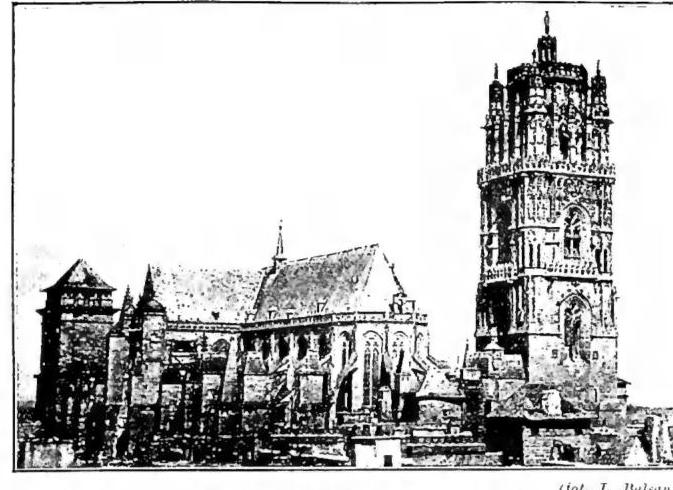
Cardinal from 1338, he corresponded with Petrarch. The bishops of the 14th and 15th centuries continued the work on the Cathedral, perfectly respecting the continuity of the original plan. The Blessed François d'Estaing (1501–29), belonging to one of the greatest families of Rouergue, carried out in his diocese work that left lasting marks, such as the reform of the Chapter, the clergy, the monasteries, the revision of the calendar, and the institution of the feast of the Guardian Angels. He had A. Salvanh build the famous bell tower, completed in 1526, a marvel of strength and soaring design, in which the pillars with their friezes harmoniously connect with garlands of egg-and-dart motifs and classical modillions, supporting at a height of 87 meters the statue of the Virgin accompanied by four incensing angels. Throughout Rouergue, works of art remain that bear witness to his piety and artistic taste, ranging from the sometimes tender, sometimes exaggerated sentimentalism of the late 15th century to the first accents of the new art known in Italy (C. Belmon, Le bienheureux François d'Estaing évêque de R., 1460–1529, Rodez 1924).
His successor, Georges d'Armagnac, of the comital family, was bishop of R. from 1529 to '62 and of Vabres from 1536 to '47; then ambassador of Francis I to Venice and later to Rome, cardinal in 1544; he further encouraged humanism and completed the Cathedral; the Gothic pillars of the western façade bear his coat of arms; a curious small Renaissance-style building with pediments and brackets, an early work by an innovator, the canon-architect G. Philandrier, commentator on Vitruvius. Unfortunately, however, at that time Calvinism spread in the southern part of the department. The subsequent bishops were three Corneillan: Jacques (1562–82), François, and Bernardino (1614–15), then H. de Préfixe, formerly tutor to Louis XIV, L. Abelly, G. Le Voyer de Paulmy (1666–82), who founded hospitals and seminaries; then G. M. Champion de Cicé (1776–81) and Cardinal G. C. E. Bourret (1871–96), a personal friend of Leo XIII. As elsewhere, the bishops had to take the leadership of the civitas during the turbulent period of the great invasions and give their dioceses the boundaries of the Roman province. With only minor modifications by Quercy (and the detachment of the canton of St-Antonin, united with Tarn-et-Garonne in 1808), the boundaries remain the same as those of the department. But the civil power long contested the chief town with ecclesiastical authority. The Count of R., successor to the county squeezed between royal possessions and their jurisdictional capitals, Millau for the Haute Marche, Villefranche, seat first of the seneschal and then a presidial for the Basse Marche, occupied only the center of ancient Rouergue. After 1607, R. is merely an episcopal city, and the bishop assumes the title of count.
From the most ancient times the ecclesiastical authority occupied a very strong position in the Rouergue. Although the diocese’s excessive expansion justified its division under John XXII, who in 1317 detached the southern part of the Tarn to create the diocese of Vabres, R., even thus amputated, remained a very extensive circumscription with 475 parishes and 66 annexes in 1771. The Concordat of 1801 reunited the two dioceses with that of Cahors, but in 1817 that of R. was recognized again. Pope Pius IX, by decree of 21 May 1875, restored the ancient suppressed title of Vabres in favor of the bishops of R.
The interior of the cathedral has the choir executed by Bishop F. d’Estaing; the chapel of the Pietà by Canon G. Roux; the tribune and the chapel of the Agony are by Philandrier; on the high altar is a Madonna of the 14th century. The church of St Amantius is a Romanesque building, rebuilt in the 18th century, of which it preserves the plan and ancient materials; a classical façade and a spire-like bell tower were added, the work of the Capuchin Father Cassagnes. The interior contains a series of gilt and polychrome wooden retables from the 17th–18th centuries. In the church of the Sacred Heart, erected in 1898, an attempt was made to imitate the abbatial church of Conques. A fine example of religious architecture is the chapel of the former Jesuit College, founded by Cardinal d’Armagnac in 1562 (L. Salter, Un témoignage de 1620 sur le Collège des Jésuites de R., in Bulletin de littérature ecclés., 39 [1938], pp. 204–27).
A country essentially religious, the Rouergue abounds in abbeys, most of them Cistercian, reorganized by Cardinal Bourret, such as Bonnecombe, Bonneval, Nonenque. Even before the Revolution the ancient Benedictine abbeys of Nant, Vabres, Conques and the female abbey of the monastery of St Saturninus near R. had disappeared or been secularized. It has been replaced by a flourishing of more recent convents and by several mother-houses of new religious institutes, such as the Sisters of the Holy Family of Villefranche (St Emily de Rodat, 1816), Dominican Sisters of Our Lady of the Rosary of Monteils (1849), Ursulines of Malet (1806), Sisters of St Joseph of Clairvaux (1824), of St Dominic of Gramont (1843), etc.
Numerous are the shrines, especially dedicated to the Blessed Virgin, such as Notre-Dame of Ceignac, the most renowned, and others like those of Fontcourrieu near Marcillac, Fraysse near Bournazel, Treize-Pierres near Villefranche, Lez near Mur-de-Barrez, Grandvabre and Gironde, Peyrusse and Romette, Estables and Lenne, Orient and La Salvage, Bergounhoux and St-Chély, "Notre-Dame-des-Buis" at St-Geniez, "de-la-Négrette" at Espalion, Notre-Dame of l'Espinasse at Millau, of Mercy at St-Affrique, Notre-Dame of Pity at R. and at Réquista. The pilgrimage of St Tarcissa at Rodelle is still much frequented, while that of St Fede at Conques has become purely artistic. At R. were born the cardinal archbishops of Paris D. A. Affre, who fell on the barricades in 1848, and G. Verdier; the historian Amant-Alexis Monteil (1769-1850), author of the Histoire des Français des divers États aux cinq derniers siècles (1808-2gg).
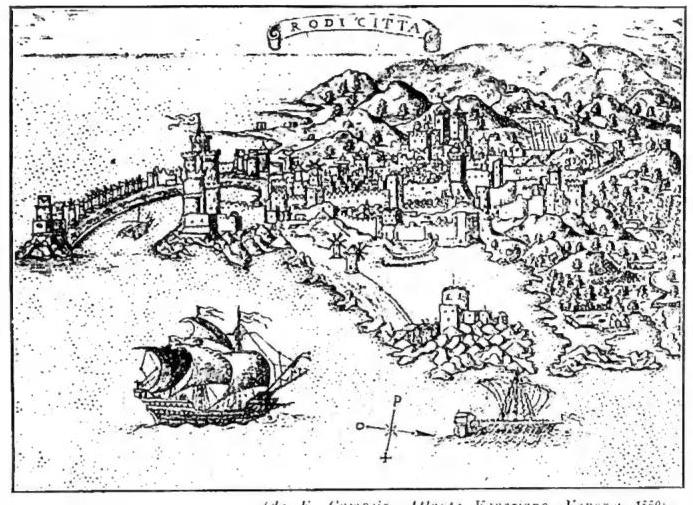
(from F. Camoio, Atlante Veneziano, Venice 1850)
Rodi - The Port of R. (engraving from the 17th century).
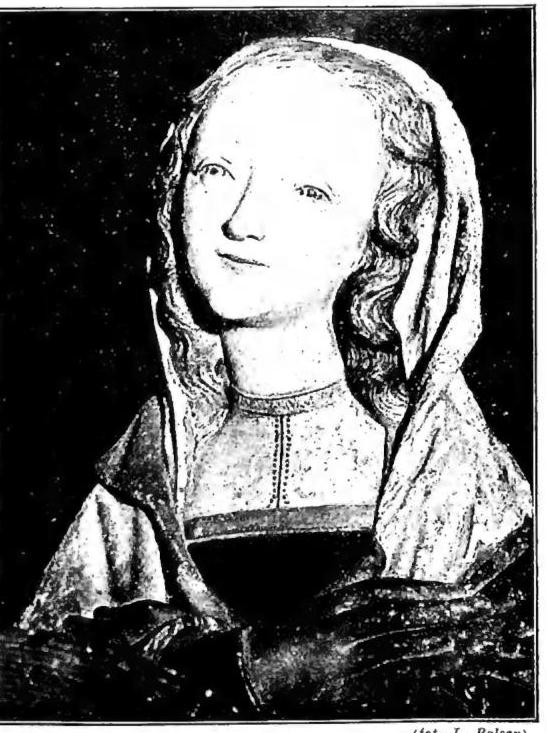
Escaped the conscious and unconscious vandals, the antiquarians and the amateurs. Notable are the Romanesque Christ and the small columns of the altar of Deusdedit, whose panel is preserved in the Cathedral; the 15th-century Christ from Bonnecombe; the Annunciate Virgin of the 16th century. The presentation of the ancient school of goldsmithing is not proportional to its importance. The collections of prehistoric and Gallo-Roman archaeology (stamped terracottas from "Graufensenque") are very abundant. The Museum dedicated to the sculptor Denys Puech will contain all ancient and modern plastic arts.