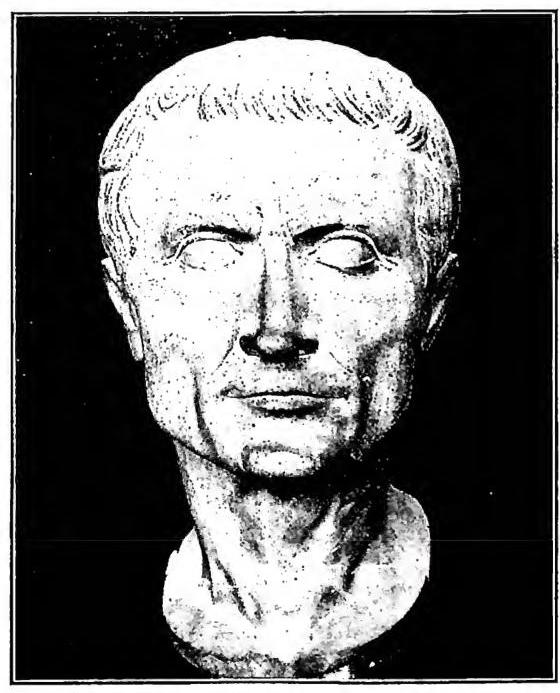
CAIUS JULIUS CAESAR (C. Iulius C. f. C. n. Caesar). — Born 13 July 102 BC, died 15 March 44 BC. Consul in 59 BC, conqueror of Gaul from 58 to 51 BC, engaged in civil war against Pompey (49–45 BC), during which he won campaigns in Spain (49–45), the Balkans (48 BC, battle of Pharsalus), Egypt (48–47 BC) where the events recounted below, concerning Jewish history, took place, Asia Minor (47 BC), and Africa (46 BC); absolute master of Rome from 45 BC until his death.
His programme aimed to adapt the state’s organization—previously too narrowly Roman and Italian—to the new frontiers that now embraced all shores of the Mediterranean. The programme rested on three pillars: improving the social conditions of the people, reducing the Senate to a merely advisory body, and equalizing the provinces with Italy. In the more “barbarous” western provinces he promoted Latin culture, while in the East he respected Greek nationality and Hellenistic culture. He reformed and unified the calendar (v.) to harmonize religious and civil life, and firmly established the army as the guardian of the new political and social order, thereby preparing the way for the definitive settlement carried out by Augustus.
Caesar’s relations with the history of Israel began after Pharsalus, when the Idumaean Antipater, advisor to Hyrcanus II and erstwhile partisan of Pompey, defected to Caesar’s side. To demonstrate his loyalty in deeds, Antipater sent 3,000 Jewish soldiers to relieve Caesar, then besieged in Alexandria, and personally fought at the storming of Pelusium; he also secured Caesar the friendship of Arab and Syrian tribal chiefs and the support of the Jewish colony at Leontopolis, enabling Caesar to defeat King Ptolemy Dionysius of Egypt.
The victorious dictator showed himself grateful to the Jews. To Antipater he granted Roman citizenship and the office of procurator (stipendiarius) of Judaea, despite the claims advanced by Antigonus, son of Aristobulus, whom the Pompeians had slain for Caesar’s cause. To Hyrcanus, who ruled in name only, he conferred the hereditary dignity of high priest, the title of ethnarch, and certain financial prerogatives. He permitted the Jews to rebuild the walls of Jerusalem, which Pompey had destroyed, enlarged the national territory to include Joppe and several Galilean cities that had passed to Phoenicia and Syria, and forbade Roman troops to winter in this territory. He exempted the Israelites from the tribute of sabbatical years and from military requisitions, diaspora (v.) the right to live according to their own customs, to collect offerings for sacrifices, and other privileges. No subject people of Rome mourned Caesar’s tragic death more deeply than did Israel.