
CIBELE. – Under the name Κυβέλη, Κυβήβη, Κυβηλίς and similar forms, there appears in Greece, from the time of Hipponax of Ephesus and Pindar, who are the first to mention her, a goddess who continued to live in the Hellenic consciousness as a deity of Phrygian origin. Under such a name, a goddess was in fact worshipped in Phrygia (Asia Minor), more precisely in the city of Pessinus, at the foot of Mount Agdo and near the Gallus and Sangarius rivers. She was not, however, a deity originally belonging to the Phrygian people. This people, having probably come from the Balkan Peninsula, where it had lived together with the Thracian people, invaded, perhaps around the twelfth century B.C., the territory later called Phrygia; in its new homeland it encountered the powerful cult of a female deity conceived as the universal mother. Indeed, not only in Phrygia but throughout the Anatolian sphere there are analogous mother-goddesses, such as, for example, Ma of Comana or the goddess of Ephesus, identified by the Greeks with Artemis.
The details of this pre-Phrygian phase of the cult are unknown. It is nevertheless connected with the indigenous population of the eastern Mediterranean region. Here the goddess is called by various names meaning “mother” (Ma, Nana, etc.) or by adjectives derived from the name of the locality, more precisely of the mountain where she has a cultic seat: thus the names Dindymene, Sipylene, Idaia and, probably, Kybele itself are explained. Goddess of the mountains, perhaps through Babylonian influence mediated by the Hittites, she is also the goddess of wild beasts. In the cities that are seats of her cult, she exercises the protective functions of a civic deity.
These features, which may be presumed to have a pre-Phrygian origin, are expanded under the influence of Phrygian religious fervour. Alongside the figure of the Great Mother of Pessinus, there now appears that of a god, Attis, whose name means father. The myth speaks of an androgynous deity, Agdistis, born from the rocks of Mount Agdo. In order to subdue her unrestrained and untameable nature, the gods deprive her of the male sex. From her blood there grows a tree, whose fruit impregnates Nana, daughter of King Sangarius; she thus becomes the mother of Attis. In the meantime, we learn that this Attis was a shepherd, loved by Agdistis. When the Phrygian king Midas wishes to give him his daughter in marriage, the goddess appears at the wedding and inspires those present with religious frenzy. Among them, Attis himself castrates himself and dies; but Zeus, in response to the goddess’s prayer, grants him a kind of immortality: his little finger will continue to move. The myth thus accounts for the practice of self-castration among the priests of the common cult of C. and Attis—priests whose name always remains “galli,” in connection with the Gallus River of Pessinus—and expresses the entire ideology of the orgiastic cult and of the aspiration to immortality proper to Phrygian religiosity.
The independent Phrygian state was subsequently submerged by the expansion of other peoples, such as the Lydians in the second half of the seventh century B.C. Pessinus nevertheless remained an independent theocratic city-state, administered by the priests under the sovereignty of the goddess. At the same time, the cult spread into Lydia, where the ruling family bore theophoric names (e.g. Alyattes), along with other signs of a fervent cult of the Great Mother. Elements of Lydian mythology nevertheless show that the Lydians remained conscious of the Phrygian origin of the cult.
Through continual contacts with the peoples of Asia Minor and through numerous Phrygian slaves, the cult of C. soon penetrated (in the fifth century B.C.) into mainland Greece as well. It attached itself to Greek cults: C. was in fact assimilated to various Greek mother-goddesses, such as Gaia, Demeter and, above all, Rhea. The bloody, savage and orgiastic forms of the mystery cult of Attis, however, were repugnant to Hellenic sensibility: Greek comic poets spoke of them with contempt, directing their irony above all at the mendicant priestly order of the metragyris. Beginning at the end of the fifth century B.C., Greece nevertheless also came to know the practice of self-castration, and from the fourth century there existed at the Piraeus a cultural association of orgeines, initiates into the mystery cult. The spring festivals in honour of the two deities, the Attideia, are also mentioned. Moreover, in Greece, perhaps not without the influence of the Eleusinian Mysteries, the cult acquired its definitive forms: from then on its ritual language remained Greek, as appears from the initiatory formulas transmitted to us by Firmicus Maternus and Clement of Alexandria.
According to Roman tradition, in 204 B.C., at the suggestion of the Sibylline Books, Rome introduced into its territory—having obtained it from Attalus, king of Pergamum—the black stone of Pessinus, an aniconic image of the goddess, and provisionally placed it in the temple of Victory on the Palatine. In any event, as early as 191 B.C. a temple was dedicated to the goddess, precisely on the Palatine—that is, contrary to what occurred with the other deities of foreign origin, within the pomerium. The goddess was in fact regarded as a deity of the Trojans, ancestors of the Romans, and therefore not foreign; this conviction is expressed even in her official name, Magna Mater Deum Idaea. The first Roman worshippers of the goddess were the aristocrats, who formed cultic associations. But the original cult, in its forms alien to the Roman republican mentality, was entrusted to Phrygian priests, and no Roman citizen could be initiated into its mysteries. Of the spring festivals, only the washing of the sacred image in the Almo River took place in public; other celebrations, such as the ludi Megalenses, had the typical character of Roman cult. Only under the emperor Claudius did the festivals become public in their original form as well. The calendar of Philocalus contains the entire arrangement of the spring celebrations (from 15 to 28 March). In these festivals, whose names are significant (Canna intrat, Arbor intrat, Sanguem, Hilaria, Requietio, Lavatio, Initium Caiani), the death and resurrection of Attis were represented symbolically; during them the self-castration of the “galli” took place. The rite of the taurobolium originally belonged to this religion: the “rebirth” of the initiate was effected by sprinkling him with the blood of the bull killed above a perforated platform beneath which the taurobolium was situated.
From Rome, its new centre, the cult spread throughout the provinces. It remained highly important even in the final period of paganism. In their struggle against victorious Christianity, Roman aristocrats were initiated into these and other mysteries. Julian the Apostate was one of the most fervent supporters of the cult of the Great Mother.
Some heretical sects of early Christianity, especially in the eastern sphere, show a clear influence of the cult of C., such as the Ophites and, more importantly, the Montanists.
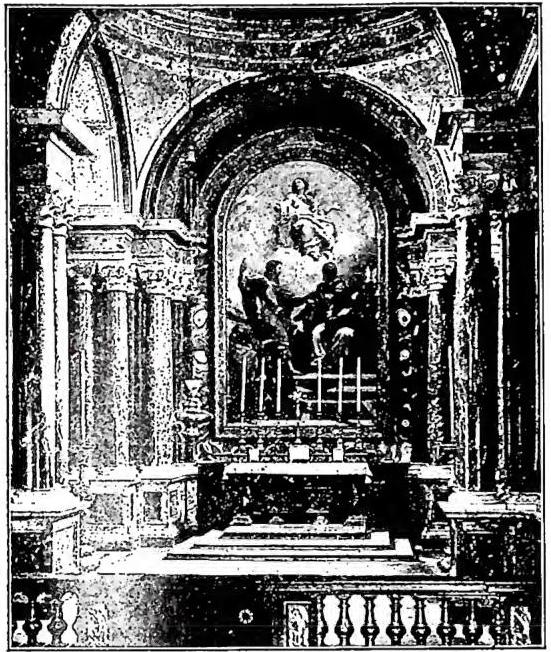
CIBO, FAMIGLIA — Cibo Chapel. Design by C. Fontana (1660). Painting by C. Maratta — Rome, church of S. Maria del Popolo.
Paris 1920, p. 43 ff.; H. Gressmann, Die orientalischen Religionen im hell-röm. Zeitalter, Berlin–Leipzig 1930, p. 50 ff. Angelo Brelich