
TAUROBOLIUM. — A ceremony originating in Asia Minor, where it was connected with the cult of the great female divinity; from Phrygia (whose evidence dates back only to the 2nd century A.D.), together with the cult of Cybele, it spread to Rome and Italy generally, from there passing into Gaul, Spain, and the Roman provinces of North Africa.
Almost nothing is known from Eastern sources about the course of the rite; the Greek term shows that the bull to be sacrificed had to be captured in the hunt, by throwing (βάλλω) a projectile weapon, according to an archaic custom that was widespread throughout the East. This hunt eventually became a circus game, a bullfight, performed independently of the religious sacrifice, which survived only, without hunting or running: this, in fact, is how the t. appears in the age of the Antonines.
The fullest information about the t. comes from a late Roman source: Prudentius (Peristeph., X, 1011–71), where the t. of the high priest of Cybele is described in considerable detail. He descended into a pit, whose upper opening was then closed by a loosely fitted wooden platform deliberately perforated with holes. Above it, the priests led in procession, to the music of drums and cymbals (as demonstrated by the iconography of votive altars), a bull crowned with flowers and garlands. It was slaughtered with a barbed harpoon (venubulum, a survival of the archaic hunting rite?) in such a way that the blood flowed through the platform into the pit and completely drenched the body and garment of the high priest, who indeed opens his mouth and turns it upward, places his ears beneath it, thrusts out his lips and nostrils, and even soils his eyes with that dripping fluid. Nor does he spare his palate, and he soaks his tongue until he is wholly saturated with the black blood (Prudentius, loc. cit., trans. Marchesi). After such a repugnant sprinkling, the celebrant emerged from the pit and offered himself for the adoration of the crowd of initiates. The animal’s testicles (vires) also had an importance in the rite, since they were collected in the χέρνος, cernus (cf. CIL, VI, 508; a kind of dish that also played an important role in the Eleusinian mysteries), consecrated to Demeter, and then buried (vires excepti, transtulit, condidit: CIL, XIII, 1751). This ceremony most probably intended to replace the more ancient and barbarous practice of the initiate’s self-castration and the offering of his own genitals to the goddess.
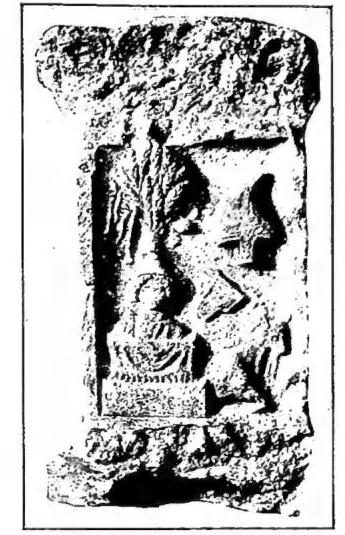
(from Exptrandien, Recueil general des bœuilles de la Gaule romaine, II, Paris 1888, p. 236)
TAUROBOLIO - Taurobolic altar at Périgueux.
a newly slaughtered animal means transfusing its vigor into one’s own person; while the descent into the pit is like entry into Hades, from which the initiate is drawn precisely through revitalization by means of the blood, as in the Homeric episode of Ulysses, who summons the soul of Tiresias (Odyssey, XII). Moreover, one must not overlook the singular fact that the taurobolite, having to place himself beneath the bull in order to receive its blood, in a certain sense came himself to constitute the altar of the sacrifice.
Anyone could be initiated into the t.; in order truly to confer the new life (cf. s. Augustine, De civ. Dei, VII, 24-
26), it apparently had to be repeated a second time after 20 years (CIL, 6, 502: Taurobolio criobolioque repetito [the criobolium was an analogous ceremony, performed, however, with a ram]). It was celebrated in every season of the year (and lasted several days), for one’s own benefit or that of others (e.g. pro salute imperii, CIL, XIV, 40); and at Rome (where it was celebrated in the Phrygianum, on the Vatican Hill) it perhaps acquired, from the time of Antoninus, an official state character, at times under the authority of the XV viri sacris faciundis.
The emperor Julian the Apostate attributed such efficacy to the bloody taurobolic rite that he wished to undergo it with the intention of erasing the washing received earlier in Christian baptism (cf. Greg. Naz., Or., IV, 52; PG 35, 576).