
CLAUDIO (Ti. Claudius Caesar Augustus Germanicus
), ROMAN EMPERORFourth emperor (A.D. 41–54), son of Drusus and Antonia, uncle of Caligola, whom he succeeded in the Empire at the age of fifty. Although he had no great aptitude for governing, being weak and timid by nature, he nevertheless rendered good services to the empire through his successful military enterprises and wise administration. He revoked some senseless measures of his predecessor, granted an amnesty, and recalled the exiles, among them his niece Agrippina, whom he later married. He completed the port of Ostia, built in Rome the great aqueduct that bears his name, and promoted regular shipments of grain for the provisioning of the city. Yet it was precisely during his reign, owing to persistent drought, that the provinces of the Empire were afflicted by a severe famine, recalled not only by Svetonio (Claud., 5, 18) and Dione Cassio (LX, 11), but also by Act. 11, 28. On the occasion of this famine, which sorely tried Palestine in the years 44–48, St. Paul promoted collections in the Churches of Syria and Asia to assist the poor Christians of Jerusalem (cf. Act. 11, 29; Gal. 2, 10; I Cor. 16, 1).
Among the military enterprises of C. are remembered the victorious campaign in Britannia, in which the valiant commander and future emperor Vespasiano distinguished himself, and the annexation of Mauritania. He eradicated the Druidic cult in Gaul. He nevertheless had the weakness of allowing himself to be dominated by the women who succeeded one another on the throne, Messalina and Agrippina, and by certain powerful freedmen, such as Callisto, Narciso, and Pallante, brother of the procurator of Judea, Antonio Felice, and administrator of the imperial finances.
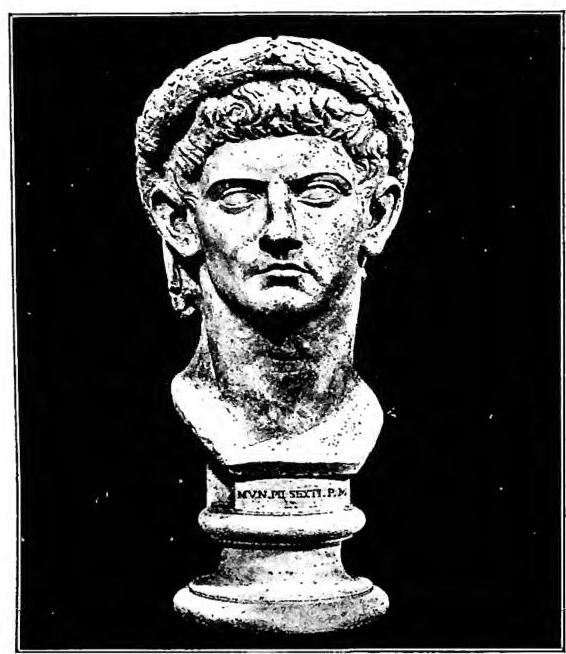
(photo: Vatican Museums Gallery)
CLAUDIO — Marble bust of Roman art — Vatican Museums.
to restore order and tranquillity by the famous Letter to the Alexandrians, promulgated on 10 Nov. 41 and preserved for us in a Greek papyrus brought to light in 1924 (Pap. 1912 of the British Museum). By virtue of this decree, the Jews were restored their full rights and ancient privileges, with the free profession of their religious faith; the divine worship of the emperor, which Caligola had imposed even upon the Jews in his “great folly and madness” (Flavio Giuseppe, Antiq. Iud., XIX, 5, 2), was abolished. Thus the principal cause of the disturbances was eliminated, and a regime of mutual tolerance between pagans and Jews was established. The ordinance, extended to the whole Empire, concludes with a warning to the Jews to beware of receiving or attracting into that city coreligionists coming from the rest of the province or from Syria, “from which,” the emperor adds, “I should be compelled to entertain greater suspicions; otherwise I shall punish them without reserve, as instigators of an evil (pestilence) which spreads throughout the whole world.” Some (e.g., H. Janne) believed they discerned in this last expression a veiled reference to the nascent Christian religion, which was already beginning to spread rapidly throughout the Empire. In that case, we would have the oldest secular document attesting the existence and development of the new religion. But this connection, too ingenious, is supported neither by the text nor by the sequence of events, and is commonly rejected. Rather, that expression should be seen as evidence of Jewish cosmopolitanism and of the corporate spirit uniting the various communities of the diaspora.
Among his other acts in favour of the Jews, C. confirmed to his friend Agrippa, as a token of gratitude for the valuable support received in his elevation to the throne, possession of the territories already obtained from Caligola in 41 (the tetrarchies of Filippo and Lisania, together with Galilea), and added to them those subject to the Roman procurator (Giudea, Samaria, and Idumea), thus restoring the administrative unity of Palestine under the Herodian dynasty.
Subsequently, between 49 and 50, the Jews of Rome were affected by a decree of expulsion: among the exiles were the Priscilla (v.), who met s. Paolo at Corinto (Act. 18, 2). The reason for the measure is given by Svetonio in the famous passage:
“Iudaeos impulsore Chresto assidue tumultuantes Roma expulit” (Claud., 25). The allusion to the Christian religion cannot be doubted. The Chrestos, the instigator, according to the pagan historian, of the Jewish disturbances, is the Christos or Messiah; and the dissensions in the Jewish community were caused precisely by the messianic question: some among the Jews of Rome regarded Gesù di Nazareth as the Christ or Messiah, and these were the Christians (sometimes also called in antiquity chrestiani, from Chrestos for Christos); others, on the other hand, did not believe this, and the conflict between the two parties gave rise to heated discussions and riots. Nevertheless, the edict of expulsion must have been applied with great leniency, or else it merely prohibited public gatherings. Indeed, a few years later, under the successor Nerone, the Jewish colony of Rome was still very numerous and perhaps more powerful than before. There is reason to think that this edict had consequences of great importance for the Christian community, insofar as it helped to sever the last ties that still bound it to the Synagogue. Thereafter it developed in full autonomy, with the clear predominance of Gentile Christians: thus, after 50, the Synagogue and the Christian community in Rome remained completely divided (cf. Act. 28, 17 sgg.). C. died on 3 Oct. 54 from poison administered to him by his wife Agrippina. Nerone (v.), son of Agrippina herself.