
Three works by him are known: Adoration of the Shepherds, 1518 (Treviso, Pinacoteca); Assumption, 1520 (Treviso, cathedral); Portrait of a Gentleman, 1528 (Bernard Castle, Bowes Museum). Modern criticism adds others, including several prophets in the coffers of the ceiling of S. Maria dei Miracoli in Venice.
J. Wellhausen and the rationalist critics, on the basis of their well-known a priori principles, commonly assign all the rites of expiation described in Lev. 16 to the post-exilic period. Among Catholics, S. Landersdorfer considers the section concerning the scapegoat to be subsequent to the exile (Lev. 16, 8-12.22. 26-28). But this is mistaken, since the unity of the chapter cannot be contested; the ceremonies in Lev. 16 are closely connected with one another, and above all the scapegoat symbolized in the most expressive manner the expiatory power of sacrificial rites. It should also be added that this eminently popular practice finds parallels in analogous rites among many other religions. S.H. Langdon collected and compared numerous examples of scapegoats in Babylonian religion, and J. G. Frazer did so among other religions. But the similarities with the biblical rite are merely external and superficial, whereas the profound and essential differences highlight its incomparable superiority in the nobility of its symbolic meaning and the purity of its religious notions. J. D. Prince sees the prototype of the biblical scapegoat in a Sumerian magical rite in which the king, at the command of Ea and Marduk, strikes a goat with an arrow, thereby transferring to it all the illnesses afflicting his soldiers. But the differences are so numerous that it is impossible to establish a dependence or connection between the two rites. Another Babylonian rite (in a fragment of Rizuale published in 1911 by P. Dhorme) offers closer parallels with the Levitical ceremony: at the beginning of the new year, on the 4th or 5th day, the mašmašu (the priest who performs the magical rites) enters the ezida (the most sacred part) of the temple of Nebo and performs the rites of sprinkling there; then he has a ram’s head cut off, using the victim to exorcise the temple; finally, he goes and throws the corpse into the Nala River. A man from the people performs the same operation with the head of the victim, and both must remain outside the walls for a week because of the impurity contracted. The points of contact with the biblical ceremony are undeniable. But the differences are even more numerous, as a simple comparison of the rites shows (A. Médebielle, p. 111 ff.). In the Levitical ceremony the scapegoat has only a symbolic value: this raises it far above the crude rites of other religions, which moreover lack any idea of collective and national expiation.
Where the Vulgate translates hircus emissarius, the Hebrew text reads 'džā'zēl four times (Lev. 16, 8. 10. 26). Much has been debated concerning this difficult word, which occurs nowhere else in the Bible; nor is there yet agreement about its meaning.
The explanations can essentially be reduced to three: 1) Some rabbis thought that 'Ažā'zēl was the name of a locality near Sinai, where the scapegoat was driven the first time the rite was instituted; the designation would then have remained to indicate the place intended for the sending away of the scapegoat. This opinion is generally rejected (though S. Landersdorfer still accepts it), also because the Bible contains no trace of a locality of this name. – 2) 'Ažā'zēl would designate a cacodemon, a malevolent principle, or even Satan, prince of the demons, opposed to God and dwelling in the wilderness: also in the apocryphal Enoch, 'Ažā'zēl is the name of a demon or of Satan (8, 1; 12, 13; 13, 1; 15, 9); moreover, in Holy Scripture the wilderness is often depicted as an image of desolation and death and as the dwelling place of demons (Is. 13, 21; Bar. 4, 35; Tob. 8, 3; Mt. 12, 43; Apor. 18, 2; cf. Enoch, 10, 4; 'Ažā'zēl bound in the wilderness of Dudael). This opinion, already found in Origen (Contra Celsum, VI, 43) and among the Gnostics (cf. Epiphanius, Haer., 36), has won the favor of numerous exegetes, both Catholic and rationalist, who nevertheless disagree concerning the meaning of the designation of the scapegoat «ad 'āzā'zēl». Lev. 16, 6 seems to support this explanation: it says, in fact, that when lots were cast over the two goats, one was «for Jahweh», the other «for 'āzā'zēl»: now the opposition between Jahweh and 'āzā'zēl seems to require that the second term, like the first, be a personal being. The argument, however, is not compelling, and from the doctrine of the apocryphal Enoch (later by approximately 15 centuries) one cannot deduce that the Hebrews in the time of Moses designated a demon or Satan by that name. In any event, even if the identification is admitted, it would be absurd to think, as many rationalist critics maintain (K. Martí, A. Sabatier, B. Stade, B. Duhm, etc.), that the scapegoat was offered in sacrifice to 'Aza'zēl:
for through the laying on of hands the scapegoat, like the first goat, was sacred to Jahweh, and both formed part of the same rite of expiation. Nevertheless, one may admit, with various Catholic exegetes (L. C. Fillion, F. X. Kortleitner, B. Welte, J. Smith, etc.), that the scapegoat, burdened with the sins of the entire people, was transferred to 'Aza'zēl as to its own master: thus there was no homage or tribute to Satan, but rather an anathema or a screen; an ignoble prey, worthy of him, was released to him. In this sense the most varied etymologies have been devised:
for example, «strong god», from 'āzāz 'ēl, a remnant of a divine name that had fallen into disuse and was employed in a derogatory sense; «fallen strong one», from 'az 'āzal; «failed strong one», from the transcription of the Pēšittā, 'azzā zajel, etc. (cf. A. Médebielle, p. 155 ff.). – 3) As a concrete or abstract name, 'āzā'zēl would mean «emissary», or «removal», «sending away»: the Vulgate is based on the etymology 'ēz («goat» or «buck») and 'āzal («to go» or «to lead away»). Thus the Septuagint, in substance (ἀποπομπάιος, twice), and, in other words, Aquila and Symmachus; on the other two occasions the Septuagint translates with the noun (εἰς ἀποπομπήν, εἰς ἄφεσιν: «for removal, sending away»: cf. Flavius Josephus, Antiq. Jud., III, 10, 3). Thus the ancient versions support the sense of «sending away», «removal». The only question is whether the word should be derived from a double root ('ēz and 'āzal) or from the single root 'āzal («to go away») or 'āzal (Arabic: «to remove», «to carry away»); likewise, it may be debated whether it is a substantive form or a verbal form. According to W. Gesenius, it may be an intensive form, the pilpel, of 'āzal, with intransitive meaning («that which is carried away», «emissary») or transitive meaning («that which removes», «carries away», with «the sins» understood). And this explanation, especially according to the interpretation of the Vulgate, still seems the most probable. Thus Lev. 16, 8 may be translated as follows: «...and he shall cast lots over them, one for Jahweh, and the other for the emissary» (that is, to constitute the goat in this capacity as emissary): in this sense vv. 10 and 26 are also readily explained.
(photo Sansuini)
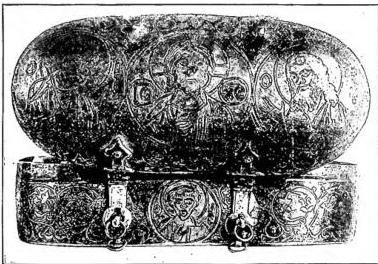
CAPSA - C. con incisioni a niello (secc. XII-XIII). Biblioteca Vaticana, Tesoro del Sancta Sanctorum.
J. Schur, Versöhnungstag und Sündenbock, Helsinki-Lipsia 1934. Gaetano Stano
CAPSA. – From the Greek χάψα, properly a case for books; it could also be called scrinium; generally circular and made of wood; if very small, capsella, and if made of bronze, cista. In the passio of the Scillitan martyrs of 17 July 180, the judge Saturninus asks: «quae sunt res in capsa vestra?» (cf. BHL, 7527). Wilpert recognized a representation of a c. for books in a painting in the cemetery of Pretestato dating from the second half of the fourth century, which he reconstructed (Wilpert, Pitture, pl. 178, 3 and p. 215, fig. 19).
C. was also the name given to the small vessel containing the elements that were to be used for the Eucharistic celebration: capsa cum sanctis apertas (but V. PISSIDE). Archaeologists have given the name capselle to the numerous reliquaries of wood, ivory, terracotta, stone, and silver found in altars and containing relics.
Such, for example, are the reliquaries of Brescia and Grado, etc., and the Egyptian-made one from the first half of the sixth century, originating from the Sancta Sanctorum and now in the Sacred Museum of the Vatican Library (C. R. Morey, Gli oggetti di avorio e di osso del museo Sacro Vaticano, Città del Vaticano 1936, p. 58, no. A. 59). Typical is the reliquary illustrated by G. B. De Rossi, found in the small basilica of Ain Zirara, 8 km from Ain-Beida in Numidia, between Tebessa and Constantina. It is made of silver and is elliptical in shape; on the lid is depicted a martyr holding in his hands the jeweled laurel crown; above, the divine hand projects from the clouds and is about to place the crown upon the Saint’s head. At the martyr’s feet emerge the four rivers of paradise, while two torches burn at the sides. On the outer faces of the c., on one side, eight sheep emerging from the two cities proceed toward the center, where the divine lamb is depicted, behind which stands the Latin cross. On the other side, above a rock, is the Signum Christi; below, the four rivers gush forth, toward which two deer hasten to drink (G. B. De Rossi, La