AQUILA E PRISCILLA (PRISCA)

Image from page 1019

AQUILA and PRISCILLA (PRISCA). - Jewish-Christian spouses, “collaborators” of St. Paul (Rom 16:3). Having come from Rome following the decree of Claudius (AD 49–50) expelling the Jews (Acts 18:2 sg.; Suetonius, Claudius, 25), they met the Apostle for the first time in Corinth in AD 51. A. was originally from Pontus, where Jewish colonies were established. P. was perhaps born in Rome, where that name was common. P. is usually named before A., perhaps because she was more distinguished or more active in good works.

They had probably become Christians before leaving Rome.

Like Paul, they were tentmakers; in Corinth they carried on this trade, employing Christian workers. Paul stayed with them, practicing the trade by which he earned his livelihood without being a burden to anyone (Acts 18:1–3), but he left their house to stay with Justus when, wishing to give a fitting response to Jewish hostility, he turned to the Gentiles. The Acts and the letters of St. Paul highlight the zeal of A. and P. for the Gospel. When Paul went to Ephesus, they followed him. After the Apostle left for Jerusalem, they brought the preacher Apollos to Christianity (Acts 18:19, 26).

They appear again in Rome (Rom 16:3), then in Ephesus (2 Tim 4:19). They moved from one center to another, perhaps for commercial reasons, taking with them their own Christian workers or recruiting others whom they converted to the faith, since Paul mentions “the church in their house” both in Rome and in Ephesus (1 Cor 16:19; Rom 16:4). At the risk of their lives, they saved St. Paul from death, probably in Ephesus (Rom 16:4; Acts 19:23 sg.).

In the letters of St. Paul, we find affectionate remembrance and praise of them (Rom 16:3–5; 2 Tim 4:19; 1 Cor 16:19).

The Roman Martyrology commemorates A. as bishop of Heraclea (July 8); the Byzantine rite commemorates him on July 14. The attribution of the authorship of the Epistle to the Hebrews to A. and P. (A. Harnack, in Zeitschrift f. neutest. Wiss., 1 (1900), pp. 16–41: the principal part would belong to Priscilla) has no foundation. Their memory remained long glorious among Christians. The ancient “titulus Priscae” on the Aventine and the cemetery of P. on the Via Salaria may refer to the wife of A. (v. PRISCA, saint). The Acts of A. (ed. Ebersolt, Paris 1902) are late (7th century).

Bibl.: H. Grisar, Analecta Romana, Rome 1899, pp. 109–112; P. Batiffol, L'abbaye de Rossano, Paris 1891, pp. 13–15; A. Harnack, op. cit.; L. von Sybel, in Real-Encyclopädie, I, 1, col. 1263.

AQUILA. - Today a hamlet in the Friuli region in the province of Udine, near the lagoon of Grado, on the Natissa River, which connects it to the sea. It has barely 1,200 inhabitants, and about 10,000 in the vast, exclusively agricultural commune. In antiquity it was situated amid lagoons accessible from the sea, whence its importance and its role that foreshadowed that of Venice.

A legend, first attested at the end of the 8th century, attributes to St. Mark the Evangelist the first evangelization of A. He is said to have established as its first bishop a certain Hermagoras, and then to have gone on to evangelize Alexandria. The origin of the Church of Aquileia can be traced back, on critical grounds, to the mid-3rd century or slightly earlier, and it became the center from which Christianity spread throughout all Venetia and even into the neighboring territories of Raetia Secunda and Upper Pannonia. After the persecution of Diocletian, in which a Fortunatus, the three Canziani, and Chrysogonus suffered martyrdom, the Church immediately entered a period of great splendor; Bishop Theodore

AQUILEIA - Interior of the Basilica (11th and 14th centuries).

attended the Council of Arles (314); Fortunatianus was a trusted man of Pope Liberius, though later he compromised with the Arians (354); St. Jerome had much to praise in St. Valerian, and with his successor Chromatius the same Doctor was bound by a fervent friendship. Famous is the Council held in 381 under the presidency of St. Ambrose, aimed at uprooting the last remnants of Arianism in the Danubian provinces.

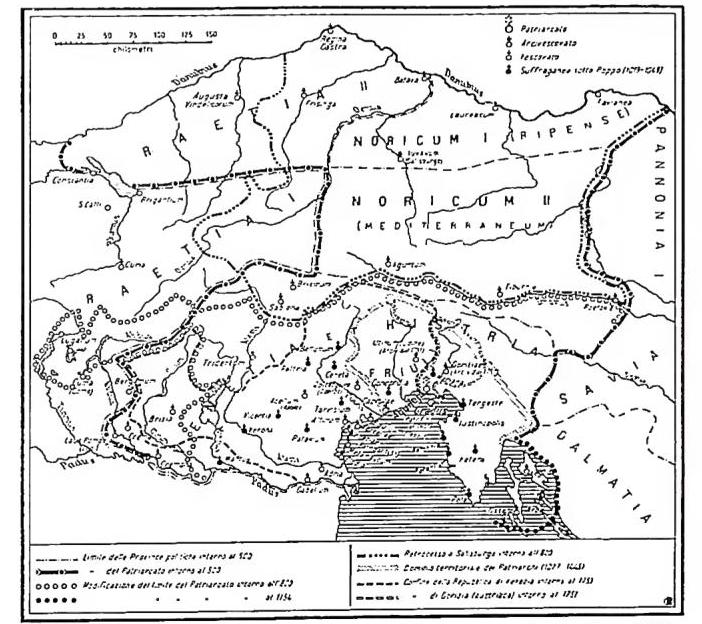
In the early decades of the 5th century, Aquileia became the metropolis of the entire province of Venetia et Histria and of the surrounding countries to the north and east, and its organization was not at all disrupted by the invasion of the Huns (451), who conquered and burned the city, for once the scourge had passed, it resumed its full activity. Greater consequences followed from the Three Chapters controversy in 553, because, in opposition to Justinian and the popes Vigilius and Pelagius, Aquileia refused to accept their condemnation and took on the appearance of a schismatic see. When the Lombards descended into Friuli in 568, Bishop Paulinus, who claimed the title of patriarch, took refuge in Grado, a fortress in the lagoons; there his successors continued to reside, stubbornly clinging to the schism, until in 605, with the consent of King Agilulf, an abbot named John was elected bishop of Aquileia, while in Grado, with the favor of the Byzantine Empire and the Pope, Candidianus was elected for the Catholics. Thus began the division of the Aquileian see into two parts: one subject to the Lombard kingdom, the other to the Empire. Both prelates proclaimed themselves patriarchs; but the one in Aquileia, unable to reside in the now desolate and unsafe city near Grado, established himself in the castle of Cormons, continuing in schism along with his suffragans until the end of the 7th century, when, through the intervention of King Cuniberto of the Lombards, Patriarch Peter returned to Pavia in union with Rome. Then the fortunes of the patriarchate revived when, under King Liutprand, his successor Callistus transferred his see to Cividale, which was the capital of the duchy of Friuli. Meanwhile, the series of patriarchs at Grado continued, and did not cease until the 15th century.

The patriarchate of Aquileia gained great renown under Patriarch Paulinus (d. 802), a man of great learning and a close friend of Charlemagne. Under him, missions among the Avars and especially among the Carantanians (Slovenes) flourished in the surrounding lands. A famous act of 810, sanctioned by Charlemagne, set the Drava River as the boundary between the metropolitan sees of Aquileia and the newly established Salzburg. With this, the diocese of Aquileia acquired an immense territory beyond the Carnic and Julian Alps, so that it could be considered the largest in Europe; to the west, however, the boundary remained roughly at the Tagliamento River. Patriarch Maxentius, however, did not succeed, though he had convened a council at Mantua in 827 for this purpose, in incorporating the patriarchate of Grado into his see, nor did some of his successors succeed in this later. In any case, all the sees of Istria and Venetia (excluding the lagoon and island areas), along with Mantua (until the 15th century) and Como (as a result of the end of the schism), remained within the metropolitan jurisdiction of Aquileia. Maxentius also deserves credit for beginning to restore Aquileia’s fortunes, thanks to the support of the Carolingian rulers. Indeed, from Charlemagne, who granted the free election of the patriarch and immunity, we have a whole series of concessions, continued more extensively by the kings of Italy Berengar and Hugh, by the sovereigns of the Saxon and Salian houses.

Patriarch Poppo (d. 1042), a German, also obtained the right of legation and the privilege of minting coins, and gave new impetus to the reorganization of his Church and of Friuli, which had been devastated a few decades earlier by Hungarian invasions. It was in this period that the great Benedictine monastery of the nuns of Santa Maria of Aquileia, the patriarchal chapter, the lesser chapters of Santo Stefano and of Santi Felice e Fortunato were founded, while the monastery of Beligna dates from an earlier period; the collegiate chapter of Cividale also received special reorganization. With this reorganization

Article illustration

The ecclesiastical organization, which developed with the progressive creation of parishes (*pievi*) and rural archdeaconries, is closely linked to the political structure that gained momentum during the Investiture Controversy. In fact, alongside the donations of vast lands and castles, there came in 1077 the donation of the County of Friuli, followed shortly after by that of the March of Carniola and the County of Istria, and in 1081 the feudal dominion over the bishoprics of Trieste and Parenzo, and later also of Pola, while that over Concordia dated back to the time of King Hugh. The patriarch thus became the head of a powerful feudal state, which, though lacking stability in the transalpine regions, grew stronger in Istria and especially in Friuli, encompassing all the territory from the Julian Alps and the Karst to the Livenza, including Cadore.

During the period of this feudal state, two important Benedictine abbeys arose: Rosazzo and Moggio, while other ecclesiastical institutions also originated at that time in the transalpine lands. A series of patriarchs, mostly of Germanic nationality, governed the patriarchate until the death of Frederick II and

Article illustration

the emergence of new political relations in Italy, thanks to the victory of the papacy. From this time onward, the patriarchate was drawn into the political struggles that succeeded one another in northern Italy and particularly in the Veneto, until in 1420, when Venice took possession of Friuli and part of Istria, the feudal dominion of the patriarchs came to an end. The new order was regulated by a compromise in 1445, with the approval of Eugenius IV. The commendatory system then began, lasting until the mid-16th century; in 1463, by imperial decree, the small bishopric of Ljubljana was erected in Carniola, leaving the ecclesiastical organization in the remaining transalpine territory, subject to Aquileia, unchanged.

The 16th century saw attempts at Protestant penetration in that territory, particularly in the Gorizia area, and conflicts between the Venetian Republic and Austria, a consequence of the occupation of Aquileia and eastern Friuli following the Wars of the League of Cambrai. The Empire indeed claimed the right to appoint the patriarch, on the pretext that Aquileia and most of the patriarchal diocese lay under its dominion; Venice, constantly supported by the Pope, strove to prevent this from happening, since it would have led to the appointment of a non-Italian ecclesiastic, whereas the ecclesiastical province was almost entirely within Venetian territory.

The patriarch no longer resided in Aquileia but in Udine, and his jurisdiction in Austrian territory was stubbornly contested and obstructed. Aquileia began its decline: the abbey of Beligna and the two chapters of St Stephen and of SS. Felix and Fortunatus disappeared; the Chapter functioned there only during the winter months because of malaria. Finally, Benedict XIV, acceding to the wishes of Empress Maria Theresa, which had matured in the preceding period, sanctioned with the bull of 6 July 1751 a new organization: the patriarchate was suppressed and two archbishoprics were created: that of Udine and that of Gorizia. To the former was assigned the part of the ancient diocese subject to Venice, to the latter that subject to the Empire; in the same way the ecclesiastical province was divided: Udine had under its jurisdiction the Venetian and Istrian dioceses, Gorizia those of Como, Trent, Pedena, and Trieste. Aquileia, with its basilica, was declared directly subject to the Holy See and placed under an apostolic delegate, who also governed the female monastery of St Mary, exempt from patriarchal jurisdiction. But the monastery was suppressed by Joseph II in 1782; and in 1786 the basilica was converted into a parish church of the village, so that the office of the apostolic delegate ceased, and Aquileia remained merely a humble parish of the diocese of Gorizia.

BIBL.: B. M. De Rubeis, *Monumenta Ecclesiae Aquileiensis*, Strasbourg [but actually Verona] 1749; P. Pasquale, P. Brusin, A. Pio Paschini.

ARCHAEOLOGICAL MONUMENTS. — The complex of the Aquileian cathedral has revealed, through Austrian and Italian excavations, exceptional interest, since it has a stratification ranging from the period of the persecutions to after the year 1000.

Aquileia also has other remains of basilicas, brought to light by excavations and dating from the 4th–6th centuries. A very fine litostrotos, which may date to the 6th century, reappeared in the Tullio estate, and a fragment of mosaic, with a peacock figure, is preserved in the local museum.

On the site of the bell tower was the original basilica, set within the confines of a house connected with other side rooms. Here, as learned from an inscription in the mosaic pavement, in the section added immediately after the age of peace, Bishop Theodore (who belongs to the early Constantinian period) rose from dignity to dignity (if this, as seems likely, is the meaning of: *«Theodore felix hic crevisti hic felix»*). In the original hall, a small channel in the floor served to insert a wooden screen separating the place of the clergy from that of the people. The mosaics are among the finest of the late 3rd–early 4th century and depict various subjects, sometimes with symbolic intent. With the advent of Constantinian peace, the place underwent transformations, and parallel to this hall a great basilica was erected, where the same Bishop Theodore is commemorated in an inscription that may be called triumphal, since it alludes to the glorious dedication that took place with the help of God and through offerings of the flock entrusted from heaven to so great a shepherd. The inscription stands upon an imposing depiction of the story of Jonah, which

may have here a double meaning, in the sense of allud-
ing to the resurrection of the Lord and at the same time
to liberation from the danger of persecutions.
The other images of this enormous litostrotos (the
most important in Paleochristian art) are also of ex-
ceptional interest. Here we find the Good Shepherd and
above all the Eucharistic Victory, surrounded by small
scenes alluding to the offertory. In this section there
must have stood the wooden altar that was placed in
the midst of the people, two-thirds of the way from the
entrance of the nave, according to the custom of Africa
and other places (traces of this were also found in Rome).
Later, when the wooden altar was replaced by a stone
one, the supports were embedded in the litostrotos, dam-
aging II. In the mosaic one can also see the vivid por-
traits of the donors. The baptistery of this basilica (prob-
ably the second of the community) was placed beside it
and had an octagonal piscina. The Aquileian basilica
has also yielded precious traces of wall paintings and
ceiling decorations. In the new basilica one sees re-
mains of a celestial garden with figures of shepherds.

In the 5th century a large three-aisled basilica without an apse, with geometric mosaic floors, was built over the one on the site of the bell tower (i.e. the northern one). For the other (the southern one) the evidence we possess does not allow for secure chronological determinations. This new northern basilica suffered a fire, which, rather than being attributed to Attila, must be linked to the devastations of the Lombards or Hungarians, which effectively closed the early medieval cycle of the *dominicum* of Aquileia. Certainly, in the Justinianic age new constructions had come, especially in the front part, where some mosaic remains stylistically belong to the 6th century. At this time the polygonal baptistery arose in front of the southern basilica, while the rest of the piscina between the two basilicas is perhaps from the 5th century.

In the time of the great Patriarch Poppo (1019–45) the new basilica (the present one) was built over the area of the ancient southern basilica, and beside it the massive bell tower was erected. — Vedi Tav. CXXVI.

BIBL.: The basilica of A. (studies by C. Ceccheli, F. Forlati, A. Morassi, P. Paschini, G. Vale and others), Bologna 1933 (with earlier bibliography there); G. Brusin, The excavations of A., Udine 1934; G. Greselin, Unpublished fragments of ancient Christian sarcophagi from the Royal Museum of A., in Riv. di Arch. crist., 14 (1937), pp. 227-41; G. Brusin, The basilica of the Tullio estate at Belgina in A., Aquileia 1947; A. Ferrua, A. and Grado, in La Civ. Catt., (1948, III), pp. 160-70.

Article illustration
Aquino – Church of the Madonna della Libera (11th century).