
ARTEMIDE ('Αρτεμις). — Goddess of Greece, whose cult was very widespread, as is also shown by the very frequent use of the name of the month Artemisius, which was sacred to her in the various Greek calendars. The name has not been satisfactorily explained: derivations from Hebrew, Persian, Egyptian, Greek, etc., have been proposed, and more recently a Minoan or Hittite origin has been suggested, but all these hypotheses are uncertain. The original nature of A. is likewise debated: either a lunar divinity; or the result of the gradual fusion of various divinities of feminine and maternal nature, transformed under the influence of the triad Apollo, Latona, and A. and becoming the virgin A.; or, finally, a divinity of wild nature and human fertility.
The characteristics under which A. appears in the classical age are numerous and diverse. She is the goddess of nature, to whom the mountains, woods, trees, and above all the waters of life-giving moisture—springs, marshes, and fountains—are sacred; very often her temples stand near them. Because of her connection with springs, she is sometimes worshipped alongside Asclepius. She protects agriculture and the crops and wards off harmful influences from them; for this reason the first fruits are offered to her. She is the goddess of wild and domestic animals, πάντα θηρών, mistress of the animal world, which she protects, but also pursues and kills with her unfailing bow. According to some, she herself was anciently worshipped in the form of an animal, especially a bear, and evidence of this has been sought in the epithet “she-bears” given to the priestesses of A. Brauronia. As huntress and archer, she is known above all from poets and artists, less so from the cult. She is also a warrior goddess, sometimes represented with helmet, sword, and spear, especially on coins. Women call upon her in childbirth under the epithet A. Ilithyia. This characteristic contrasts with that aspect of the cult which makes her the goddess of chastity, the “pure” one par excellence, she who shuns every amorous relationship.
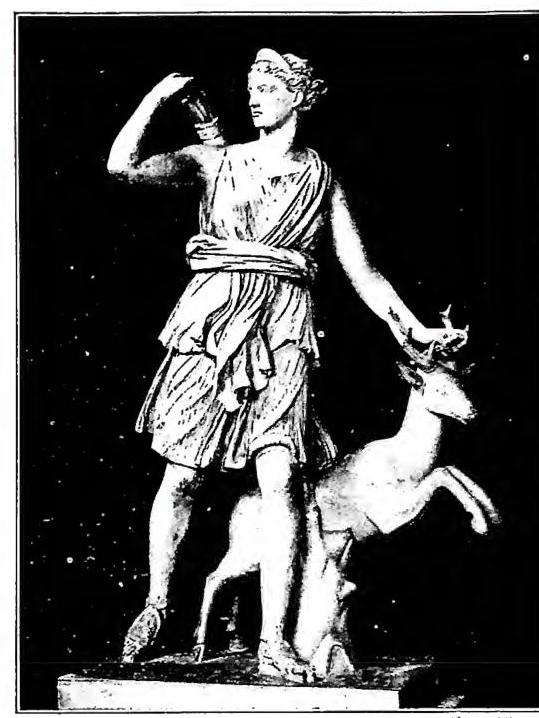
(Alinari photograph)
ARTEMIDE - The goddess in the guise of a huntress. Roman copy of a Hellenistic original - Paris, Louvre.
and a happy crossing: in this aspect she was celebrated at Athens during the Delphinia festival. She is a lunar goddess and has the torch and the crescent as attributes; according to some, indeed, this would be her original aspect, which would also appear in certain expressions of the Iliad; according to others, however, it is a late development and would have received impetus from her identification with Hecate. As a lunar goddess she exerted no influence on worship, but, from the Hellenistic period onward, on poetry and art.
The places of worship were numerous. Among the most interesting was that of A. Orthia at Sparta, built in a marshy place on the banks of the Eurotas; Orestes is said to have brought the image from Tauris. One of the rites that characterized it was the flagellation of boys, perhaps in substitution for ancient human sacrifices of an expiatory nature. Legend connected this sanctuary with those of A. Facelite at Reggio and Diana Aricina at Nemi. A recent attempt to associate A. Orthia with the goddess Rehtia of Este (Veneto), whereby the A. of Sparta would have the character of a healing goddess, is erroneous. Also characteristic of Sparta was the “festival of the nurses,” during which infants were offered to A. In central Greece the cult of A. Laphria was widespread; during her festivals, living animals—birds, wild boars, deer, wolves, bears, etc.—were thrown into the fire, and the priestess was carried on a chariot drawn by deer. In Arcadia A. was, together with Zeus Lycaeus, the ancestor of the Arcadians. At Athens A. Brauronia was celebrated; it had been introduced from nearby Brauron, where the tomb of Iphigenia was located, to whom the clothing of women who had died in childbirth was offered. Only women took part in the Brauronia festivals; the priestesses were girls between five and eight years of age, nicknamed “she-bears.” In Asia the sanctuary of Ephesus was famous; according to legend, it had been founded by the Amazons and possessed the right of asylum. It had great political and religious importance; a very numerous staff, priests and priestesses, depended upon II. The latter had to be mobile, and married women could not enter the temple. According to Act. 19, 24 ff., reproductions of the temple and the goddess were used as amulets. In March or April the Artemisia festivals were celebrated and, every four years, the “Great Ephesia.” A. Persica is important more for its artistic influence than for its cult.
Ancient art represented A. in many different aspects. The iconographic types are the huntress in a short chiton, armed with bow and arrows, accompanied by the dog and the doe; the lunar goddess with torch and patera; A. Persica or Taurica, often winged, in the act of grasping by the legs or the neck the animals over which she is mistress; and A. Ephesia, with a cylindrical body to which the numerous breasts were added in a later period, a reproduction of Oriental ornaments.