
DOGMATIC INSCRIPTIONS. — Epigraphic material can greatly assist in the knowledge of the life and thought of the ancient Christians, especially with regard to religious beliefs and dogmas in the strict sense. In this respect epigraphy is much more eloquent and explicit than the other archaeological sciences, e.g., iconography. But anyone who, following the ideas of the old archaeologists, believed that a true archaeological dogmatics could be reconstructed would be mistaken. Those who composed the early Christian inscriptions had absolutely no intention of enclosing in them a summary of Christian doctrine, nor did they have the opportunity to do so; consequently, it would be a waste of time to seek from them what they did not intend to give us. Nevertheless, it cannot be denied that Christian epigraphy as a whole marks an entirely new world of sentiments and ideas in contrast with the old pagan world; and even for the Protestants of the sixteenth century, especially with regard to the more radical aspects of that movement, such as Calvinism and Anabaptism, contact with the world of the catacombs must have produced the confused feeling of a religious life altogether different from that which they claimed to establish precisely by appealing to the origins.
The unity of God was an unquestioned belief among Christians, and it is therefore rare to see it affirmed on tombstones, as in Cassus Vitalio... qui in una Deu crededit, in pace (Diehl, no. 1596). Only in Syria and Egypt is the acclamation εἷς θεός frequent, often with the addition ὁ βοηθῶν, and sometimes with others such as μόνος, ὁ ζῶν, and the like (E. Peterson, ΕΙΣ ΘΕΟΣ, Epigraphische Untersuchungen, Göttingen 1926). The context clearly indicates its monotheistic meaning, although it is an adaptation of a similar formula used by the pagans, especially in honor of Serapis, with a henotheistic meaning. Professions of faith in the Most Holy Trinity are likewise not uncommon, whether in the individual Persons or in all three together; for example, the inscription of the little temple at Clitumnus, which emphasizes their specific activity: sanctus deus angelorum qui fecit resurrectionem, sanctus deus profetarum qui fecit redemptionem, sanctus deus apostolorum qui fecit remissionem (Diehl, no. 1606); and that beautiful inscription from Emmaus: ἐν ὀνόματι Πατρὸς καὶ Τίοῦ καὶ ἁγίου Πνεύματος, καλή ἡ πόλις χριστιανῶν (Revue biblique, 10 [1913], p. 100). Jesus’ divinity, messiahship, and other principal attributes are celebrated countless times, as in the famous monogram Ἰησοῦς Χριστοῦς Θ(εοῦ) Τ(ιὸς) Σ(ωτὴρ), and in the fine inscription recently removed from the Roman catacomb of Priscilla: Ἐρμάννη γλῶτι[τέστην]... ἐν Θεῷ Ἰησοῦ Χριστοῦς Ἰαπλε[τ] (Riv. di arch. crist., 21 [1915], p. 168). In the inscription which Pope Damasus dedicated in honor of the martyrs Felice and Filippo, also in Priscilla, a substantial part of the Christological creed appears in verse: qui natum passumque deum repetitus paternas[ sedes atque iterum venturum ex aethere credit, iudicet ut vivos redibus pariterque sepultos, martyribus sanctis pateat quod regia caeli[ respicit interior (A. Ferrua, Epigrammata Damasiana, Roma 1942, no. 39); in an inscription from Pannonia (CIL, III, 13382), the most ancient example of Jesus being proclaimed φῶς and ζωή has recently been recognized. The dogmas most frequently affirmed in the inscriptions are
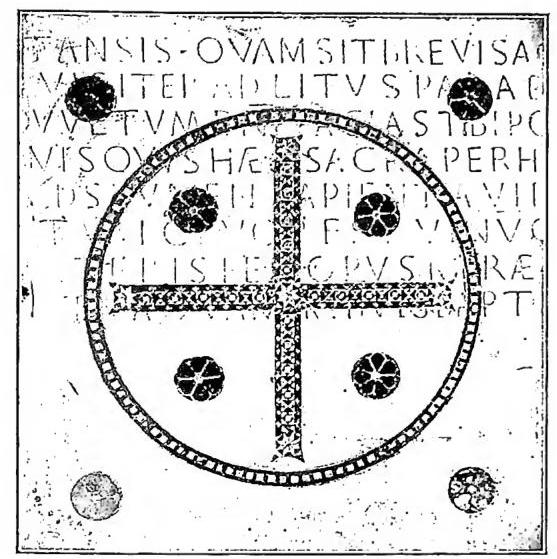
DOGMATIC, INSCRIPTIONS — Inscription referring to the Most Holy Eucharist — Verus in altari cruor est vinumque videtur — (5th–6th century) — Rome, basilica of S. Lorenzo fuori le mura.
those concerning the last things. First of all, hope in the Resurrection of the body, expressed, for example, in various epitaphs from Venna (in France) with the clause resurrecturus in Christo, cum sanctis, cum dies domini advenereit (Diehl, nos. 3468 A–4375), and in that beautiful one of the deacon Severus: corpus pace quietum/ hic est sepultum donec resurgat/ ab ipso, / qui animam rapuit Spiritu Sancto suo/ quamque iterum dominus spiritali gloria reddet (Diehl, no. 3458); and Pope Damasus, in his own epitaph, does nothing but enumerate some wonders wrought by the Lord, to conclude post cineres Damasum faciet quia surgere credo (A. Ferrua, op. cit., no. 12). While the souls of the just await reunion with their bodies in the final Resurrection, are they already admitted into Paradise or held in a kind of limbo? Among ecclesiastical writers there is considerable uncertainty on this point; but epigraphy demonstrates that the body of the faithful believed in immediate recompense. They always speak of their dead as though they were already blessed or were soon to become so in Deo, ad Deum, in Christo, apud Deum, as in the case of Junius Bassus, prefect of Rome in 359, who neofitus iit ad Deum, and of a certain Gentianus fidelis, of whom it is said roges pro nobis quia scimus te in Christo (Diehl, nos. 90 and 2350). Simple believers are spoken of as martyrs, to whom all granted the immediate beatific vision; hence they are said to live with the saints, to be in the regia caeli, to enjoy praemia lucis, to have arrived at heaven and the heavenly kingdoms, or, as Damasus says of his father, non timni mortem caelos quod liber adiret (A. Ferrua, op. cit., no. 11); and descriptions of this abode are sometimes given that cannot refer only to limbo. On the occasion of deaths, belief in the communion of saints and in the efficacy of prayers of intercession is repeatedly expressed. Prayers are requested from the dead who are with God, and God and the holy martyrs are prayed to on their behalf and on behalf of the living; for example: Vincentia in Christo; petas pro Phoebe et pro virginio eius (Diehl, no. 2336); domina Bassilla commendamus tibi Crescentinus et Micina filia nostra (Diehl, no. 2379); and a deceased woman from the cemetery of Priscilla left written: vos precor, o fratres, orare hoc quando venitis/ et precibus totis Patrem Natumque rogatis,/ sit vestrae mentis Agapes cara[e] meminisse, /ut Deus omnipotens Agapeu in succula servet (Diehl, no. 2392). Very many examples of prayers to the holy martyrs, of confidence in their intercession, and of proximity to their relics have been collected by Fr. Delehaye (Les origines du culte des martyrs, 2e ed., Bruxelles 1933, pp. 100–40; cf. also Diehl, nos. 2323–82 and 2126–87).
These and similar texts also shed light on the very lively cult shown by the faithful toward the holy martyrs and their relics, and also toward the angels. In particular, epigraphy also comments on the use of medals, little crosses, and reliquaries worn on the person. Highly indicative of the cult of the angels are a long inscription from the theatre of Miletus with prayers to the seven archangels and the clause ἀρχάγγελοι φυλάσσετε ἡ πόλις Μιλισίων καὶ πάντες οἱ κατ[ο]κοντες, and the many funerary inscriptions from the island of Tera, each dedicated to an angel (A. Ferrua, Gli angeli di Tera, in Orient. Christ. periodica, 13 [1943], pp. 149–67).
Countless texts illustrate the constitution of the Church. Abercio (v.) attests its unity in its diffusion, with the same faith and the same Eucharist, and the incomparable pre-eminence of the Roman See; the divine fecundity of the Ecclesia mater is expressed in this way by the inscription of the Lateran Baptistery: virgineo faetu genetrix Ecclesia natos, quos spirante Deo concipit amne parit (Diehl, nos. 1513 and 1582); it is founded upon S. Pietro, to whom dominus legem dat, as he had once given it to Moses on Sinai, and upon the supreme power of the keys, thus illustrated in an epigraph by Bishop Spes of Spoleto: solve iubente Deo terrarum Petre catenae/ qui facis ut pateant caelestia regna beatis (G. B. De Rossi, Inscr. Christ., II, Roma 1888, p. 80, no. 12), and in another from the basilica of S. Paolo fuori le mura: ianitor hic caeli est, fidei petra, culmen honoris (Diehl, no. 1761). The coming and death of S. Pietro at Rome have also recently been confirmed by the graffiti brought to light beneath the basilica of S. Sebastiano and by the Vatican discoveries. The ecclesiastical hierarchy appears in epigraphy in all its degrees from the earliest period, including the lower degrees of the minor Orders and certain offices for women, such as those of deaconesses (Diehl, nos. 951–1326; C. Kaufmann, Handbuch der altchristlichen Epigraphik, Friburgo in Br. 1917, pp. 233–94); the same may be said of male and female monastic institutions, and of the higher rank of the virgines consecratae.
But perhaps the dogmas most often professed in inscriptions, after the last things, are the Sacraments, especially Baptism. Of the Eucharist there are eloquent testimonies both in the already-mentioned epitaph of Abercio and in that of Pettorio of Autun (M. Guarducci, L'iscrizione di Pettorio, in Rend. Pont. Acc. di arch., 23 [1947–48]), and still more in an epigraph now affixed to the ceiling of the crypt of S. Lorenzo: verus in altari cruor est vinum(que) videtur (in Nuovo Bull. di arch. christ., 17 [1921], p. 106). Baptism is very frequently mentioned with the formulas accipere, consequi, percipere Dei gratiam and many other expressions more specifically connected with the ceremony. From these one learns of the practice of baptizing children at an early age and of receiving baptism as adults on the deathbed, practices that coexisted throughout antiquity. Thus Junius Bassus in ipsa praefectura urbi neofitus iit ad Deum, and the little boy Maurus annorum quinque... bimus trimus consecutus est P (Diehl, nos. 9 and 1527). Baptism was especially regarded as an illumination; hence those who in Latin were generally called neophyti were called in Greek νεοφώτιστοι. Several inscriptions placed in baptisteries describe admirably the theology and effects of Baptism. That of the Lateran Baptistery already cited (Diehl, no. 1513) is certainly the most eloquent, and thus expresses itself concerning original sin: insons esse volens isto mundare lavacro/ seu patrio premeris crimine seu proprio. Confirmation is often mentioned together with Baptism, with which it was received, and is called signum Christi, σφραγίς, consignaris, σφραγοθῆναι. A certain Picentia Legitima boasts of having been consignata by Pope Liberius; of Julius Catervius ex praefecto praetorio and his wife Severina it is said quos Dei sacerdos Probianus lavit et unxit (Diehl, nos. 965 and 98), and Marea, the vicar of Pope Vigilius, declares himself an advocate of the indelibility of the Sacrament: tuque sacerdotes docuisti crismate sancto/ tangere bis nullum indice posse Deo (Diehl, no. 989). There are only rare and late references to Penance and Extreme Unction; Orders have been discussed in connection with the hierarchy; Marriage as a sacrament has few but interesting epigraphic testimonies, such as that for the aforementioned spouses Catervius and Severina: « quos paribus meritis iun-
xit matrimonio dul-
ci/ omnipotens do-
minus, tumulum cu-
stodit in aevium.
Inscriptions in which a profession of heresy is made are also of a certain dogmatic interest. A number of these have appeared in Africa (Donatists and Montanists), Rome (Gnostics and Montanists), Asia Minor (Novatians), and Syria (Monophysites).