Machine translation of the 1948–1954 Italian original. The original text is authoritative.
CRONO. — Greek god, for some pre-Hellenic, or originating in Asia Minor, where he would have to be identified with Baal; but every hypothesis concerning his origin and nature is uncertain. He has no cults; he is known only from mythology.
Hesiod makes him the son of Gaia and Uranus, whom he mutilated in order to free his mother. By Rhea he had numerous children, whom he devoured for fear that they would take his throne from him. Zeus forced him to disgorge them, defeated him, and shut him up in Tartarus. According to others, C. became king of the islands of the blessed. Already in Hesiod his reign is that of innocent happiness, the golden age. The Romans identified him with Saturn.
BIBL.: U. V. Wilamowitz-Moellendorf, Kronos und die Titanen, Berlin 1929; K. Marot, Kronos und die Titanen, in Studi e materiali di storia delle religioni, 8 (1932), p. 48 ff.; F. Dornseiff, Altoriental, in Hesiodi Theogonia, in L'antiquité classique, 6 (1937), p. 248 ff.
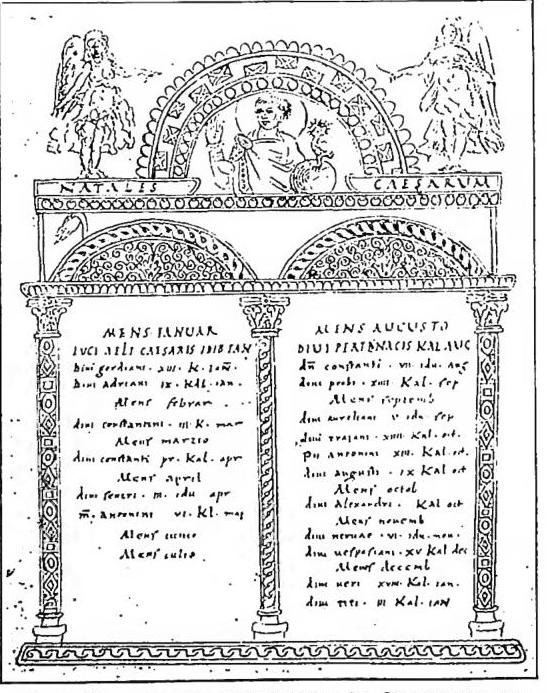
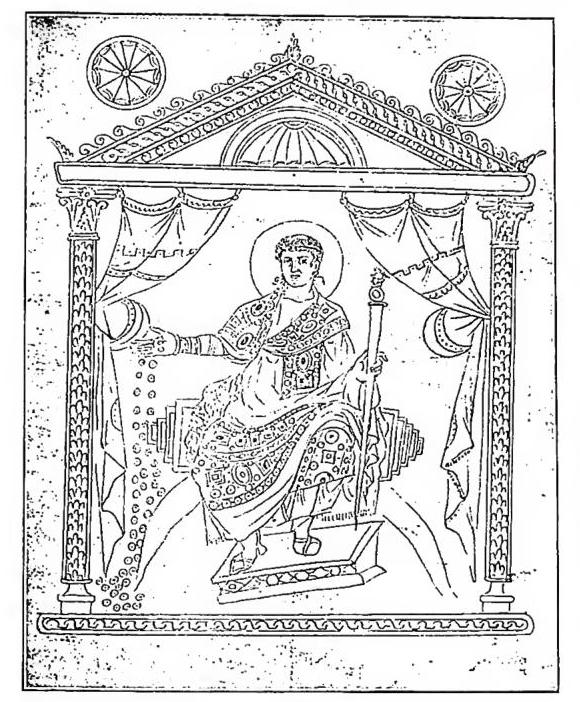
CRONOGRAFO dell'a. 354. — This is the title given to an important collection consisting of a calendar and other historical-chronological documents assembled together in that year, although several of them betray a considerably earlier composition or were subsequently continued and updated. The calendar is official in character, neither pagan nor Christian, and consists of an astrological and a civil section.
It is adorned with many figures and comprises: 1) on the first page, the dedication Valentine lege feliciter, vivas, gaudae, floreas in deo; Furius Dionysius Filocalus titulavit, which must designate not only the decorator of the booklet but also its compiler or author. The Valentinus for whom it was intended seems to have been the tribunus protectorum ex primicerio, who in 349 was dux Illyrici and in 365 became consularis Piceni (v. FILOLOGIA). 2) A list of the consuls up to the year 354, the most accurate and complete of all, also called Anonymus Norisianus after its first editor Enrico Noris (Florence 1689), which depends upon the same source as the Fasti Capitolini. 3) An Easter canon calculated initially from 321 to 354 and then extended to 412, with many errors of calculation after 359. 4) A list of the prefects of Rome from 254 to 354, together with the consular Fasti for the same years. 5) The Depositio episcoporum (v.) and the Depositio martyrum (v.), that is, a list of martyrs and popes venerated in Rome. 6) The list of popes up to Liberius, hence commonly called the Catalogo Liberiano (v. CATALOGHI DI PAPI E DI VESCOVI). 7) The Fasti consolari of Rome in two versions. One, extending from Caesar to 539, is found immediately after the calendar and is lacunose and disorderly; the other contains a list of kings followed by annals from Caesar to 403 and from 455 to 496. It is called Anonymus Cuspiniani after its first partial editor Giovanni Cuspiniano (Basel 1553), or also Consularia rovennatis, after the city where it was at least partly compiled. It is evident that it did not originally form part of the compilation of the C. Mommsen calls them Annales and Fasti Vindobonenses. 8) This is followed by a universal chronicle under the name of Chronica Horosii, composed in 334, with reference to biblical history. It is a version of a chronicle of Hippolytus (v.), which also occurs in the Liber genealogus, in the so-called Fredegarius (v.), in the Chronicon paschale (v.) or Alexandrinum, in the Liber generationis, and in the Anonymus or Barbarus Scaligeri (v. BARBARUS). 9) A chronicle of the kings and dictators of Rome and then of the emperors from Caesar to the death of Licinius. It derives chiefly from Suetonius. 10) A description of Rome by regions, certainly drawn up after 334, which, together with the Curiosum urbis Romae, which derives from a similar
(from J. Strygowski, Die Kalenderbilder des Chronographen vom Jhr. 24, Berlin 1885)
source, is the principal documentation for knowledge of the ancient topography of Rome.
BIBL.: The parts of the rich compilation of the C. are now scattered among various codices, all of which must derive from an eighth-century codex from Luxembourg, now lost. They were edited by Th. Mommsen, Über den Chronographen vom Jahre 354 (Abhandlungen der Königl. Sächs. Gesell. der Wiss.; Phil.-Hist. Kl., 1), Berlin 1850, p. 607 ff., and again in MGH, Auctores antiquissimi, IX, 1, except for the calendar, published in CIL, I, 254 (the figures by I. Strzygowski, Die Kalenderbilder des Chronographen vom Jahre 354, Berlin 1888), and the regionary, published by H. Jordan, Topographie der Stadt Rom, II, Berlin 1871, p. 539, and R. Valentini-G. Zucchetti, Codice topografico della città di Roma, I, Rome 1940, p. 63 ff. Antonio Ferrus
Cite this article
“CRONO.” Enciclopedia Cattolica, vol. IV (1950), p. 598. Azione Romana digital edition, https://azioneromana.com/article/crono.