
CATALOGHI DI PAPI e DI VESCOVI. — From an early period, individual churches began the practice of keeping an official list of the succession of bishops. At issue was the necessity of making no mention of bishops who had defected from the faith or who had been excluded as usurpers.
There is evidence as early as the 3rd century of the practice of reading such catalogs during the sacred liturgy; they were written in special «diptychs» (v.), and the inscription or removal of names from these diptychs constituted the official recognition or denial of the legitimacy of individual bishops (F. Cabrol, s.V. in DACL, IV, cols. 1045–94).
I. C. d. p. — Beginning in 1947, the c. d. p. has been critically compiled in the Annuario pontificio. The many catalogs transmitted over the centuries, the work of private compilers, present discrepancies in the number of names, in the inclusion or exclusion of names, and in the chronology itself. This is due to deficiencies in the positive data or in criticism; to the reality of situations confused by contested elections, schisms, and depositions; to the different ways of dating the beginning of a pontificate; and all this entails delicate canonical as well as historical problems. Uncertainties in certain details, however, do not invalidate the uninterrupted succession of the popes from the apostle Peter in the Roman see.
The oldest known catalogs are those compiled by Irenaeus (Adv. haer., III, 3, 3) and Hegesippus (Eusebius, Hist. eccl., IV, 22) in the controversy with the Gnostics. They are lists of names without chronological indications. Gathered from local tradition (as Hegesippus states), they attest to the existence and use in Rome around A.D. 150 of a catalog, probably written and used in the liturgy. According to E. Caspar, it lacked indications of the duration of the pontificates, but the succession of names was stable, so as to provide a chronological basis for dating ecclesiastical events otherwise undated (for example, the arrival and activity of heretics in Rome), which were associated with the name of a pope (Irenaeus, Adv. haer., III, 4, 2–3).
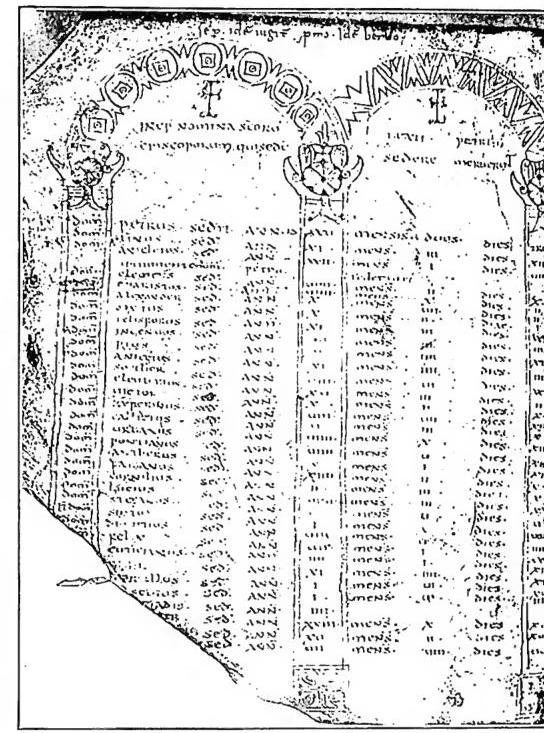
(from M. Besson, St Pierre et les origines de la primauté romaine, Gnerera IeD, p. III)
CATALOGHI DI PAPI - C. of the first bishops of Rome (fifth–sixth centuries) Cologne, Cathedral Library, cod. 212, fol. 168.
In his Ecclesiastical History and Chronicon, Eusebius reports two lists that agree in the identity and succession of the names but differ in the number of years assigned to each; the Liberian Catalogue, besides indicating the duration of the pontificates in years, months, and days, and, from 135 onward, also the date of ordination, presents a variant in the names. Whereas Eusebius has: Linus, Anacletus, Clement, Evaristus..., the Liberian has Peter, Linus, Clement, Cletus, Anacletus, Evaristus. The duplication of Cletus–Anacletus (Cletus, the Western form of Anacletus) and its placement after Clement are due to the chronological difficulties of the compilers of the Liberian, as are the inversion of Anicetus–Pius among the popes of the second century and the supposed duplication of Marcellinus–Marcellus in the time of Diocletian, to cover a vacancy of the Roman see lasting several years. These errors passed from the Liberian into other catalogues and especially into two collections that preserved influence until the last century: the portraits in the basilica of S. Paolo and the Liber Pontificalis.
The portraits of S. Paolo in the oldest series date from the fifth–sixth centuries and, with the inclusion of the antipope Lawrence (early sixth century), reflect the struggles of the period; in the inscriptions, however, they reflect later influences.
The Liber Pontificalis expands the data of the Liberian in order to provide biographical information about the popes. Composed at the beginning of the sixth century, in compiling the older notices it did not escape the controversies aroused by the Laurentian schism; but it is accurate concerning contemporary events, and, having met with approval, it was continued.
In the sixth–ninth centuries, the additions made by clerics of the Curia—some while the popes were still living—with the aid of the papal archives are important and, in general chronology, accurate. For a certain period (ninth–tenth centuries), the Liber Pontificalis was reduced to little more than a list added subsequently; this allowed that confused period to include a Donus II (973) who never existed, and, in some codices, also the female pope Joan. With Leo IX (1049), the more extensive biographies resumed. Written by different authors, they were assembled as a continuation of the Liber Pontificalis in the twelfth century.
A similar work was carried out in the fourteenth and fifteenth centuries, reaching as far as Pius II (1464). The Vitae pontificum of Platina then appeared, an elaboration of the Liber Pontificalis without excessive critical pretensions. In the following centuries O. Panvinio, C. Baronio, and many others concerned themselves with the c. d. p. In 1751 C. Marangoni published a Chronologia romanae pontificum, deriving it from the oldest series of portraits of S. Paolo; this passed into the yearbooks: Notizie per l'anno... (1818–1860), Annuario (1863–70), the Gerarchia cattolica (1873–1903), Annuario pontificio (1913–46).
In the nineteenth century, historical criticism introduced new methods into research and produced new results. L. Duchesne’s masterful edition of the Liber Pontificalis, richly annotated, provided the basis for a critical catalogue which, generally accepted by scholars, has today, with the clarifications of A. Mercati, entered into use in the Roman Curia.
II. C. d. V. — Like Rome, the other episcopal cities soon had their own catalogue, for liturgical purposes in the diptychs and later for historical purposes, with chronological indications. Irenaeus considered it easy to establish one in his time, but reports only the Roman catalogue. Eusebius, drawing on Hegesippus and Julius Africanus, reports those of Jerusalem, Antioch, and Alexandria. In the sixth–seventh centuries and thereafter, the ambition to trace their origins back to an Apostle or a disciple of the Apostles altered many catalogues with fictitious names (the Apostle Andrew as bishop of Byzantium, bishops of Italy and France sent by S. Peter, etc.), repeated with approval in subsequent centuries; v.: APOSTOLICITÀ DELLE CHIESE.
The example of the Roman Liber Pontificalis, imitated by other cities, produced the Liber Pontificalis Ecclesiae Ravennatis (ninth century), Eichstettensis (eleventh century), etc., and the Gesta episcoporum, much in use during the medieval period. With Humanism came many local or diocesan histories, which, through local patriotism, favored the ancient legends. In the seventeenth and eighteenth centuries came the great erudite works of the Maurists, Gallia Christiana, and of F. Ughelli, Italia sacra, still useful but insufficient.
The episcopal sees of Italy go back to great antiquity, but the scanty notices of ancient writers, the few certain data from martyrologies and the Passiones, the subscriptions of bishops to synods, and the relatively few surviving liturgical diptychs do not make the compilation of catalogues easy. Ughelli, with Italia sacra (9 vols., Rome 1644–48), produced it amid many defects and errors, eliminated in small part by N. Coleti in his greatly expanded and corrected edition (Venice 1717–1733), and by L. Cappelletti with Le Chiese d'Italia (21 vols., ibid. 1844–70). F. Savio opened new paths with Gli antichi vescovi d'Italia dalle origini al 1300, limited by his death to Piedmont and Lombardy. Narrowing the field, F. Lanzoni, with Le diocesi d'Italia dalle origini al principio del sec. VII (604), completed Savio’s design for the whole of Italy.