
GALLIA CHRISTIANA. — Abbreviated title of the very well-known work in 13 folio volumes on the bishoprics of ancient Gaul, published in the eighteenth century by the Benedictines of the Congregation of St-Maur (Maurists). The bishoprics are arranged according to the ecclesiastical provinces, listed in alphabetical order following the initials of their Latin names. A complete list of the dioceses contained in the G. C. is found in the Catalogue alphabétique des livres imprimés mis à la disposition des lecteurs dans la salle de travail, suivi de la liste des catalogues usuel du département des manuscrits (4th ed., Paris 1933; cf. also P. B. Gams, Series Episcoporum Ecclesiae catholicae, Regensburg 1873, pp. 476–658). Each province is given a general historical account; each diocese then has its own historical account, the chronology of its bishops and dignitaries, and information on the abbeys established within its territory. At the end of the volume, the instrumenta, or supporting documents, are reproduced. The work, despite the gaps, errors, and defects found in it, is a monument of erudition and a working tool that remains indispensable today to historians of Christianity in Gaul. Mons. L. Duchesne, in his three volumes of the Pastes épiscopaux de l'ancienne Gaule (Paris 1907–1910–15), revised, with his extensive and reliable scholarship, the episcopal lists of the G. C. from their origins through the entire ninth century, sifting them of the dross left in them by the meritorious Maurists.
(for a handwritten label, A. P. Frutes)
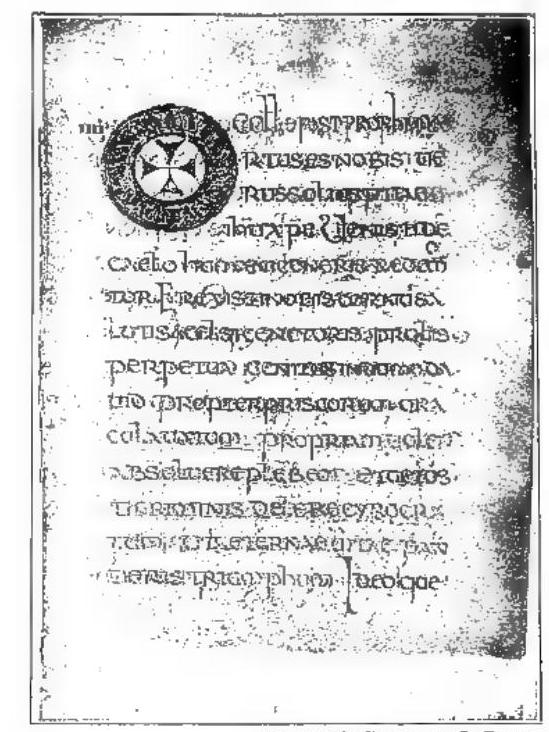
GALLICANA LITURGIA - Miracle Gallicum (7th century–beginning of the 8th century) - Collectio post prophetis - of the Christmas Mass. Vatican Library, cod. Regiments 217, fol. 6.
Paris 1621); the priest Claude Robert, who published G. C. in qua Regni Franciae, ditionumque vicinarum dioecese, et in iis proscales, describuntur (1 vol. in-fol., ibid. 1626; it should be noted that he was the first to use the expression G. C.); and, above all, the twin brothers Scevola and Ludovico di Sainte-Marthe (Sammartani), to whom Robert entrusted the task of preparing the second edition of his work. The two scholars died at their posts, but their work was published by Scevola’s sons, Pietro, Abele, and Nicola: G. C., qua series omnium archiepiscoporum, episcoporum et abbatum Franciae vicinarumque ditionum, ab origine ecclesiarum ad nostra tempora per quatuor tomos deducitur et probatur ex antiquae fidei manuscriptis Vaticani, regum, principum, tabularis omnium Galliae Cathedralium et abbatiarum (2 vols. in-fol., ibid. 1656).
Given the usefulness of the G. C. of the Sainte-Marthe brothers, the general assembly of the French clergy of 1710 invited dom Denis de Sainte-Marthe (Sammartana), of the Benedictine Congregation of St-Maur, to resume the work on a broader basis. The learned Benedictine accepted the assignment and, assisted by various confrères, especially dom Claude Estiennot and dom Jean Thiroux, began publishing the new G. C. in 1715, with the volume containing a lengthy preface on the plan of the work and on the introduction of Christianity into Gaul, as well as the episcopal lists of the ecclesiastical provinces of Albi, Aix, Arles, Avignon, and Auch: G. C. in provincias ecclesiastica distributa qua series et historia archiepiscoporum, episcoporum et abbatum Franciae vicinarumque ditionum ab origine ecclesiarum ad nostra tempora deducitur, et probatur ex authenticis instrumentis ad calcem appostis (ibid. 1715; it should be noted that from vol. V, after abbatum, one reads: regionum omnium quas vetus Gallia complectebatur); vol. II is devoted to the provinces of Bourges and Bordeaux (ibid. 1720); vol. III to the provinces of Calais, Cologne, and Embrun (ibid. 1725, the year of dom Denis’s death); vol. IV to the province of Lyon (ibid. 1728); vol. V to Mainz and Malines (ibid. 1731); vol. VI to the province of Narbonne (ibid. 1739). With this volume, dom Félix Hodin and dom Etienne Brice assumed direction of the work; vols. VII and VIII concern the province of Paris (ibid. 1744); vols. IX and X the province of Reims (ibid. 1751). The work was delayed by the deaths of the two directors in 1755; vol. XI, concerning the province of Rouen, appeared under the direction of dom Pierre Henri and dom Jacques Taschereau (ibid. 1759); vol. XII concerns the province of Sens and Tarentaise (ibid. 1770), and vol. XIII the provinces of Toulouse and Trier (ibid. 1785).
The Revolution interrupted the work: in 1790 the supporting documents for vol. XIV, devoted to the province of Tours, were being printed. It was completed by the lay scholar Barthélemy Hauréau, who published vols. XIV, devoted to the province of Tours (ibid. 1856); XV, devoted to the province of Besançon (ibid. 1860); and XVI, devoted to the province of Vienne (ibid. 1865). These three volumes were called Gallia profana by the priest Tresvaux (Revue des questions historiques, 11 [1872], p. 210), on account of the secular spirit in which they were composed.
Dom Paul Piolin undertook to publish a second edition of the thirteen volumes edited by the Maurists, but his work did not improve the publication. Of the G. C. (same holdings as above), Editio altera labore et curis Domini Pauli Piolin recentita et aucta, only vols. I–V, XI, and XIII were published in Paris between 1870 and 1877; the other volumes were reprinted in facsimile by the publisher H. Welter (ibid. 1899). Canon J.-H. Albanès set out to correct the blunders that had escaped the first authors of the G. C. with his G. C. novissima, subsequently published by his friend U. Chevalier. The idea, excellent in itself, resulted, owing to the author’s death, in a miscellany practically useless to scholars. The volumes of the G. C. novissima number seven (in-4 format) and concern Provence: vol. I is devoted to Aix, Apt, Fréjus, Gap, Riez, and Sisteron (Montbéliard 1899); vol. II to Marseille (ibid. 1899); vol. III to Arles (ibid. 1901); vol. IV to Saint-Paul-Trois-Châteaux (ibid. 1909); vol. V to Toulon (ibid. 1911); vol. VI to Orange (ibid. 1916); and vol. VII to Avignon (ibid. 1920). H. Fisquet published in Paris, between 1863 and 1869, in 22 undated volumes, a free version of the G. C., with additions concerning the modern condition of the dioceses, under the title France pontificale (Gallia Christiania), histoire chronologique et biographique des archevêques et évêques de tous les diocèses de France, depuis l'établissement du Christianisme jusqu'à nos jours, divisée en dix-huit provinces ecclésiastiques (Paris). None of the projects proposed for a complete rewriting of the G. C. has so far met with happy results.