
NARBONA. – Ancient diocese and city in southern France, capital of an arrondissement in the department of Aude. First occupied by the Ligurians, Iberians, and Celts, N., under the name of Narbo Martius, was the first Roman colony in Gaul and
became the capital city of Gallia Narbonensis Prima throughout the Roman period. Under Claudius it assumed the name Colonia Iulia Paterna Claudia Narbo Martius. A fire devastated it, and it was restored by Antoninus Pius, but as early as the third century it was no longer so prosperous. Antonius and Sidonius Apollinaris, however, praised its public buildings.
With the conquest of 413, N. became part of the Visigothic Kingdom until 759. In the sixth century N. was still a flourishing colony of merchants from Syria; canons 4 and 14 of the Council of N. in 589 mention among its inhabitants Goths, Romans, Syrians, Greeks, and Jews. It then passed to the Carolingians, and thereafter to the Capetians, and from them to the counts of Toulouse, who became dukes of N. It subsequently belonged to the house of Foix until 1509, when it passed definitively to the French Crown. It gave its name to the ecclesiastical province of Narbonensis, more or less corresponding to the civil province of the time of Honorius, and included the territories of five cities: N., Nimes, Toulouse, Lodève, and Béziers. Following the conquests of Charlemagne and Louis the Pious, the territories of the dioceses of Urgel, Vich, Gerona, and Barcelona, and later those of Ampurias and Egara, were annexed to France; on passing under the province of N., they remained there until the end of the eleventh century.
Paul is the first known bishop, mentioned in the Hieronymian Martyrology on 22 March and assigned by Gregory of Tours to the middle of the third century (Historia Francorum, I, 30). Prudentius seems to number him among the martyrs (Peristephanon, IV). Bishop Hilary is mentioned in letters of Popes Zosimus and Boniface (Jaffé-Wattenbach, pp. 332, 349, 362). Rusticus (426–61) is attested by inscriptions (CIL, XII, 5336–38) and by letters of Popes Sixtus III and Leo I (Jaffé-Wattenbach, pp. 434–79, 480, 544). His successor was Hermes, who was nevertheless deprived of the rights of metropolitan by Pope Hilary (ibid., 554–55). Megethius took part in the Councils of Toledo in 589 and 597; at the beginning of the seventh century there was Bishop Sergius, followed by Selva, present at Toledo in 633 and 638, where Scunifredus attended in 683, 684, and 688. Bishop Daniel took part in the assembly at Rome in 769; Nebridius attended those at Urgel in 799 and 800; Bartholomew attended that at Toulouse in 828, but was deposed in 835.
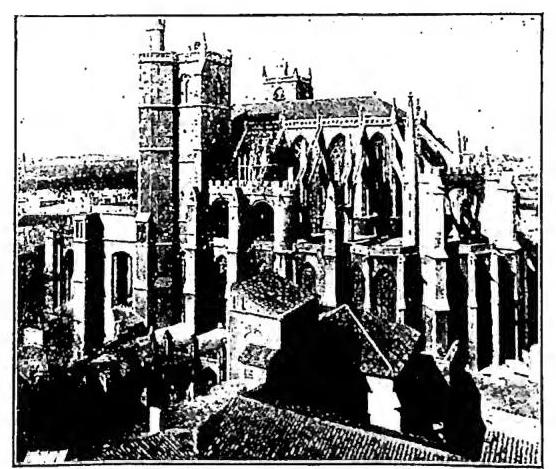
(from R. Reg. L'Art gothique du Midi de la France, Paris 1931, p. 193) NARBONA – South side of the Cathedral (late thirteenth century).
Clement IV (1265–68), and Giulio de Medici, later Clement VII (1523–34).
The diocese, suppressed in 1790 by the French Revolution, was united by Pope Pius VII, under the Concordat of 1801, with the diocese of Toulouse; in 1822 he added to the archbishop of Toulouse the title of bishop of N. From the inscription of Bishop Rusticus (CIL, XII, 5336) it can be inferred that the Cathedral rebuilt in 445 replaced, on the same site, the one that had burned down and perhaps dated from the fourth century. The text is highly important because it records the demolition of the walls of the old church, the laying of the foundation stone, when the apse was completed, the participation of the prefect of the Gauls at the time, Marcellus, «devoted to the worship of God», who paid the workers during the two years of his administration, and records offerings received from other bishops. The inscription was placed in the Cathedral by Cardinal de Bonzy in 1681 and is now in the Lamourgnier Museum. The present former Cathedral, dedicated to St. Justus and begun in 1272, remains unfinished.
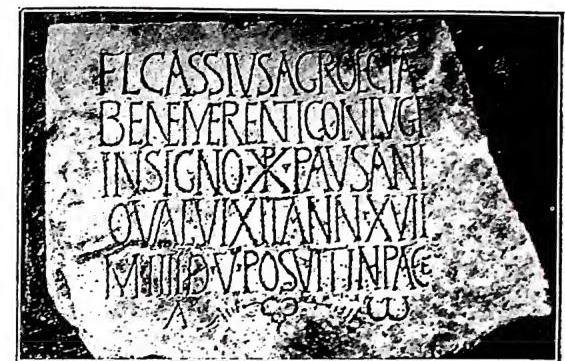
There are the tombs of Archbishop B. de Farges (d. 1341), Cardinals Peter la Jugie (d. 1376) and Briçonnet (d. 1514), and Archbishop L. de Vervins (d. 1628). The treasury preserves Flemish and Aubusson tapestries; fourteenth-century polychrome stone statues of the Apostles Peter and Paul; an eleventh-century missal and evangelary; Cardinal Jugie’s pontifical; and a twelfth-century ivory cover for a liturgical book, with eight scenes from the life of Jesus Christ and his Crucifixion at the center. Of the eleventh-century Cathedral, only the bell tower remains; the site is now occupied by the cloister (1350–1417). The church dedicated to St. Sebastian, a native of Narbona, was erected by Archbishop J. D’Arcourt (1436–51) on the site of an oratory that, according to tradition, had stood over his ancestral home. The church (fourteenth century) of the former Benedictine priory of Lamourgnier, or la Mourgnie, in the eleventh century, has now been converted into a lapidary museum; its epigraphic collection is rich, including the inscription of Agroeccia from the fourth century. The church of St. Paul rises above an ancient oratory near the Via Domiziana, in the locality then called ad albolas, where an ancient Christian cemetery was formed; from it came the sarcophagi now preserved in the Gothic church which, begun in 1224, became a collegiate church. A fire devastated it in 1364; it was extended in the fifteenth century and reinforced in the sixteenth and nineteenth centuries. Excavations begun in 1948 have brought to light numerous sarcophagi from the fourth and fifth centuries. The tomb of St. Paul was venerated in the fourth century; from Prudentius we know that Paul had become the glory and ornament of the province. «Surget et Paulo speciosa Narbo» (Prudentius, Peristephanon, IV, 34). The Hieronymian Martyrology mentions Paul on 22 March. Gregory of Tours recalls him among the group of seven bishops who are said to have evangelized Gaul in the middle of the third century (Historia Francorum, I, 38: PL 71, 175–76). Excavations carried out since 1942 have demonstrated the existence of a cemetery around the venerated tomb; coins of Constantine II were found in the sarcophagi. In the locality of St-Loup-
an ancient Christian cemetery was discovered, with a funerary chapel dedicated to Bishop Rusticus.
The former archbishop’s palace is now used as a town hall and museum. The latter contains the Library and a collection of Roman, Christian, Visigothic, and medieval inscriptions; one of the finest collections in France of ceramics from antiquity, and paintings from French, Italian, and Flemish schools. It also contains a reproduction of the aedicule enclosing the Holy Sepulchre as it existed at the time of the Crusades. Several Christian funerary inscriptions bear the dates of the years 508 (CIL, XII, 5339), 527 (ibid., 5340), 541 (ibid., 5344), 568 (ibid., 5344), and 593 (ibid., 5345); in a seventh-century inscription, the presbyter Adroarius commends himself to all who will enter the church; one mentions a subdeacon named Adelphus (ibid., 5346), and another a Maria abbatissa (ibid., 5352). The Christian sarcophagi of N. were first studied by E. Le Blant and subsequently by G. Wilpert (Sarcofagi, vol. 26, 3; 45, 2; 106, 1; 122, 2; 124, 3; pp. 38, 116, 118, 124, 128, 167, 188). The Library of N. preserves Merovingian capitals reproducing Roman models (D. Fossard, Chapiteaux mérovingiens, in Cahiers archéologiques, 2 [1947]).