
NANCY, DIOCESE of — City and episcopal see, capital of the department of Meurthe-et-Moselle, formerly capital of the Duchy of Lorraine. The diocese comprises the whole of the said department, with approx. 55,000 inhabitants. It has 29 deaneries, 324 titular parishes, 303 annexed parishes, and 5 auxiliary chapels, served by 530 diocesan priests and 40 religious; it has two seminaries, one major and one minor. The patroness of the diocese is Notre-Dame under the invocation of the Assumption.
N. was originally a Celtic settlement; it appears for the first time in a diploma of the Emperor Otto dated 3 Aug. 947; it belonged to the Kingdom of Lotharingia. The city consists of the Vieille ville, which developed around the Palace of the Dukes of Lorraine, and the Ville neuve, created in 1587 by Duke Charles III. N. remained a modest borough even when, in the 11th century, the dukes of Lorraine erected their castle there, «castrum Nanceium»; it began to develop in the 13th and 14th centuries. In 1428 Duke Charles II received Joan of Arc there; in 1475 it was occupied by Charles the Bold, but was immediately reconquered by Duke René II of Vandémont; the victory was commemorated by the erection of the Cordeliers chapel in 1480. In the 16th century the arts flourished at the court of the Dukes of Lorraine; the Ducal Palace was erected and the two villes were united. But in 1633 the dukes were driven out by the King of France and returned only in 1697, through the Treaty of Ryswick, which nevertheless made N. an open city. Through his marriage to Maria Theresa, Duke Leopold became emperor, and Stanislaus Leszczyński, King of Poland, succeeded him at N.; he embellished the city (Place Stanislas). In 1597 Duke Charles III of Lorraine had asked Clement VIII for the creation of the diocese of N., but the Pope granted only a primatial church with a prelate bearing the title of primate and episcopal insignia, without, however, granting him jurisdiction. The diocese was instead created by Pope Pius VI through the dismemberment of the diocese of Toul, by a bull of 19 Nov. 1777, as the primatial see of Lorraine and a suffragan of Besançon, as it still is today. The Concordat of 1801 Toul (v.) and N. then included, in addition to the department of Meurthe, those of Meuse and Vosges, which were detached from it in 1822. In 1824 the bishop of N. received the title of bishop of N. and Toul. The first bishop of N. was L. De la Tour Dupin Montauban in 1777; in 1787 A.-L.-E. de La Fare, later a cardinal; C. Forbin Janson (v.) was the first bishop of N. and Toul (1824–44); afterward there were Mgr. Darboy (1853–63) and the future cardinals Lavigerie (1863–67) and Foulon (1867–82).
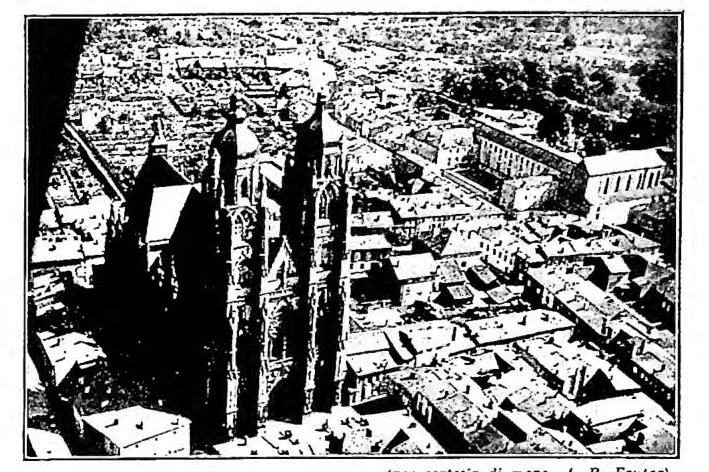
The Cathedral was begun in 1703, according to a design by G. Betto, which H. Mansart modified, and it was completed
Since 1824 N. has had an «Ecole nationale des eaux et forêts»; it has been a university center since 1854; and it also possesses an «Ecole supérieure de commerce» and various museums.
The Municipal Library of N. preserves a cameo with the apotheosis of Hadrian, belonging to a reliquary destroyed in 1792 that had been offered by King René and Joan of Laval to the church of St-Nicolas-du-Port (L. Germain, Le camée antique de la Bibliothèque de N., in Bulletin monumental, 49 [1883], pp. 458–64).
A Merovingian cemetery, in use from the 5th century to 751, was discovered near St-Jean-du-vieil-aitre (atrium). Gregory XIII, by a bull of 5 Dec. 1572, established the University at Pont-à-Mousson; the Faculties of theology and arts were entrusted to the Jesuit fathers. Queen Mary Stuart founded in the same city a seminary for 24 Scottish and Irish students. St. Peter Fourier was also a student there.