
NAMUR, DIOCESIS of. — City and diocese, capital of the province of the same name in Belgium.
It extends over 80,782 sq. km., with 569,568 inhabitants, of whom approximately 569,000 are Catholics, distributed among 731 parishes served by 1,252 diocesan priests and 654 religious; it has 2 seminaries, 72 male and 332 female religious communities (Ann. Pont., 1951, p. 282).
Some have identified N. with the oppidum Adusticorum conquered by Julius Caesar and later sacked by the Vandals in the 5th century. In the Merovingian period the place was called Namuco; in the 7th century it was a castrum; in the 10th century one finds both Castrum Namugo and Namucum and castrum Namucum.
In 1047, in place of an ancient chapel, Albert II, count of N., had a church dedicated to the martyr St. Alban (St-Aubain) built; its first rector was Frederick of the dukes of Lorraine, Albert II’s brother-in-law, who in 1057 became Pope Stephen X (v.). The church was greatly enriched by gifts and rebuilt between 1751 and 1767 in imitation of the Vatican Basilica.
Among the bishops of N. are remembered: the first, A. Havet, a Dominican (1562–78); T. J. F. de Sciclant (1727–40), who enlarged the episcopal residence and the seminary; and Godefroy, who had the present cathedral built. In 1883 the Jesuit college of Notre-Dame de la Paix was founded in N., with its two faculties of philosophy and letters and of sciences. Pope Pius XII, by the apostolic letter Excultioribus templis of 8 May 1950, elevated to the rank of minor basilica the ancient collegiate church of St. Materne of Walcourt, dating from the 11th century, where the precious statue of the Blessed Virgin is venerated, enriched by many artistic gifts (AAS, 43 [1951], pp. 268–69).
Since the middle of the 19th century N. has possessed a rich museum containing archaeological material from the Gallo-Merovingian and Belgian periods, discovered in fruitful explorations. A Merovingian cemetery was found at Flavion, in the locality of Terre-al-Pire; a second, near Lavaux-Ste-Anne, at the place called “mountain of the old church,” where the ruins of buildings were discovered, among them an apsidal oratory; Frankish cemeteries were identified at Franchimont, Wancennes, Froidlieu, etc. (A. Bequet, Les premiers monuments chrétiens du pays de N., in Annales de la Soc. archéol. de N., 18 [1890], pp. 309–24). Various abbeys flourished in the territory of the diocese of N.: the Benedictine abbey of Brogne, 19 km. from N., founded in 919 by St. Gerard and initially dedicated to Sts. Peter and Eugene, and later (1308) to its founder (Cottineau, II, cols. 510–11); the Benedictine abbey of Gembloux on the Orneau River, founded in 922 by Guilbert of Darnau; its first abbot was Erluin; it flourished in the 12th century, but was sacked by the Calvinists in 1578, burned in 1712, and suppressed in 1793 (Cottineau, I, cols. 1263–64); the Premonstratensian abbey of Floreffe, 12 km. from N., on the banks of the Sambre, established by Geoffrey, count of N., in 1121. A minor seminary was founded at Floreffe as early as 1819, later suppressed in 1825 and re-established in 1830 (Cottineau, I, cols. 1155–56); the Benedictine abbey of Notre-Dame at Walcourt (or Waulsort), founded in 944 by Eilbert and suppressed in 1795 by the French Revolution (L. Labaye, Etude sur l'abbaye de Waulsort [944-1795], Liège 1890; Cottineau, II, col. 3435); the abbey of Cistercian nuns called Val-St-Georges at Salzinnes on the Sambre, founded in 1111; the abbey church was consecrated by Pope Innocent II in 1130; it was devastated in 1249 and 1581 and suppressed by the French Revolution (Cottineau, II, col. 2944). For the abbey of Maredsous, V. MAREDSOUS.
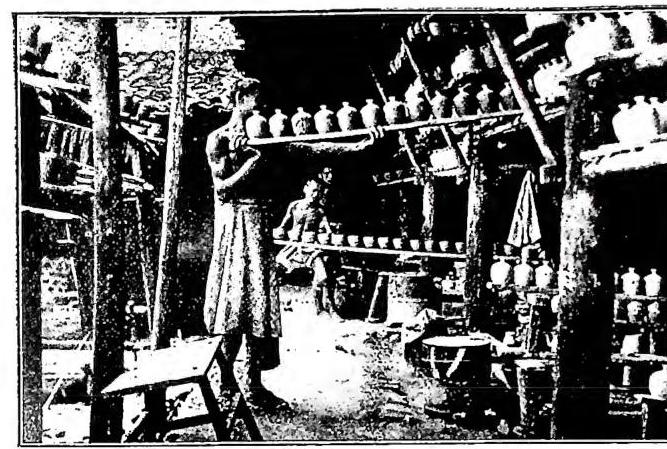
NANCHANG, ARCHDIOCESE of. — Factory producing painted and glazed earthenware vessels. (phot. Fidix)
dge (1199–1409), I, La Seigneurie foncière, Namur 1943; E. Godenne and H. G. Van Elven, La province de N., pittoresque, monumentale, artist. et histor., there 1950; E. de Moreau, Histoire de l'Église en Belgique, 5 vols., Bruxelles 1940–48, passim. Enrico Josi