
NABUCHODONOSOR II. — Second Neo-Babylonian king (Babylonian ‘Nabū-kudurri-uṣur = “May Nabū protect the heir son”; Hebrew Nēbhūkhadhre’sar, the older and more genuine form of Nēbhūkhadhnešar), during whose reign (605–562) the Neo-Babylonian Empire reached its apogee. The firstborn son of Nabopalassar, who had had to struggle throughout his life to establish the Empire, he had already been designated for the throne in 614, when Nabopalassar and Ciassare met upon the ruins of the city of Aššur: his father entered into a closer alliance with Media, and N. married Amýhia, the daughter of Ciassare—an important event for the foreign policy of his reign. His abilities became evident after the fall of Nineveh (612). In the wars against Assyria, which had allied itself with the pharaoh Nechao, N. was given command of the troops. Especially at Carcamis, a decisive battle in the history of a century, N. revealed himself to be a brilliant strategist.
Despite the heroic resistance (the excavations at Carcamis have established that the city’s defenders fought until the fire burned them alive), N. defeated the Pharaoh and pursued him until, having already reached the gates of Egypt, he received news that his father had died in Babylon. He then entrusted an associate with the army and the booty and, as quickly as possible, reached Babylon by way of the Syrian desert. Arriving at his father’s tomb, who had been buried in the palace, after approximately 15 days of travel, the victor over the Pharaoh had no difficulty securing the throne; once he had ascended it, he became the greatest figure of his time—as a troop commander, a highly skilled statesman, a builder and architect—so as to make his Babylon the most splendid city ever to exist.
If the cuneiform sources are exceedingly eloquent regarding his building activity, however, they are silent about his foreign policy and his wars, just as they are about Hammurabi, whom N. deliberately imitated. Only one inscription remains, containing the traditional and general statements that he had crossed distant and difficult mountains, from the Upper Sea (= the Mediterranean) to the Lower Sea (= the Persian Gulf), annihilated the rebels, taken enemies prisoner, and brought immense booty to his city of Babylon, before the lord Marduk; in addition, the inscription of Wādī Brissah in Lebanon (it relates that he drove from that mountain, the “forest of Marduk,” an enemy who was stealing its riches, and that, by splitting rocks, he built
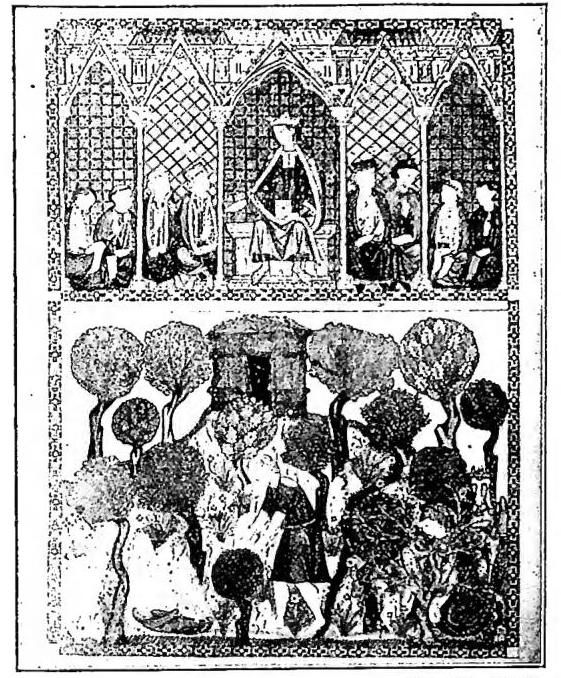
NABUCHODONOSOR II - N. seated on a throne among dignitaries of his court. Below: a child is abandoned in a forest. Fourteenth-century miniature from a Spanish codex containing Part 4 of the Universal History of Alfonso X of Castile: A qui se comença la storia de Nabuchodonosor rey de Babilonia... - Vatican Library, cod. Urb. lat. 539, f. 2.
and another, mutilated at the end, from the reign.
The Bible provides more information, but in some cases one must take into account the literary genre of the biblical passages that one wishes to use as historical testimony. Thus, according to Dan. 1:1, it is highly probable that N., pursuing the Egyptians in 605, entered Jerusalem and plundered the Temple, taking some hostages. King Ioakim, placed on the throne by the Pharaoh, according to II Reg. 24:1-7, submitted and became N.’s vassal for three years. He then rebelled, placing greater trust in his diviners and false prophets than in Jeremiah. N. initially harassed him with raids, which he had carried out by neighboring peoples, but finally set his army in motion and besieged him in Jerusalem (597). Ioakim died during the siege, and punishment fell upon his son Ioachin: the city was taken, and the nobles, the military men, craftsmen, the treasury, and part of the Temple’s sacred vessels were deported to Babylon. Ioachin too was taken prisoner to Babylon, where N. provided for his maintenance (the “tickets” recording the delivery of oil, etc., supplied to Ioachin, written in cuneiform, have survived). N. appointed Matthania as the new king, EZECHIA (v.), and during the first years he remained faithful to N. Then Egypt, Ephree (v.), incited the neighboring peoples and succeeded in forming a coalition against N. Moab, Ammon, and the naval power of Tyre joined it, all eager for freedom and confident in Egypt’s promises. Despite all the warnings of the prophet Jeremiah, the Egyptian party prevailed in Jerusalem, and Sedecia took part in the conspiracy. N. hastened forward with his army and established his headquarters at Rebla. His troops reconquered Lebanon, with the exception of insular Tyre, which resisted for a full thirteen years; they invaded Judea, taking fortress after fortress—as is also well illustrated by the ostraca of Lachis—and besieged Jerusalem for more than a year. Ephree also moved out and came to Gaza, but when N.’s army advanced to meet him, he realized that it was not the moment to risk battle and withdrew behind the
Delta. The Babylonians returned to Jerusalem and took the ever-rebellious city; a month later the “chief charioteer” (Jer. 39:3, 13), in reality the commander of the bodyguard, Nabuzardan (v.), destroyed II. Only Tyre continued to resist, but at last Ethbaal submitted, recognizing N.’s sovereignty, and maritime commerce thereby resumed. A cuneiform tablet, miserably mutilated, as mentioned above, reports another expedition against Egypt in the year 567, but whether, and how far, N. entered Egypt cannot be determined.
MEDINA (v.), N. had no need to fight in the east or north of his Empire. It seems that his relations with Media—which even in his time possessed the most formidable army—were always those of good neighbors. N., however, perceived the danger and therefore completed the inner and outer walls of the city of Babylon, built Imgur-Bël and Nimitti-Bël, and further fortified the latter with an artificial marsh. But a more monumental defensive system—the “Median wall” admired by the Greeks—was built farther north, where, between Opis and Sippar, the Tigris and the Euphrates approached within 30 km of each other, incorporating canals, marshes, dikes, and walls. During the war between Media and Lydia, between 590 and 585, N.’s representative, Neriglassar (v.), his son-in-law and second successor, succeeded in inducing the two parties to agree to a compromise peace that established the frontier on the Halys.
N.’s foreign policy gave great impetus to commerce, and the city of Babylon, inhabited by approximately 200,000 people, became the commercial center of the world. It may be supposed that N. also imposed his authority on Arabia, at least in order to control certain caravan routes. Thus he enriched his country, and this advantageous position enabled him to adorn it in an incredible manner, so that one cannot excavate a site of any importance in southern Mesopotamia without bringing to light bricks bearing his inscription—true bricks fired in the kiln, no longer merely dried in the air.
N.’s palace was especially splendid. Excavated by R. Koldewey, it occupied an area in the “district” of the “Gate of God,” together with fortifications measuring 500 by 400 m., between the processional road of Aiburšābum, the wall of Imgur-Bël, the Euphrates, and the canal Libil-ḫegalla. It was divided into two parts: the “southern castle,” already inhabited by Nabopelassar but rebuilt on stronger foundations, and the “main castle,” constructed around a courtyard measuring 60 by 55 m. (the principal one, since there were four others), whose walls, on a blue background, were adorned with palm trees in enamel. South of this courtyard was the throne room; this palace bore the names markas nīlī or markas māti, that is, “bond of men” or “bond of the land.” The northeastern part of the main castle, facing the temple of Ē-maḥ and toward the marvelous Ishtar Gate, served as a storehouse, and on its terrace were the hanging gardens, built, according to Berossus, for Queen Amýhia, to remind her of the beautiful mountains of her homeland. Immediately beyond the walls of Imgur-Bël, in the angle between the Ishtar road (also processional, part of Aiburšābum) and the Euphrates, he built the so-called “northern castle,” enclosing, among other things, a veritable museum of monuments taken in the wars (the bīt tabrāt nīlīm, “house of the wonders of the people,” might refer to it). At the entrance stood colossal basalt lions. The walls were covered with blue paste and paintings.
The processional road of the god Marduk was another wonder, and still more so the Ishtar Gate, 23 m wide, paved with large limestone slabs, enclosed on both sides by walls 7 m thick, and adorned with lions, bulls, and the sacred mūlūšī of Marduk. Farther north, where the outer walls of Nimitti-Bël reached the Euphrates, N. built another castle, apparently for summer recreation. He also renewed or excavated many canals anew, and in particular lined their banks with brick walls.
Even more than secular constructions, sacred buildings were close to N.’s heart, for he was a man sincerely devoted to the gods of Babylon. By rebuilding and embellishing the temples, N. won the favor of the priests and solved a problem of internal politics that was current during the Neo-Babylonian period.
First of all there was Esagila, the temple of his si-
lord, the national god, king of the gods Marduk, “the house of the raising of the head,” a rectangle measuring 79.50 by 85.50 m., with four magnificent gates (the gates were of great importance in architecture). Around a courtyard measuring 31.30 by 37.50 m. stood the marvelous “chapels,” built of marble and adorned with lapis lazuli, sparkling with gold: the È-kua, with the great statue of the seated Marduk, table, chair, and footstool all of gold; the Kā-hili-sud, dwelling of Šarpanitu, divine consort of Marduk; the È-zida, residence of Nabû; and finally the du-kh, where at New Year, on the 8th and 11th days, Marduk received all the gods in audience. They stood reverently bowing before him, and in this sacred assembly the destinies of heaven and earth were determined. Although he was the “zealot” of Esagila, the principal temple of the Empire, N. did not neglect the Etemenauki, the “house of the foundations of heaven and earth,” within its vast enclosure: a colossal square building measuring 91.50 m., consisting of seven superimposed and progressively narrower steps, until it reached a height of 90 m. It was rebuilt by N.; it belongs to a type of construction known in Babylon from time immemorial, so much so that it constitutes the historical basis of the passage in Gen. 11:1-11 (v. BABELE, Torre di). Almost all the temples were the object of N.’s attentive care, not only in Babylon, but also in Borsippa, Kuta, Sippar, Akkad, Kif, Dilbad, Larsa, Ur, Uruk, and other cities. He rebuilt and embellished them, and endowed them with magnificent revenues, specifying minutely in his inscriptions the garments, sheep, grain, and everything necessary for their cults.
N. renewed the splendor of Babylon, surpassing all previous periods; but he was unable to remedy two causes of ruin: internally, the excessive political influence of the priests, especially those of Marduk; externally, the fact that the Medes remained militarily more powerful. The Babylonians, a people of wealthy and luxurious merchants, did not possess the physical strength of the Medes, shepherds of the mountains. In his time the Babylonian army was composed mainly of mercenaries, including Greeks. Thus, only six years after N.’s death, Nabonide (v.) inherited not merely the splendor, but the grave problem of such an Empire, which was eventually to meet disaster before the Iranian power directed by the genius of Cyrus.
africains, in Nuovo Bull. di arch. crist., 7 [1900], pp. 113-19).
For the meaning assigned to N. by Origen, V. Ene. Catt., V, col. 1020, where the scene painted in the cubicle of the martyr Crescenzione in Priscilla is also reproduced. St. Augustine, however, emphasized that, unlike other persecutors, N. « divino correctus miraculo, piam et laudabilem legem pro veritate constituit » (ep. 185: PL 33, 796). Enrico Josi