
NABOPOLASSAR. — Founder of the Neo-Babylonian Empire (Babylonian Nabû-apal-uṣur = “May Nabû protect the heir son”), who reigned from 625 to 605. Originally he was merely a prince of the Chaldeans, and frankly admits that he was a “son of nobody,” poor in power, but that he ascended the throne “by the word of Nabû and of Marduk... and by the great and irresistible weapons of the terrible Girra.” To the traditional policy of the Chaldeans and Babylonians—the yearning for independence and hostility toward the Assyrians—an excellent opportunity presented itself when, in 626, the great Assurbanipal, king of Assyria, and his representative Kandalânu, king of Babylon, died. N. then seized the throne of Babylon, probably recognized by the Assyrians, who retained possession of Nippur, Uruk, and the whole south of the Kingdom of Babylon. Thus in the first years he ruled over a very small territory and did not entirely sever relations with the throne of Nineveh. But, when he received from Sin-šar-iškun, around 619, the mandate to subjugate the tribes of the Sea, he openly rebelled and took Nippur, Uruk, and city after city from the Assyrians, until he ruled more or less over all Babylonia.
To defend himself against Assyrian claims, he undertook the greatest work of his life: the complete destruction of the Assyrian Empire. For this purpose he formed an alliance, no longer with ancient Elam, forever destroyed by Assurbanipal, but with Media, a young people of shepherds and fierce warriors, then the greatest military power in the Near East, after Uvakšatra Yeretragna (Cyaxares) had reorganized the army to perfection according to Scythian and Assyrian models. These exceedingly bold warriors were then the terror of human civilization, sparing not even the statues of the most venerated divinities. The entire civilized world, with the exception of N., perceived the danger, and Sin-šar-iškun found allies among Assyria’s traditional enemies, such as the Mannel (between Lake Van and Lake Urmia), Egypt, and, at first, before they had yet been defeated by the Medes, the Scythians.
A very long war therefore ensued, with battles of varying outcome, as the Chronicle of N. recounts for the years 616 to 609. The superiority of the Medes emerges from these war reports; for example, in 615 N. undertook the occupation of the city of Aššur, was defeated, and withdrew to Takritain, where he was shut up in the fortress; in 614 the Medes stormed Aššur; N. arrived when the battle was over, but nevertheless Cyaxares confirmed the alliance, and Amyhia was given in marriage to the heir to the throne, Nebuchadnezzar.
The war was not yet over when Sin-šar-iškun, according to Greek reports, threw himself into the flames of his palace during the capture of Nineveh (612). A part of the Assyrian army managed to escape, and Aššur-uballit established himself at Haran; the war of annihilation, in which the Babylonian army was soon placed under the inspired command of Nebuchadnezzar, lasted until 605, when Pharaoh Necho was decisively defeated near Carchemish. Nebuchadnezzar pursued the Pharaoh at a man’s walking pace as far as the Brook of Egypt; there he learned that his father had died in Babylon and, with a small retinue, hastened to return to Babylon as quickly as possible so as not to lose the throne.
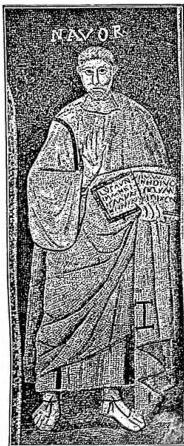
(from Wilpert, Mosaiken, pl. 55)
NABORE and FELICE, saints, martyrs — St. N. Mosaic from the first half of the fifth century — Milan, Basilica of St. Ambrose, Chapel of St. Victor.
the most famous temples, dedicated to Babylonian divinities, such as the celebrated temple of Ištar of Nineveh, founded by one of his predecessors, Maništušu, king of Akkad. The precious “libraries,” such as the enormous collection Assurbanipal (v.), were destroyed and scattered among the ruins of Nineveh. For Babylonian civilization, this was at least a partial cultural suicide. Another suicide of the Akkadian Semites occurred in the incredible massacres of human beings, comparable in every respect to those of Jerusalem in 586: slaughter of the upper classes, deportation of men capable of practicing trades, and even of a large part of the agricultural population, so that, as at Aššur, only small and extremely impoverished communities survived.