
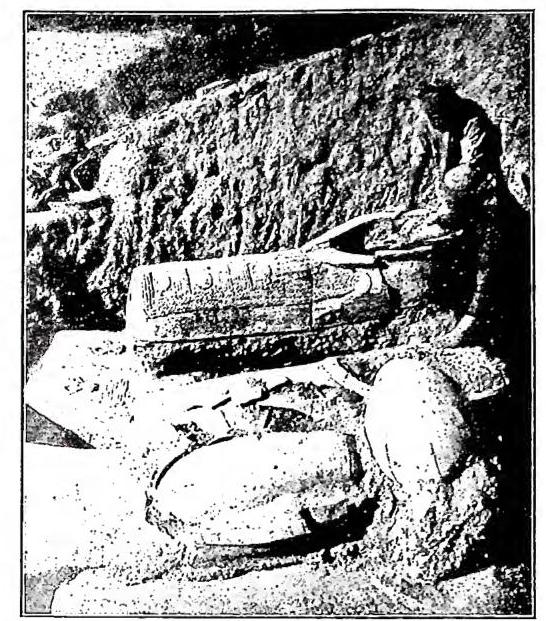
NIPPUR - Votive tablets, discovered by the expedition of the University of Pennsylvania.
#### NIPPUR. - City of ancient Babylonia.
The various mounds (= tell) of N. — situated between Kūt el-Amārah and Dīwānijjeh (in the desert between the Euphrates and the Tigris) — separated by the dry bed of the Shatt en-Nil canal, rise 14-17 m. above the level of the plain. After a first exploration made by A. H. Layard and W. K. Loftus, in 1889 an American expedition composed of J. P. Peters, P. H. Field (architect), R. Fr. Harper and H. V. Hilprecht (assyriologists), and J. H. Haynes began to excavate. But subsequently either J. P. Peters or J. H. Haynes excavated alone (without architects and without assyriologists) until 1900, when H. V. Hilprecht once again attempted to coordinate the various results with 2 architects.
Two rings of walls were found: Imgur-Marduk, which encircles the sanctuary of Enlil, namely tower, temple, and courtyard, and a more extensive one, Nimit-Marduk, which also includes the sovereign's palace.
In the northeastern corner is the temple of the god Enlil, a very famous sanctuary of ancient Mesopotamia, and immediately to the west the tower (ziqqurat), in front of which extends a large courtyard that communicates via a wide gate with another courtyard (to the southeast). The ziqqurat
(tower), restored by Ashurbanipal (668-626?), and earlier by the Kassite king Kadašman-Turgu (1294-1278) and by Ur-Ninurta of Isin (1864-1837), had been built by king Ur-Nammu (of the 3rd Dynasty of Ur, ca. 2050-2030), but contains within itself an even older tower of king Naram-Sin (of the 1st Dynasty of Akkad, ca. 2275-2238). Fragments of votive gifts and statues of the ancient Sumerian and Akkadian kings of Mesopotamia came to light in the temple of the god Enlil. Around the temple, tombs were found whose corpses had been subjected to the action of fire before burial.
In the tell, especially in the "tablet hill", more than 23,000 cuneiform tablets were excavated, including economic and legal texts from the Presargonic and Sargonic periods, from the 3rd Dynasty of Ur down to the Persian period; many Sumerian poetic texts also came to light. From the latest epoch is the archive of the banker and merchant Murashu and sons under Artaxerxes I (465-424 B.C.) and Darius II (424-405 B.C.).
Since 1949 a new American expedition of Pennsylvania University (Philadelphia) and the Oriental Institute of Chicago, under the direction of Donald E. McCown, has excavated in two locations at N. In the temple of Enlil the results of 50 years ago were thus verified. The other location is the "tablet hill", the scribal quarter, where excavations are being conducted in two sectors, which have already yielded 750 tablets and a fine collection of pottery.