
SUSANNA. – Protagonist of a narrative belonging to the complex of Daniele (v.), daughter of Helcia (whom it is customary to associate with the one mentioned in Ier. 29:3), wife of the Israelite Ioakim in Babylon, praised for her beauty and virtue.
The name appears in the Septuagint as Σουσάννα, from the Hebrew šūfan “lily”; it may perhaps be an Aramaized form in -nā', whereas the flower was šūfantā'.
The tragic affair in which she became involved closely reflects certain special conditions of Judaism in exile. The various deported groups, except insofar as their political status as subjects and tributaries and their business relations with outsiders were concerned, which were to be regulated according to local law, governed themselves by their own laws and leaders. Among the Jews, the “elders,” already authoritative within the earlier tradition, eventually became in practice the true leaders of the exiled communities, as is evident from Ezechiele (8:1; 14:1; 20:1) and from Geremia, who reproaches them for abuses (29:22–23).
Two elders governed the community to which Ioakim belonged; since he was well-off, he made his house available to the two leaders for hearings. In the afternoon his wife S. would go into the garden adjoining the house with some of the female servants; on such occasions the two elders watched her and eventually became enamored of her. When they discovered that they shared the same desire, they reached an agreement with the precise intention of giving free rein to their passion. The opportunity arose once when, after S. had sent the maidservants away to fetch a bath, she found herself alone; the two immediately approached her and gave her the alternative: either to yield, or to be brought by them before a court on an infamous charge, to which they would bear sworn witness; the departure of the young women would be good evidence against her. S. perceived the danger, but declared that she preferred to die without having offended God. And she cried out. The elders also cried out; people came running. But the two formulated their accusation: the woman had been sinning with a young man who, when surprised, had quickly fled. S. was brought to trial, condemned to death for adultery, and led away to execution. At this point the scene suddenly changed: the young Daniele, who was among the crowd, proclaimed the iniquity of the affair; heard by the people, he persuaded everyone to reopen the trial (such an intervention by popular judgment was also in keeping with the customs of the time), in which the two elders contradicted each other and were themselves condemned. S. was acquitted and honored.
The original of the narrative was Semitic, but now only the Greek version survives. The passage is therefore “deuterocanonical.” In the Greek Bible the passage is generally placed before the book of Daniele under the distinct title S.: the event is assumed to have occurred before Dan. 1:1. In the Latin version, on the other hand, it is added at the end as chapter 13.
The ethical and exemplary value of the narrative is self-evident, since it offers the model of a virtuous woman who prefers death to sin and, in the face of danger, “cries out.” Artistically, moreover, the manner in which the episode is conducted, from tension to rapid resolution, displays refined technique.
Giovanni Rinaldi
ARCHAEOLOGY. – The oldest pictorial cycle relating to the story of S. is found on the two long walls of the so-called Greek Chapel in the cemetery of Priscilla (2nd century); there S. is depicted being surprised by the two elders, together with the accusation and the thanksgiving for her deliverance (Wilpert, Pitture, pl. 14). In Callistus there is the judgment of S. (ibid., pl. 86); other scenes of S. are found in the cemeteries of Domitilla (ibid., pl. 142, 1), in the Maius (ibid., pl. 220), and in that «inter duas lauros» (ibid., pl. 232, 3). A typical scene is found in Pretextatus, in the arcosolium of Celerina: S. is painted as a sheep between two wolves identified by the inscription in black SENIORIS (ibid., pl. 251); above the sheep one reads the name SVSANNA.
Among the mosaic scenes, mention should be made of the now-lost one in S. Costanza in Rome, of which some good ancient copies remain (cf. R. Michel, Die Mosaiken von S. Costanza in Rom, in Studien über christliche Denkmäler, 12 [1912], p. 25, passim).
The sarcophagi so far known with a scene of S. are likewise few in number, but almost all contain several representations, forming a complete cycle: a fact explainable by the different
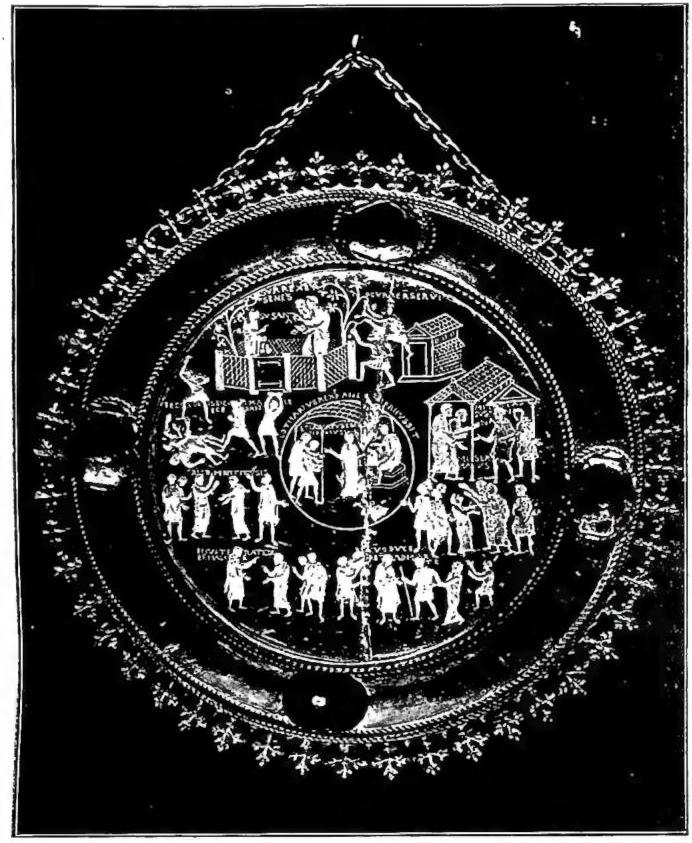
SUSANNA - Medaglione di cristallo di rocca intagliato con storie di S., fatto eseguire da Lotario II (ca. 860), proveniente dalla abbazia di Waufsort-sur-Meuse. La ghiera è del sec. XV - Londra, British Museum.
possibilità e lo spazio maggiore a disposizione dello scultore. Daniele profeta è il personaggio preminente, in tunica e pallio, spesso seduto in qualità di giudice davanti alla tenda (velum) che lo separa dal popolo. I seniori in vari atteggiamenti possono essere imberbi (sarcofagi gallici) o barbati (sarcofagi romani). Il sarcofago di Gerona (Wilpert, Sarcofagi, tav. 196, 1) ha fra tutti il ciclo più vasto dell'episodio di S. Le scene si susseguono ininterrottamente da destra a sinistra, iniziando dal tentativo dei seniori fino all'esecuzione capitale degli stessi. Gli altri sarcofagi con la medesima scena non presentano altre varianti di rilievo; qualcuno poi è ancora dubbio (cf. bibl.).
Notevole interesse presentano per la cura di S. il notissimo disco vitreo di Lotario II figurato con tutto il ciclo biblico, ora al British Museum (cf. Ph. Lauer, Le joyau carolingien de Waufsort sur Meuse, in Bull. de la Soc. nat. des antiq. de France, 1908, pp. 102-107); le due coppe di vetro di Homblières e di Podgoritza (cf. J. Pilloy, Coupe gravée en verre trouvée à Abbeville, commune d'Homblières (Aise) dans une sépulture du IVe siècle, in Gazette archéol., 1884, pp. 224-30, tavv. 32-33; G. B. De Rossi, Insigne tazza vitrea figurata, in Bull. d'arch. crist., 2ª serie, 5 [1874], pp. 153-55, tav. 11; id., L'insigne piatto vitreo di Podgoritza oggi nel Museo Basilewski in Parigi, ibid., 3ª serie, 2 [1877], pp. 77-85, tavv. 5-6); e la doppia scena rappresentata insieme a Daniele tra i leoni sulla faccia Brescia (v.). Ippolito vede in S. la rappresentazione della Chiesa di Cristo tra due popoli ostili, quello di Israele e quello « ex gentibus » (In Daniel, 1, 14, 5-6). Nella Commendatio animae si invoca
il Signore perché liberi l'anima « sicut liberasti Susannam de falso crimine ».
ICONOGRAPHY. — The Baroque painter Baldassarre Croce frescoed in the church of S. S. martire in Rome, in the early years of the seventeenth century, the scenes narrated by Daniel concerning the heroine S.; among them was also the episode of the young woman who is surprised while bathing by the two old men.
Only this episode, among all the stories of S., enjoyed great success in the art of the sixteenth and seventeenth centuries, which conceived it as a profane genre scene. Its earliest depiction dates from the final years of the fifteenth century and is found among Pinturicchio’s frescoes in the Borgia Apartment of the Vatican Palace. Notable sixteenth-century paintings having as their subject “S. in the bath and the two old men” include: the panel by Lorenzo Lotto, formerly in the Benson collection in London; two paintings by Jacopo Tintoretto, one of which is in the Nemes collection in Munich and the second in the Vienna Museum; two paintings by Paolo Veronese, one in the Louvre in Paris and the second at the Accademia di S. Luca in Rome; and also two paintings by Jacopo Bassano, called da Ponte, one of which is in the Civic Museum of Bassano and the second in the Museum of Nîmes (France). Among seventeenth-century paintings, mention should be made of the painting by P. P. Rubens in the Pinacoteca Sabauda in Turin and another in the Galleria Borghese in Rome, the painting by Gherardo delle Notti in the Galleria Borghese in Rome, that by Guido Reni at the Uffizi, and that by Artemisia Gentileschi in the Museum of Naples. - Vedi tav. CVIII.