
OATH. —
I. NOTION
It is the invocation of God as witness to the truth of one’s assertion and to the actual performance of a future act or the occurrence of a future event. The oath thus presupposes the conviction that God exists and knows that for which He is called as witness; insofar as it depends on the person who swears, he desires and wills that God attest to what he affirms under oath. From the fact that, in this first sense, the oath presupposes belief in the existence and omniscience of God, it immediately follows that an atheist cannot swear; and from the fact that the oath consists in calling God as witness, it likewise follows that, in order to have a true oath in the proper sense, it is not enough to affirm that God knows everything, that God knows our thoughts, etc.Sometimes, however, the term oath is understood merely as a particularly solemn and binding form of affirmation: a mode of affirmation that is particularly conscious because of the psychological preparation presupposed, particularly solemn because of the manner in which it is made, particularly worthy of belief, and particularly binding (especially when it concerns a fact or an act to be performed).
The existence of these two concepts of the oath, and particularly of the second, is clearly demonstrated by Sacred Scripture, legislation, and common usage. In Sacred Scripture, in fact, it is often said that God swears (e.g., Gen., 26, 3; Ev. 6, 8; 13, 5; 33, 1; Num. 32, 11; Deut. 31, 20; etc.); now it certainly cannot be admitted that God swears in the first sense indicated. As for legislation, it suffices to recall Law no. 3184 of 30 June 1876, by which the oath was stripped of the essentially religious character that it had previously possessed, in order to give it the character of a solemn civil act; the religious aspect may be retained by those who desire it, but it is no longer essential to the act of swearing. Regarding current usage, it is enough to consider the meaning given to it by many people, especially today: for example, atheists, indifferent persons, many officials, etc.
II. MORAL THEOLOGY
Here the first sense is chiefly under consideration, and predominantly from the moral point of view. In order to possess the elements of the solution more fully, we shall first examine the forms in which it appears and the motives from which it arises.First of all, the invocation of God may be made in order to testify to the truth of an assertion or to the actual occurrence of an act or fact. In the first case, one has the assertory oath (e.g., “I swear that I am innocent”); in the second case, one has the so-called promissory oath (e.g., “I swear that I shall faithfully enforce the constitution”). The latter contains an invocation of God as witness that, at the moment when the person swearing makes the promise, he truly has the will to do what he promises; it also contains an invocation of God to testify that this will shall continue in the future and that, consequently, the promised act or fact shall actually occur. It thus consists in a twofold divine testimony: one concerning a will presently existing, and the other concerning a will persisting in the future.
A special form of oath is the imprecatory or exercitory oath. It consists in invoking God as witness to what one says or promises and at the same time as the punisher of the person swearing (or of his loved ones) should he have sworn falsely. It therefore presupposes, in addition to the conviction that God exists and knows what he is called to witness, the conviction that God is offended by false testimony and punishes perjury.
Each of these oaths may be made with words (a verbal oath: e.g., “I swear that I am innocent”); with gestures (a real oath: e.g., raising one’s hand toward heaven or touching the Cross or the Gospel); or with words and gestures together (a mixed oath).
As regards the rite, an oath may be simple or solemn, according as it is taken without particular ceremonies or with special ceremonial display (e.g., lighted candles, a Crucifix, over the entrails of a victim, etc.).
Finally, the invocation of God may be explicit or implicit. To the latter form belong oaths by the life of the person being addressed (e.g., Gen. 42:15; 1 Reg. 1:26; 17:55; 20:3; etc.), by one’s own head (Mt. 5:36), by the earth (Mt. 5:35; Iac. 5:12), by heaven (Mt. 5:34; 23:22; Iac. 5:12), by the temple (Mt. 23:16), by the altar and the offerings (Mt. 23:16, 18), by Jerusalem, etc., of which Scripture so often speaks. These forms arose from the Jewish concern not to pronounce the name of God explicitly.
Turning now to the question of the root from which the oath arises, it may be said that it springs from the desire to give one’s assertions an absolute value. Human beings have the faculty of expressing their ideas through particular oral or written signs: they can communicate to others, by means of freely established sounds or freely chosen signs (spoken and written words), the judgments they have formed. Yet such communication is in no way necessary. Each of us can always prevent it by concealing our thoughts; more than this, each of us has the possibility of communicating content different from what we actually have in mind—that is, we can lie. This possibility remains even with the most solemn forms of assertion, namely, with the oath.
in the second sense indicated. Nor can much assistance come from the testimony of others. Apart from the fact that it is extremely difficult for others to enter into our thoughts, for the reasons mentioned above, there always remains the possibility that they too may lie. And so we are back where we started. Absolute certainty can be obtained only through the testimony of one who cannot in any way be mistaken or deceive, of one who knows things as they are
and declares them as he knows them. This one can only be God. And it is precisely to him that the person who swears has recourse; in swearing, he seems to say: “God, who knows all things and therefore also this which I affirm, God, who never lies, not even in the case we are considering, testifies that things are as I say; consequently, they truly are as I say.”
All this appears even more clearly in the promissory oath. Here there is also the assertion that an act or fact will take place in the future; now, such an assertion cannot be known with absolute certainty either by the individual who makes it (since he cannot know with absolute certainty what he will want or do in the future), or by other human beings, who, from a study of the individual’s character and tendencies, can at most infer what he will probably want or do, not what he will certainly want or do. Here too it is once again necessary to have recourse to God: he alone knows the free future; he alone, therefore, can give testimony of absolute validity.
From what has been said, several conclusions immediately follow: 1) the oath always arises from the will to give others special proof of the truth of one’s assertions; in particular, the religious oath arises from the desire to give others an absolute guarantee of the truth of one’s words or of the actual fulfillment of one’s promises; 2) consequently, the oath presupposes a certain insufficiency and a certain distrust of the human capacity to provide entirely reliable proof of the truth of one’s assertions; it seeks to remedy this insufficiency by means of a particularly solemn form of assertion or, still more, through an invocation of divine testimony. Consequently: 3) the oath always includes, in addition to the will to invoke God as witness, the external expression of that will. A purely interior oath would be inconceivable; a purely external invocation, however (a simulated oath), is conceivable; 4) the religious oath includes the affirmation that God possesses knowledge and truthfulness superior to those of any human being. From this point of view, it is a form of worship. Yet this superior divine knowledge and truthfulness is not invoked for its own sake, in order to acknowledge it and thus pay homage to God, but as a means of giving others absolute certainty of the truth of our assertions or of the seriousness and efficacy of our promises.
The question arises whether it is lawful to perform an act of this kind. Is it lawful to use divine knowledge and truthfulness as a means of making up for our insufficiency?
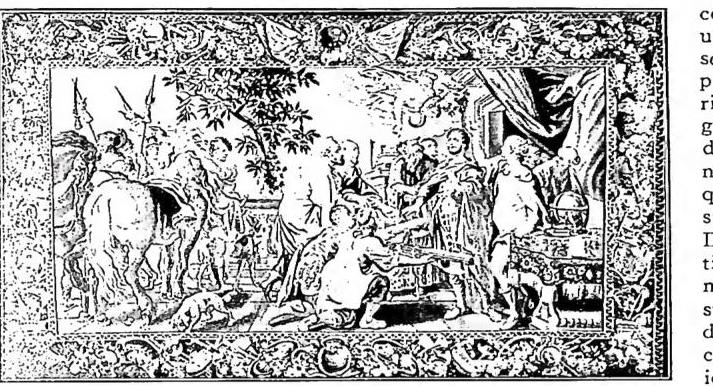
OATH – O. of a Roman consul. Flemish tapestry (second half of the seventeenth century) – Rome, Quirinale.
Some answered the question in the negative, appealing also to Sacred Scripture, especially to Mt. 5:33–37 (“You have heard that it was said to the ancients: do not violate the o., but render to the Lord what you have sworn. But I say to you, do not swear at all; neither by heaven, which is God’s throne, nor by the earth, because it is the footstool of his feet, nor by Jerusalem, because it is the city of the great King; nor shall you swear by your head, because you cannot make one of your hairs white or black. But let your speech be yes, yes, no, no; for whatever is more than this comes from evil”) and to Iac. 4:12 (where the same idea is repeated). Among others, this was the position of the Waldensians, the Beghards and Beguines, the Fraticelli, Wicleff, the Hussites, the Anabaptists, the Mennonites, the Quakers, Kant, and Fichte.
It is pointed out to them that in certain cases there is a need to acquire absolute or nearly absolute certainty concerning the truth of an assertion or the actual fulfilment of a promise. Consider, for example, cases in which an accusation calls for the death penalty or life imprisonment (that is, the end of a life), and in which the truth or falsity of the charge can be established only through the statement of the accused or of a witness; consider the case in which a people entrusts a man with the guardianship of the constitution, the defence of the fatherland, and so forth. In such cases, it is not clear why one should not have the right to demand absolute proof of the truth of his words. On the other hand, such absolute proof is possible only through a religious oath; consequently, it is not clear why a religious oath should not be legitimate.
One should also add to this the whole testimony of Scripture. It speaks very frequently of the oath; at times it even reports its formula (cf. Num. 33:10; Deut. 1:34; II Reg. 19:8; Ier. 22:3), all this without ever indicating or implying that it is a morally illicit act. Indeed, more than once Scripture advises or commands that one swear (cf., for example, Num. 5:19; 30:3–16; Deut. 6:13). As for the passage of St Matthew cited above and that of St James which repeats it, Jesus there intends to exclude the abuse and frequency of oaths and implies that perfection would consist in never swearing; his disciples must attain such a degree of sincerity that they are believed on their word, without the need to resort to oaths of any kind, neither “by heaven,” nor “by the earth,” nor “by Jerusalem.” Otherwise it would be difficult to understand why, immediately afterwards, a disciple as faithful as St Paul should resort to oaths with considerable frequency (cf. Rom. 1:9; II Cor. 1:23; Gal. 1:20; Phil. 1:8, etc.). One may therefore conclude that an oath is licit; but one must immediately add that it cannot be a very frequent, still less a habitual, act. It arises from a certain distrust of human assertions and from the desire to have special, indeed absolute, proof of their truth. It is therefore by its nature an exceptional act, which cannot be repeated too often without losing its effectiveness. On these concepts cf. also Eccle. 23:9–14; 27:15. Pursuing these considerations and following the indication of Ier. 4:2 (“Iurabis: vivit Dominus in veritate et in iudicio et in iustitia”), Catholic moral theology has specified the conditions for the morality of the oath as follows: first of all, truth; what invokes divine testimony must correspond to reality, at least insofar as this can be known—that is, it must correspond at least to what one has in mind; otherwise one would make God a false witness. The second condition is justice: namely, that the assertion may be made. Not everything true may always be said by everyone (for example, sins disclosed by the penitent to the confessor may not legitimately be revealed by the confessor); it is not moral for God to lend his authority in order to validate an assertion that the person swearing cannot make without violating the moral order. If this should nevertheless occur, the oath is not binding (can. 1318, 2). Finally, there is judgment, that is, the existence of a genuine necessity for swearing; hence those who swear continually without any necessity, over trifles and trivialities, cannot be approved. The gravity of the fault depends on the frequency with which one swears and on the pettiness of the motives for doing so. Applying this to a promissory oath, it is necessary that the person swearing truly have the serious intention of doing what he promises, and that it be physically and morally possible (that is, something he can do without requiring special assistance from God and without offending the moral order); finally, there must be a reason for confirming his intention by an oath.
A further question concerns the obligations arising from a valid and licit oath. The problem arises practically only with the promissory oath, since no new obligation proceeds from an assertory oath. The matter is different with the promissory oath, in which God is called as witness to the actual performance of the act. By it, therefore, one assumes the obligation of doing what one has promised, also out of regard for the divine testimony (in this sense can. 1317, 1 states: “Qui libere iurat se aliquid facturum, peculiari religionis obligatione tenetur implendi quod iureturando firmaverit”). This obligation, however, cannot have a scope greater than that assumed by the promise itself (can. 1318, 1); consequently, the oath is interpreted within these limits and remains binding as long as its object is possible and good; it ceases when the object ceases to be possible and honest or undergoes a substantial change (can. 1319, 2).
The oath also ceases for an internal reason when the final cause or the condition under which it was made is lacking (can. 1319, 3). Externally, it may be remitted by the person in whose favour it was made, or through annulment, commutation, or remission (can. 1319, 4) by those who possess the same vow (v.), unless the dispensation entails injury to the rights of third parties, in which case only the Holy See may dispense, in view of the supreme interests of the Church (can. 1320). An oath extorted through violence or grave fear may also be remitted by the competent ecclesiastical superior (can. 1317, 2). The obligatory bond created by the oath and arising from the virtue of religion (can. 1317, 1), because of the reverence due to the name of God, never binds, in the internal forum, beyond the intention of the person swearing, and therefore it must be interpreted according to that intention. If, however, he acts deceitfully, in the external forum the interpretation of the oath is entrusted by the ecclesiastical legislator to the person in whose favour it was made (can. 1321); moreover, in both forums the person swearing is bound to compensate any damage caused. The obligation to observe a promissory oath and to be truthful in an assertory oath is in itself grave; nevertheless, many theologians admit slightness of matter. In canon law, the obligation of an oath is personal and cannot be fulfilled through a procurator (can. 1316, 2). Its violation is punished with special penalties (cf. cann. 1743, 3; 1757, 2, 1; 1795, 2; 2323; V. SPERGIURO).
III. LAW
In various cases the Church obliges persons to take an oath, especially those about to assume an ecclesiastical office or assignment (the oath de munere fideliter implendo or another promissory oath).Thus, before beginning the exercise of their office or assignment, the following are required to take an oath: cardinals (can. 234), bishops (can. 332 § 2), members of the diocesan Curia (can. 364 § 2, n. 1), tellers in Chapters (can. 395 § 4), diocesan consultors (can. 425 § 2), religious who are to participate in the election of one of their superiors (can. 506 § 1), administrators of ecclesiastical goods (can. 1520 § 4 and 1522 n. 1), judges and other officials of the tribunals (can. 1621), those who take part in beatification or canonization proceedings (cann. 2037 and 2047), clerics who are to be incardinated in a diocese other than their own (can. 117 n. 3), and, in certain cases, those to be ordained (cann. 956 and 994: that provided for by can. 994 is, however, an assertory oath), etc.
Of particular importance from the juridical point of view is the oath in judicial proceedings, which may either be an autonomous means of proof or a supplementary element of a deposition.
1. The oath as a means of proof. — It constitutes the most effective evidentiary remedy for the resolution of a dispute, and may be judicial or extrajudicial, according as it is referred by the judge—whether or not at the request of a party—to one of the parties to the case, or results from an agreement between the parties intended to bring about the settlement of the dispute.
The judicial oath, in turn, is divided into a voluntary or decisory oath, which is ordinarily referred by one party to the other, and a necessary oath, which, conversely, is referred by the judge ex officio. The latter may in turn be either suppletory, that is, intended to supplement the results of other evidence already acquired in the proceedings, or estimatory, which occurs when the judge orders the injured party to assert under oath the amount of the damage suffered (when the case concerns compensation).
With particular regard to the suppletory oath, it should be noted: a) that it is widely used in cases concerning a person’s civil or religious status; b) that it may not be referred in cases concerning facts or rights of particular importance, or in any criminal case (cann. 1829–31).
With regard to the estimatory oath, the following two fundamental rules should be borne in mind: a) first, in order that the estimatory oath may be referred by the judge to the plaintiff, the right to compensation for the damage must already have been judicially established, and the extent of the damage must not be capable of certain determination by other means; b) the estimatory oath may not be referred, since it is reserved to the party who suffered the damage and to that party’s heirs (cann. 1832–33).
Finally, the decisory oath, by far the most frequently used of the three types of judicial oath, may be referred only when the conditions established by can. 1835 are present, namely: a) first of all, it must concern a matter in which assignment or settlement is permitted; consequently, the oath in question may not be referred in criminal cases, in cases involving the public interest (and particularly matrimonial cases), or, generally, in cases concerning property whose alienation is permitted only with the authorization of the competent ecclesiastical authority; b) the subject of the oath must not be of excessive importance or value; c) the reference of the oath must be made by persons and against persons who, by law, have capacity to dispose of their own rights; minors, interdicted persons, and their representatives who lack special authorization are therefore excluded; d) the oath must concern either simple information about facts or facts proper to the person to whom the oath is referred.
In general, the reference of the judicial oath is established by a decree of the judge, to be served on the party to whom the oath is referred, indicating the period within which that party must make known which of the courses of action permitted by law it intends to adopt. The party to whom the oath is referred may, in fact, simply accept it, in which case it substantially declares itself ready to swear according to the formula served upon II. The party may also refuse to swear (and failure to appear on the day fixed for the taking of the oath is equivalent to refusal, unless the existence of a legitimate impediment is demonstrated). If the refusal is justified, the reference of the oath loses all procedural effect; if, on the other hand, the refusal is unjustified, it is for the judge, in the exercise of his prudent judgment, to determine whether or not it should be treated as equivalent to a confession.
Finally, the party to whom the oath is referred may refer it back to the party who referred it (with the exception of the estimatory oath). In this case, the reference of the oath naturally reverses the positions, since the burden and advantage of the oath pass from the party referring it back to the party that originally referred it; and since the reference back is equivalent to a new and definitive reference, it is subject to the same conditions established for its original reference. As a result of the reference back, the original referring party is bound by the oath, provided that it has no legitimate grounds for refusal (cf. cann. 1835 and 1836 § 5). If that party refuses, the case is resolved to its detriment (can. 1836 § 4), since it is defeated in its claim or defense.
The judicial oath produces different effects according to its type.
Indeed, the decisory oath is so called because the judge is obliged to decide the case according to its outcome; and this effect is produced even when, in the event of the reference back of the oath, the original referring party has refused to swear (can. 1836). Moreover, the decisory oath renders unappealable the judgment pronounced on its basis (can. 1880 n. 5), without prejudice to the remedy of restitutio in integrum (can. 1926).
As for the specific effects of the estimatory oath, it binds the judge only when the opposing party has accepted its outcome or when the judge himself does not consider that outcome excessive; in the latter case, however, the judge may reduce the amount of the damage to more equitable limits.
Finally, with regard to the suppletory oath, it should be borne in mind that its having been taken does not in itself preclude the submission of other evidence (can. 1861 § 1), given the greater evidentiary possibilities that the suppletory oath offers the judge, by enabling him to form his conviction on the basis of its results, suitably examined and evaluated in comparison with those of the means of proof previously produced.
Entirely identical norms have been issued (and will enter into force on 6 Jan. 1951) for the Eastern Church (cf. motu proprio Sollicitudinem nostram, 6 Jan. 1950, cann. 353–60 and 404 n. 5, in AAS, 42 [1950], pp. 77–79 and 88).
2. The oath in confirmation of a judicial deposition. — As a supplementary element of a witness’s deposition or of a party’s deposition, the oath may be of three kinds. First there is the preliminary oath or de veritate dicenda, which is a promissory oath, although not strictly necessary in cases concerning merely private rights; it is, moreover, forbidden to refer this oath to the accused in criminal trials (cann. 1744, 1746, 1758, 1767, 2037 § 3, 2145 § 2).
Furthermore, in the Church’s judicial practice, the oath de veritate dicorum is generally required in spiritual or criminal cases. This oath is assertory and may concern the deposition given either in its entirety or in part (cann. 1768, 1824 § 3, 2037 § 3).
Finally, there is another type of promissory oath, namely the oath de secreto servando, by which the judge has the power to bind the party or the witness to secrecy until the publication of the acts or, if the dangers referred to in can. 1623 § 3 exist, without limitation of time (cf. cann. 1769, 1944 § 1, 2037).
Experts, too, may be administered the oaths mentioned above; and, in any case, before beginning his assignment, the expert must take the oath de munere fideliter implendo (can. 1797).
For Eastern canon law, the motu proprio cited above establishes (in canons 266, 268, 280, 289–291, 320) rules identical to those mentioned above for Latin law; only the regulation of the oath of the parties is more complete.