Machine translation of the 1948–1954 Italian original. The original text is authoritative.
PREMONSTRATENSIANS. – Regular canons who took their name from Prémontré (diocese of Soissons), where in 1120 they were Xanten (v.) according to the Rule of St Augustine. Emerging from the movement of apostolic poverty among itinerant preachers and from the canonical reform of the Gregorian era, the branch of the P. soon constituted—vis-à-vis the other Regular Canons—a distinct order.
I. HISTORY
In 1126 they received apostolic confirmation. For the formation of observance and organization, the Cistercians served as a model, especially after, at Prémontré under Bl. Ugo di Fosses (d. ca. 1164), who succeeded St. Norberto, elevated in 1126 to the archiepiscopal see of Magdeburg, the regulation of customs, liturgy, and organization was defined in its essential form. The abbot of Prémontré became abbot general; relations among the monasteries were based on the principle of the daughter house; supreme authority lay with the General Chapter. The abbots of S. Martino (Laon), Floreffe, and Cuissy enjoyed prerogatives as patres Ordinis. The attempts at centralization advanced by the mother house were opposed by
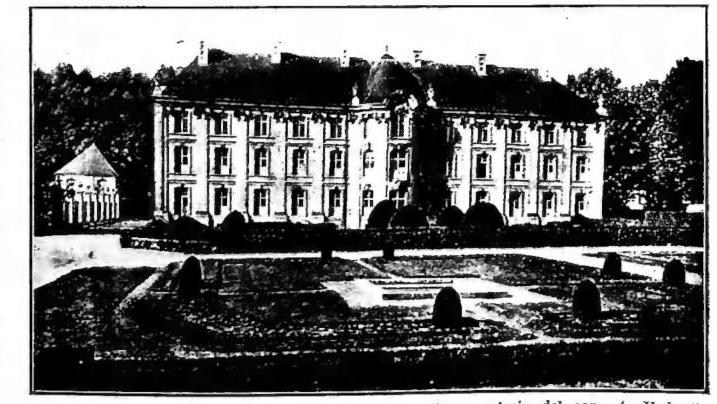
(courtesy of Canon A. Hubert) PREMOSTRATENSI - Abbey of Prémontré, now transformed into a psychiatric hospital of the Aisne.throughout the monasteries of Saxony, whose center was Magdeburg; their prelates retained the title of provost, sending from 1239 onward only one representative every third year to the General Chapter. In contrast to the Cistercians, the P. had convents for women from the very beginning, indeed double monasteries; from 1140 onward, however, these were transferred to distant regions. Favored by feudal lords and bishops zealous for reform, the Order soon spread, especially in France and the Empire; in conjunction with the missionary and Crusading movements, the P. also expanded into eastern Europe and even the Holy Land. East of the Elbe they also carried out a great colonization mission. A primitive life of solitude was soon joined by the care of souls, exercised first of all in the countryside, which led to an increase in possessions and to the formation of the system of incorporated parishes. The P. subsequently also established cathedral Chapters and bishoprics in the territories of German colonization (Brandenburg, Havelberg, Ratzeburg, Riga).
The 12th and 13th centuries were the most flourishing period of the Order, which distinguished itself by very strict observance, works of charity and preaching, personal sanctity, mystical devotion, and a notable intellectual life. Representatives of this period are the bb. Godefrid of Cappenberg (d. 1127), Gilbert of Neuffontaines (d. 1152), Evermodus (d. 1174), Frederick of Mariengaarde (d. 1175), Isfrid (d. 1204), Hermann Joseph (d. 1241), Bronislava (d. 1252), and Gertrude of Altenberg (d. 1297); the writers Anselm of Havelberg (d. 1158), Philip of Harveng (d. 1183), Adam Scotus (d. 1212), and Zacharias Chrysopolitanus (12th century). In Paris, in 1252, the Order opened a college of studies. In 1320, districts called Circaries were established in order to facilitate regular visitations.
In the late Middle Ages the P. too underwent a period of relaxation, though in the 15th century attempts at reform were not lacking. Commendatory abbacies long hindered the recovery, especially in the mother house itself: in the Nordic countries the Order became a victim of the Protestant Reformation, while in Italy, Greece, and the Holy Land it died out completely. Following the Tridentine Reform, however, it succeeded in undergoing a new flourishing. New statutes were issued in 1628–31; monasteries and churches were restored in the splendor of Baroque art; colleges of studies arose in Salamanca (1568), Louvain (1571), Pont-à-Mousson (1603), Cologne (1617), Rome (1618), and Prague (1637). During the Reformation, the Spanish P. and the Lorraine congregation «antiqui rigoris» attempted to separate themselves from the common observance. In 1750 Benedict XIV reconfirmed the privilege of parishes for the P., and in 1751 the Premonstratensian Third Order assumed an organized form.
Distinguished P. of this period include, among the martyrs of Gorcum, Adrian Beckam and James Lacoupe; Nicola Pseaume (d. 1575), bishop of Verdun and a zealous promoter of the Tridentine Reform; the hagiographer C. van der Sterre (d. 1652); the historians of the Order J. Lepaige (d. 1650) and Ch. L. Hugo (d. 1739); the theologian G. Hirnheim (d. 1679); and the writers L. Goffiné (d. 1719) and G. Lienhardt (d. 1783). The P. published volume LIII of the Acta SS at Tongerloo. The French Revolution and secularization in Austria, Germany, Poland, and Spain inflicted extremely grave damage on the Order; the organizational bond consequently ceased. The 19th century, however, saw a new revival, which became particularly fruitful in Belgium, while the external organization was due chiefly to the efforts of the P. in Bohemia and Austria (1869–83). In 1937 the Abbot General established his residence in Rome, and the latest revision of the statutes took place in 1947. The habit of the P. is made of white wool.
II. SPIRITUALITY
The P. unite the contemplative life with the active life of pastoral ministry; their spirituality therefore reveals a tendency toward the life
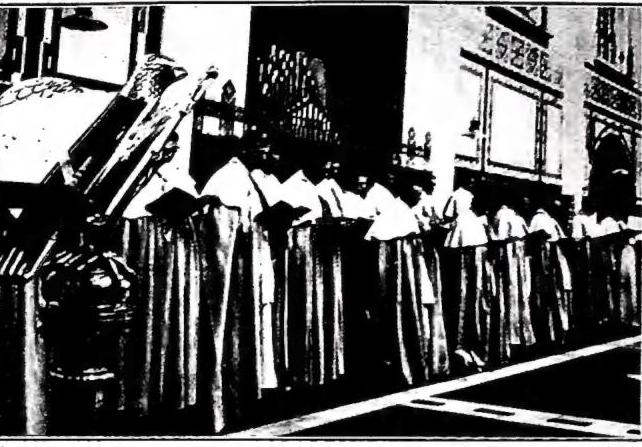
PREMOSTRATENSI – Choral office in the abbey of Tongerloo.
practical life, whose sources are the liturgy, Sacred Scripture, and priestly experience; fundamental ideas: imitation of Christ in poverty, charity, and hospitality; devotion to the Cross, the Eucharist, and Mary is added.
III. LITURGY
In the 12th century the P. used the Roman (Rhenish) rite with Cistercian and Cluniac elements, which influenced the liturgy of the Dominicans; in the years 1618–1622, the Roman liturgy was adopted for the most part.
IV. ORGANIZATION
A general abbot, elected for life, 4 definitor abbots, 4 assistants to the general abbot. The General Chapter is held every 6 years. The professed number 1,500 in 5 Circarie (Austrian, Brabantine, Bohemian, French, Hungarian) and in new foundations in the United States and Germany; there are 7 monasteries of the Second Order; at the head of the Circarie are general vicars. They also have missions in the Belgian Congo, India, Brazil, and Denmark; various forms of the apostolate are: the reparatory Mass, the Eucharistic Crusade, the mission of the “Travelling Chapels” in the German diaspora, etc. – Vedi tav. CXXXII.
BIBL.: J. Lepaige, Biblioth. Praemonstrat. Ord., Parigi 1633; Ch. L. Hugo, Sacri ac candidi Ord. praemonstrat. annales, 2 vols., Nancy 1734-36; G. Lienhardt, Ephemerides hagiologicae Ordinis Praemonstratensis..., Augusta 1764; F. Winter, Die Prämonstratenter im 12. Jahrh. und ihre Bedeutung für das nordöstl. Deutschland, Berlino 1865; L. Goovaerts, Ecrivains, artistes et savants de l'Ordre de Prémontré, Bruxelles 1899-1914; R. van Waefelghem, Les premiers statuts de l'Ordre de Prémontré, in Analectes de l'Ordre de Prémontré, p. 1913, append.; F. Petit, L'Ordre de Prémontré, Parigi 1927; H. Heijman, Untersuchungen über die Prämonstratensergebahnheiten, Tongerloo 1928; R. V. Waefelghem, Répertoire des sources imprimées et manuscrites relatives à l'hist. et à la liturg. des monast. de l'Or. de Prémontré, Bruxelles 1930; B. Grassl, Der Prämonstratenserorden, seine Gesch. und seine Ausbreitung bis zur Gegenwart, in Anal. Praemonstrat., 10 (1934), appendix; A. Eren, s. V. Prémontrés, in DThC, XIII, cols. 2-31; M. Fitzthum, Die Christologie der Prämonstrat. im 12. Jahrh., Plan 1939; G. Schreiber, Prämonstratenserkultur des 12. Jahrh., in Anal. Praemonstrat., 16 (1940), p. 41 ff.; 17 (1941), p. 5 ff.; F. Petit, La spiritualité aux XIIe et XIIIe siècles, Parigi 1947; C. Dereine, Les origines de Prémontré, in Rev. d'hist. ecclés., 42 (1947), pp. 352-78; id., Le premier Ordo de Prémontré, in Rev. bénédict., 38 (1948), p. 84 ff.; P. Lefèvre, La liturgie de Prémontré, in Ephém. Liturg., 62 (1948), p. 195 ff.; N. Backmund, Monasticon Praemonstr., I, Straubing 1949; H. M. Colvin, The White Canons in England, Oxford 1951. Journal of the Order: Anal. Praemonstrat., Tongerloo since 1925. Agostino Huber
Cite this article
“PREMOSTRATENSI.” Enciclopedia Cattolica, vol. IX (1952), p. 1158. Azione Romana digital edition, https://azioneromana.com/article/premostratensi.