
CROCIATE. — The movement of expansion of the Faith and of the new Roman-Germanic civilization reached its culmination, as the feudal regime was disintegrating and the communal autonomies were already arising, toward the end of the 11th century, in the great enterprise of the C., which continued in various forms until the fourteenth century.
It was a movement of return to the origins that was channeling the fresh energies of the West toward the places from which the word of the Gospel had spread ten centuries earlier. And it was a movement arising from an awareness of the significance for Christendom of the Muslim occupation of the holy places and the spread of Islam throughout the Mediterranean. But reasons of faith and the flourishing of spiritual and material life increasingly coincided with the desire to decide, through a struggle among peoples, the dominion of the Mediterranean and to keep its shores open to trade, to which the degree of prosperity attained by the states and, in particular, by the maritime cities, gave both possibility and justification.
The economic relations of the maritime cities with the Muslim potentates of the coasts of Africa and Asia constituted the strongest obstacle to a lasting understanding and a sincere accord with the one power that no interest could induce to abandon its position of struggle against the infidels. An impulse of faith had to overcome the narrow economic outlook and reveal, in a broad political-religious initiative, a higher purpose of human activity; the papacy itself had to place itself resolutely at the head of the movement, at the moment of its greatest earthly power, to explain its reasons and aims and to clarify its goals. Finally, favorable circumstances had to intervene in order to resolve, with the possibility of success, the hesitations of the leaders.
Already, especially in Spain, the struggle against the infidels had taken on a mystical fervor through the intervention of Burgundian and Norman knights in defense of the faith; and from the beginning of the century the pilgrimages to the holy places by French, German, and Scandinavian prelates and lords, who arrived there by sea, as well as by Hungarians arriving by land, had become more frequent and significant. At times the groups had grown until they became armies, and weapons had been resorted to in order to clear their path: thus, in 1064, twelve thousand German pilgrims, led by Archbishop Sigfrid of Mainz, reached Palestine.
But, weakening the already divided structure of the Islamic Empire, there came the Turkish invasion and the formation in the Middle East of a vast Seljuq state, which soon absorbed the caliphate of Baghdad and, in Syria and Armenia, came into conflict with the Byzantine Empire:
in 1071 the Seljuq Turks conquered Jerusalem and crushed the forces of the Empire at Malazkirt; five years later Damascus fell into their hands.
Only an authority and a power, by taking an initiative that should have belonged to the Empire, could draw upon the energies of the West to urge it into action: the papacy.
In 1073, Emperor Michael VII of the East appealed to Rome, suggesting the possibility of a reunion between the Greek and Roman Churches and requesting aid in anticipation of new assaults. Gregory VII, having just ascended the chair, formed the grandiose plan of liberating southern Italy from the Normans and the Holy Land from the infidels. He designated Goffredo di Lorena and Guglielmo di Borgogna as leaders of the enterprise, which was to be carried out by the united forces of the Empires of East and West, under the patronage of the Holy See. Various difficulties impeded the success of the attempt, and shortly afterward the Investiture Controversy absorbed all the pontiff’s activity.
In March 1095, at the Council convened by Urban II at Piacenza, Byzantine envoys arrived to plead the cause of their Empire and of the Holy Places. Pope Urban issued a fervent invitation to those present to hasten to the aid of the threatened Empire of the East. The idea of the C. took shape and gained substance through the papal initiative. After Urban had gone to France and called a solemn council at Clermont for the end of the year, he became its herald: at the solemn assembly held on 27 November in the presence of a great crowd in the public square, he proclaimed the Christian intervention in the East; to provide the princes with greater guarantees, he proclaimed the Truce of God, which was to last until their return, and granted those departing the fullest indulgences. The freely and publicly expressed resolve to participate in the enterprise assumed the character of a solemn vow, symbolized by a red cross sewn onto the garment, while those departing were assured of the Church’s protection for their families and possessions. Tireless preachers, such as the hermit Pietro d'Amiens, to whom legend would assign a much greater role than the one he actually played, ensured that the effect produced by Urban’s words would be lasting and fruitful among princes and people alike.
I. THE FIRST CRUSADE
In the winter between 1095 and 1096, in the countries to which the Pope’s words were most directly addressed, and where he went about preaching (France and Provence), considerable masses of the people began gathering for the Crusade. Urban had chosen as his representative the bishop of Puy, Ademaro di Monteil; the meeting place was Constantinople; departure was fixed for 15 August 1096. But the excited and undisciplined throngs did not wish to wait until the princes, who were to lead the expedition, were ready with their vassals and arms, nor until the movement, born in France, had spread.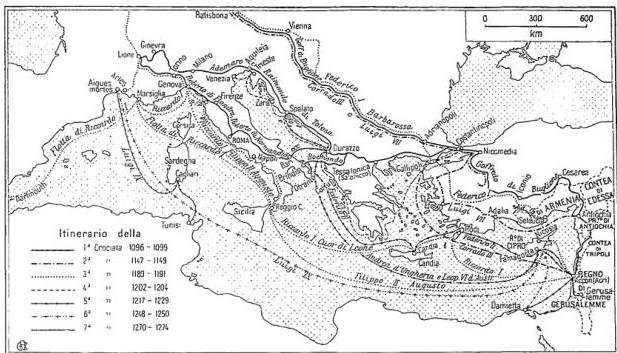
Meanwhile, the princes were moving with their feudal armies. Goffredo di Buglione, duke of Lower Lorraine, followed the route of Pietro l’Eremita with his brothers Baldovino and Eustachio, reaching Constantinople on the day before Christmas Eve in 1096. Ugo di Vermandois, Stefano di Blois, Roberto di Normandia, and Roberto di Fiandra crossed Italy and, by way of Brindisi and Durazzo, reached the halfway point, some
CROCIATE - Itinerary of the seven C.
six months later. Count Raimondo of Toulouse and the papal legate Ademaro, after crossing northern Italy, preferred to follow the Dalmatian coast as far as Durazzo. Last of all, the Norman princes of southern Italy, Boemondo, son of Roberto il Guiccardo, and his nephew Tancredi d'Altavilla, having crossed from Brindisi to Valona, joined the others in Apr. 1097.
They were many thousands of well-armed men, on horseback and on foot; each group was closely gathered around its own lord, and the varying nationalities—northern French and Lorrainers, Provençals and Normans—were reflected in the composition of the crusading army. But an even greater influence on the subsequent course of events was to be exerted by the position of the Crociati in relation to the Byzantine Empire. If, in the lofty papal conception, the C. had been regarded as the supreme defense of the East against the Infidels and as the best instrument for a possible return to religious unity, neither the Pope nor the princes had concerned themselves with the aims or the internal situation of the Byzantine state, ruled by a traditionalist bureaucracy and institutions quite different from the feudal arrangements proper to the Westerners. But the greatest difficulty concerned the territories, formerly imperial, that were to be reconquered and that the crusading princes intended to retain for themselves. Byzantine consummate skill succeeded, for the time being, in finding a compromise: the emperor Alessio had the crusading princes swear a feudal oath concerning all future conquests. Some of them resisted paying homage; and only the rivalry between the Provençals and the Normans, Raimondo and Boemondo, skilfully exploited, opened the way to an agreement, while the Emperor undertook to provision the Crociati and transport them to the Asian coast.
Thus, in the spring of 1097, the undertaking began, with the Crociati’s passage into Asia Minor and the siege of Nicea; but before the city fell, secret agreements concluded with Byzantium, which was concerned to secure the nearby Islamic stronghold, prevented the Crociati from entering it, and only Greek diplomacy, working through insinuation, together with Boemondo’s firmness, succeeded in averting a revolt by the disappointed troops.
ciati entered Armenia; two columns broke away from the main body of the forces: one, commanded by Tancredi d'Altavilla, advanced into Cilicia and proceeded to occupy Tarso; the other, under the leadership of Baldovino di Lorena, reached Edessa, whose lord, Thoros, adopted Baldovino as his son and heir. In Oct. the Crociati reached Antiochia; after several months of siege, they took it by treachery on 2 June 1098, with the support of a Genoese squadron, which came to support the allies’ action by sea on the direct initiative of Pope Urbano. Boemondo, who, while a powerful Seljuk army was already in sight, had succeeded in entering the city by surprise, was granted it as his lordship, contrary to the agreements with Alessio, and was entrusted with supreme command. In turn besieged, the Latins, inspired by faith, succeeded in defeating the Turkish army on 28 June.
A serious crisis, caused by the rivalry between Boemondo and Raimondo di Tolosa over possession of Antiochia, threatened to cause the C. to fail at its outset. But then Raimondo, having resumed the march toward Jerusalem and laid along the way the foundations of a third crusader lordship, the county of Tripoli, managed to persuade Goffredo and the other princes to follow him toward the holy city, where the Turks had shut themselves in, divided and weakened by the conflict between the sultans of Aleppo and Damascus.
At the beginning of June 1099 the crusading army came within sight of Jerusalem. The final assault, however, was launched on 14 July, once again with the assistance of the Genoese under Guglielmo Embriaco, who had landed the siege engines at Giaffa. On the 15th the city was taken and rapidly organized for defense. Thus, when a Fatimid army arrived from Egypt, the Crociati were able to defeat it at Ascalona on 12 Aug. The liberation of Jerusalem produced an immense response in Europe, all the more enthusiastic because the three years of hardship had repeatedly aroused fears that the undertaking would be abandoned. Pope Urbano, who had already urged people to hasten to the East at the Councils of Bari (1098) and Rome (1099), renewed his appeals to monarchs and princes to organize expeditions of
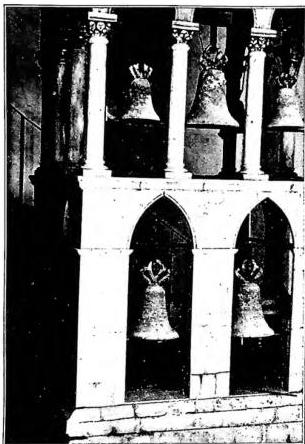
(phot. Custodia di Terra Santa)
CRUSADES — Bells of the Basilica of the Nativity, from the time of the first C., discovered during excavations at the Casa Nova — Bethlehem.
reinforcement. The Crusaders immediately set about giving a stable organization to the conquest, which embraced the three principalities of Antioch, Edessa, and Tripoli, as well as Palestine proper. A kingdom was established, which they entrusted to Goffredo di Buglione, and which was given a feudal organization analogous to that of the Western states; the country was divided into fiefs, and a high court of feudal lords stood alongside the king, limiting his powers; a permanent army was established; but the need for a continual influx of men and resources from the West, and the failure to merge with the indigenous population, made the conditions of the kingdom difficult. An ecclesiastical organization of a Latin character was also created, with a patriarch, archbishops, and bishops, as well as powerful Latin monasteries. The military and religious orders of the Knights Hospitaller and the Templars gradually acquired power; they were independent of the king and the patriarch and subject only to the Pope. Powerful castles were built at the most dangerous points and to defend the ports, which were so necessary for maritime communications.
A further cause of weakness was the difficult relationship with the Byzantine Empire, made particularly acute by the ambitions of the Normans, who had made themselves masters of Antioch, so coveted by the Byzantines; they were at war with one another precisely while Palestine was being conquered.
Attempts to carry the war into the heart of the East, by marching on Sivas and Baghdad itself, failed. The expeditions organized by the Italian Maritime Republics—Genoa, Pisa, Venice, and Amalfi—on the other hand, achieved their purpose, beginning at the time of the conquest of Jerusalem. Yet in return for their services they sought economic concessions, commercial quarters—which they obtained in all the Syrian cities, in Constantinople itself, and in the provinces—and markets.
II. THE SECOND C
The Crusader states were able to maintain themselves as long as division and discord lasted in the opposing Turkish and Muslim camp. But they had to turn to the aid of the West when the initiative was taken by their adversaries.In 1144 the atâbeg (governor) of Mossul captured Edessa after a month-long siege: thus the first of the Christian states came to an end. From Jerusalem, help was sought from the West: the bishop of Langres, Goffredo, and the king of France, Luigi VII, became its advocates, and Pope Eugenio III the proclaimer of a new C., whose enthusiastic preacher and apostle was Bernardo di Chiaravalle. At the assembly of Vezelay, the great French lords, in obedience to the summons and following the example of the king, took the Cross; as did the German feudatories, at the Diet of Spira at Christmas 1146, following the example of King Corrado III.
Negotiations took place between the French and German kings and the emperor of the East, Manuele Comneno, who, like his father, was engaged in a struggle with the Norman enemy, Ruggero II. Following the Danube, Corrado set out in late spring through the Balkans, amid suspicions and conflicts; after crossing the Bosporus and entering enemy territory, he found himself in difficulties for lack of provisions and, pressed by the Turks, had to turn back to Nicea. Luigi VII had meanwhile arrived there by the same route; during his passage through Costantinopoli, pressure had been brought to bear on him to form an alliance with Ruggero II and overthrow the Greek Emperor for his own advantage. Joined by Savoyard and Lombard Crusaders, led by Amedeo III di Savoia and Guglielmo V di Monferrato, the French king set out toward Attalia and then Acri. After Corrado’s return, and with the plan of reconquering Edessa abandoned, Luigi VII turned toward Gerusalemme, where Corrado joined him and where the king, Baldovino III, received him. In agreement, they decided to attack Damasco, from which pressure against the Christian state was becoming increasingly intense. But faced with the necessity of a lengthy siege, their spirit of initiative failed them; indeed, their reciprocal attribution of responsibility created a profound rift between the sovereigns. Preceded by Corrado, Luigi returned from Gerusalemme to France after Easter 1149. He hoped to return and make Costantinopoli a more effective base for operations against the infidels, but the plan was subsequently abandoned.
III. THE THIRD CRUSADE
In 1176, Ṣalāḥad-dīn (Saladin), already master of Egypt, also took possession of Syria. The Crusader States were now surrounded by the compact power of a single Islamic State, young and expanding. In a great battle lasting three days, at Ḥaṭṭīn, near Lake Tiberias, in 1187 Saladin defeated the Latin army led by Guido di Lusignano, king of Jerusalem, who was taken prisoner. The road to Jerusalem lay open. Saladin took it after a short siege, on 2 October 1187. Only Tyre and the cities of the northern coast remained to resist.The consternation of Christendom was immense. Pope Gregorio VIII had his legates preach a Crusade even in the distant Scandinavian regions, proclaiming a truce of seven years. Reconciled by the occasion, the kings of England and France, Enrico II and Filippo II Augusto, took the Cross, as did the emperor Federico Barbarossa.
At the head of the largest army that any Western monarch had hitherto assembled for the Crusade, he set out in May 1189 by the now customary Balkan route. The enterprise, the best prepared and conducted, encountered its first difficulties from Isacco II l'Angelo, emperor of Constantinople, who had made agreements with Saladin; Barbarossa had to impose himself by force in order to cross the Strait of Gallipoli (March 1190). Having then continued his march and occupied Iconium, Barbarossa met his death while fording the Selef, near Seleucia, on 9 June 1190. The event dissolved the army: with a few faithful followers, the emperor’s son and companion, Federico, reached the following year, bearing his father’s body, the Christian camp which the French and English Crusaders, having set out in the spring of that year, had established beneath the walls of S. Giovanni d'Acri; there he too died. The expedition of the two Western kings, Filippo II and Riccardo Cuor di Leone, successor to Enrico II, had been long delayed. Having crossed France, separated, and then met again at Messina in September 1190, they spent the winter there amid serious disputes with the local population. Once the departure for S. Giovanni d'Acri had been decided upon—besieged for many months by the king of Jerusalem, Guido di Lusignano, with the ships of Pisa—Riccardo Cuor di Leone first wished to carry out a diversion against Cyprus, which he wrested from the Byzantine Empire. Finally, before the united forces of the Crusaders, S. Giovanni d'Acri surrendered on 12 July 1191. But then discord between Filippo and Riccardo prevented an active and effective continuation of the war against Saladin. When the former returned home, Riccardo remained alone to conduct the Crusade. Yet he squandered its remaining forces and, when the siege of Ascalon failed because of Saladin’s prompt intervention, he entered into negotiations with him, though prolonging them while hinting at enterprises against Jerusalem, Damascus, and even—this being the first time attention had been directed there—Cairo. Finally, having rebuilt the destroyed Ascalon and made peace with Saladin in return for the promise of free access for Christians to Jerusalem, he returned to Europe in October 1192.
The Crusade had failed in its purpose. A new enterprise, prepared by Enrico VI in his new Sicilian kingdom but in agreement with the German forces of the Empire (and preceded by the dispatch of a fleet to Palestine in 1195, and in 1197 heralded by the first Crusader contingents embarking under the leadership of the dukes of Lorena and Champagne), likewise came to nothing because of Enrico’s sudden death.
IV. THE FOURTH CRUSADE
Innocenzo III resumed the plan for Western intervention in the East, urging the European princes and the Byzantine Emperor himself to this end and seeking, through special levies, to finance the undertaking.But the internal dissensions in Germany and the conflict between the French and English kings made a large-scale renewal of the enterprise impossible; preaching could appeal only to the mystical sentiment of certain princes, especially French ones.
Indeed, it was due to the zeal of one of the preachers of the Crusade, Folco di Neuilly, that, on 28 Nov. 1199, certain feudal lords of Champagne, gathered for a tournament, took a solemn vow in his hands. To the first among them, Teobaldo di Champagne and Ludovico di Blois, were added Bal-
davino, Eustachio, and Enrico di Fiandra. It was decided on this occasion, in agreement with the Maritime Republics, to act against the Ayyubids of Egypt. Upon the death of Teobaldo, designated leader of the expedition and replaced by the marquis Bonifacio di Monferrato, brother of Corrado, an agreement with Venice, which undertook to equip the fleet and to cooperate militarily with the Crusaders, seemed to open the way to carrying out the plan. But when the Crusaders assembled in the lagoon between July and Aug. 1202, their number proved far smaller than had been expected,
and the payment agreed upon for the Republic could not be made. It was then that the Crusaders massed on the shore themselves became an object of negotiation between the emperors of the East and Venice, and the enterprise diverged from its appointed course.
ising in return the union of the Church; but Innocenzo III, who nevertheless sought that union, had placed no faith in the fugitive. Alessio then turned to Filippo di Svevia, husband of his sister Irene, and through him sought to reach agreements with the Crusaders, who remained in humiliating expectation at Venice; appealing to the ambition of Bonifacio di Monferrato, whose former family power had declined, he proposed diverting the expedition toward Constantinople. The plan having been rejected by the Pontiff, hostile to every diversion that threatened to give rise to a war among Christians rather than against the infidels, the Venetians, already favourable to the scheme, succeeded in exploiting to their immediate advantage the inactivity of the Crusaders by proposing an expedition against Zara, occupied by the king of Hungary.
Many, both before and after the capture of Zara, including one of the most capable, Simone di Montfort, preferred to make their own way to the East. The main body of the crusading forces re-embarked at Zara on 20 Apr. 1203 for a further stage at Corfù. There the agreements with Alessio were finalized and the expedition against Constantinople announced. Putting to sea again, the fleet arrived before the city on 24 June. The Crusaders landed on the opposite Asian shore, beginning the at-
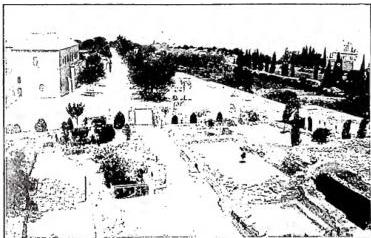
CROCIATE - Remains of the Benedictine abbey on Mount Tabor, erected at the time of the First C.
(phot. Custody of the Holy Land)
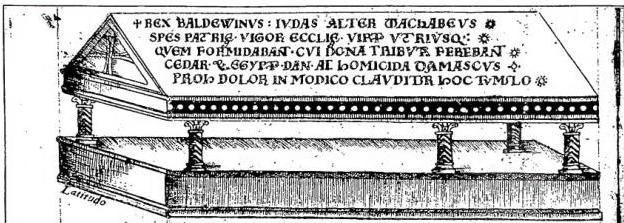
(phot. Vatican Library)
CROCIATE - Tomb of Balduino I, situated at the foot of Mount Calvary.
Drawing contained in the Liber I de Sanctis Civ. Iernanica... descripta... 27 Sept. 1725: cod. Vat. lat. 9233, f. 102° - Vatican Library.
tack, which was carried out from several directions, succeeded on 6 June in penetrating the Golden Horn. But only when, during the night of the 17th to the 18th, after the opposing resistance had repelled the attacks from the walls, a revolt drove out the usurper Alessio III and restored Isacco Angelo to the throne. The entry of the crusading forces could then take place peacefully, and on 1 Aug. they attended the coronation of Alessio Angelo, associated with the throne by his father. The letter of Innocenzo III of 20 June, which urged the Crusaders to refrain from any interference in the Byzantine question, to break off relations with the Venetians, and to remain faithful to the undertakings assumed, arrived at this moment of triumph; it was therefore easy to reply by showing the Pope the advisability of not allowing events to slip from his grasp.
But the agreement between the Crusaders and the Empire was based upon an undertaking which the grave Byzantine economic crisis at that moment was to prove impossible to fulfil: the payment of the enormous sum promised at Zara.
Only half the agreed sum could be raised, and meanwhile a popular upheaval in the Empire replaced the Angelo with one of their relatives: Alessio V Ducas. The Latins, for their part, in their quarter of Pera, angered by the change, proceeded to acts of war and resolved upon the conquest of Costantinopoli; special agreements were concluded between Bonifacio di Monferrato, the other leaders, and the doge of Venezia: three quarters of the booty were to fall to the Venetians, and only one quarter to the Crusaders; the emperor was to be chosen from among the princes and was to receive a fourth part of the Empire, the remainder being divided between the Crusaders and the Venetians, who were to retain all their ancient privileges without swearing any oath of fealty. By now the C. had changed its character: the religious aim, in all those who had remained, had been swept away by the mirage of a war of conquest. From 12 to 13 Apr. 1204 the general assault upon the city was launched: in the furious struggle entire districts burned, horrible massacres were committed, and the pillage was systematic. Only one voice was raised to recommend moderation and mercy: that of the marquis of Monferrato. In the conquered and humiliated metropolis, a more secret struggle of parties then took place over the imperial election: the Venetian and French electors united against Bonifacio; having placated him with Crete and with the kingdom of Tessalonica, created for the occasion, and having recognized the Venetians’ right to appoint the patriarch of Costantinopoli, Baldovino di Fiandra was elected and crowned emperor in S. Sofia.
But the Latin Empire of the East was not viable: the Greek element, overwhelmed in the capital, resisted in the provinces and remained in a position of antagonism that was to herald a recovery and to deepen, perpetuating it, the religious conflict; among the crusading leaders, who everywhere replaced the Byzantine governors with autonomies of the Western type, enmity soon prevailed; far from constituting a bond among them, the Venetians, true masters both through their ships and through their wealth, constituted a state within the state. If, moreover, to the causes of rapid internal disintegration one adds the pressing Bulgarian danger, against which the forces of Emperor Baldovino were already destroyed in 1205, and the alliance with the external enemies of the Greek rulers who had risen against the Latins at Nicea, Trebisonda, in the Peloponneso and in Epiro, boasting that they were heirs of the last dethroned emperors, one obtains a picture of the concrete effect of the diversion of the fourth C. from its purpose. The disappearance of the sole bulwark against the Turks in the East caused the final collapse of the Christian positions in the Holy Land. Only Venezia, through the political genius of Enrico Dandolo, attained its goal, and from commercial hegemony in the Levant derived, together with its splendour, that link between East and West which, between the Middle Ages and the modern age, was its historical function.
V. LA QUINTA C
Innocenzo III reaffirmed at the Fourth Lateran Council (1215) the necessity of a new Crusade. Popular preachers had already appealed to the religious sentiment of the rural masses in France and Germany. Evident symptoms were the movements of the “shepherds” and the so-called “Children’s Crusade” of 1212. Thus in 1215 Innocenzo proclaimed the Crusade, the sacred truce, and the prohibition of all commercial relations with the Muslims. His protégé, Federico II, solemnly took the Cross at Aquisgrana (25 July). But when the Pontiff died (1216), he postponed the undertaking, which had been set for June 1217.At the urging of Onorio III, in that year bands of Scandinavian, Baltic, and Hungarian Crusaders set out by various routes: some first went to lend support in Portugal to the struggle against the Moors, while others embarked at Venezia. The king of Hungary, Andrea, set out from Spalato. At S. Giovanni d'Acri, in September, the forces assembled, and the Hungarian king joined the king of Cyprus and Jerusalem, Giovanni di Brienne, and Duke Leopoldo of Austria. There was no plan: their energies were dissipated in fruitless attempts to force a way to Jerusalem, and many, including Andrea of Hungary himself, weary and disheartened, departed. The king of Cyprus and the duke of Austria then redirected the objective of the Crusade towards Egypt, the conquest of which would have brought about the collapse of the Muslim positions in Syria and put an end to all their initiatives against the West. In May 1218 the Crusaders landed before Damietta: the siege lasted for more than a year, until the city fell in November 1219. The march on Cairo was then to be resumed; but Brienne’s idea of awaiting the promised arrival of Federico II prevailed, and the winter was spent at Damietta. German reinforcements under Ludovico of Bavaria gave confidence for the resumption of the struggle. Towards the end of July 1221, when the Crusaders had reached al-Manşurah, a formidable bulwark on the road to Cairo, the sultan made peace proposals, promising the restoration of Jerusalem; but the legate, Cardinal Pelagio, refused all negotiation. A fierce battle followed: defeated, the Crusaders were compelled to withdraw, and Brienne, having reached Damietta (30 Aug.), obtained peace from Egypt.
Even after the disaster Federico II did not move, nor did he do so in 1225. According to a new plan presented to the Pope, only in 1227, at the insistence of Gregorio IX, did he prepare to depart, but an epidemic compelled him to desist: the Pope excommunicated him. The following year, after negotiations with the sultan of Egypt, he sailed for the Holy Land, subduing the island of Cyprus on the way. Shortly afterward he landed at S. Giovanni d'Acri and succeeded in obtaining from Malik-al-Kāmil, sultan of Egypt, by the Treaty of Giaffa (1229), possession of Jerusalem and the Holy Places, with access from the sea for pilgrims, both parties undertaking to observe a ten-year truce; the mosque of 'Omar remained in Muslim hands. As a result of this agreement, Federico II entered Jerusalem on 17 March 1229 and on the 18th was crowned in the basilica of the Holy Sepulchre, afterwards departing from S. Giovanni d'Acri for Italy. Yet reopening to Christians the road to Jerusalem did not suffice to restore the Emperor to the favour of the Church, which condemned and declared the treaty null.
But the peace of S. Germano also produced here a feeling of détente and led the Pontiff to recognize the accomplished fact (1230).
When the truce established by Federico expired, the attempt of the Christian princes to take up arms again failed for lack of forces. On the contrary, victorious at Gaza, the Muslims of Damascus entered Jerusalem.
To put an end to all discussion, as well as to the plan for an understanding between the Latins and the sultan of Damascus, a large troop of horsemen from Turkestan in the pay of Egypt intervened, and in 1244 took and horribly sacked Jerusalem.
VI. THE SIXTH CRUSADE
Christian consciousness in the West could not renounce the idea of the liberation of the East. Moreover, Innocenzo III himself had at a certain point assigned to the Crusade the purpose of repressing heresy in Provence, and his example had also been imitated by Gregorio IX.The renewed proclamation of the Crusade at the Council of Lyon in 1245, by Innocenzo IV, found only Luigi IX, king of France, ready to take the cross. In June 1248 he departed from Marseille for Cyprus, whence, a year later, resuming the plan of attacking Egypt, he landed and occupied Damietta (1249). But the march on Cairo was again shattered at al-Manṣūrah, where the king himself was taken prisoner on 6 April 1250. Ransomed and having moved with the survivors of his army to S. Giovanni d'Acri, his appeals for aid, and those of the Pope for a resumption of the struggle, now encountered not only general indifference but also the resolute hostility of monarchs such as the king of England. And Luigi IX, upon receiving news of the death of his mother and regent of the kingdom, could only return home (1254).
VII. THE SEVENTH CRUSADE
With the disappearance of the Christian threat posed by Luigi IX during his six-year stay in the East, the Ayyubids of Egypt were left with a free hand in Syria, and the Latin centres in the Holy Land, lacking forces and divided among themselves, could offer no effective resistance.A Mongol invasion delayed the Egyptian offensive;
but from 1265 onward, the sultan Bajbars proceeded to occupy Caesarea, Arsūf, Ṣafād, Jaffa, and Antioch. Clemente IV once again addressed an appeal to the Catholic princes. And once again only Luigi IX, despite the cool reception encountered even in France, answered the appeal and in 1270 departed from Provence, this time directing his attack against Tunis. But scarcely had he landed at Carthage when the plague mowed down the Crusader ranks, and the king himself also died. His brother, Carlo d'Angiò, brought the troops back to Europe, after having made the Tunisian sultan his tributary. In vain, in 1274, did Gregorio X preach at Lyons the resumption of the Crusade. Although many kings and princes took the cross, none set out. Finally, in 1291, after Tripoli and Sidon, S. Giovanni d'Acri too fell.
VIII. LAST ATTEMPTS
The commotion in the West was considerable at the fall of the last posi-(courtesy of Dr. B. Denenhart)
CRUSADES — Siege of Damascus in 1148. Fifteenth-century miniature. Paris, Bibliothèque Nationale, ms. franç. 5594, f. 148.
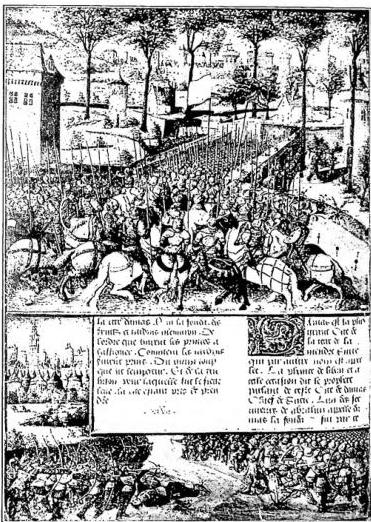
It is therefore rather a voluntary illusion, motivated from time to time by different reasons, that causes purposes and initiatives of the C. to re-emerge in the fourteenth and fifteenth centuries in their ancient sense, whereas, preceded by the discussions of publicists (Raimondo Lullo, Marin Sanudo, Pier Dubois, Guglielmo di Nogaret, Broccard), a new phase of the question, so to speak, of the East and the Holy Land was entered upon; interest shifted toward the Ottoman Empire, which tended to unite under firm control the Balkan and Asian regions of the former Byzantine Empire.
As was logical, it was the pontiffs who marked the juncture between the two phases, attempting by every means to channel forces toward the East against the infidels. Clemente V renewed, but in vain, the prohibition on trade with Muslims and made himself protector of the Knights of Jerusalem in their stubborn guerrilla warfare against Arab and Turkish ships. Against Muslim pirates Giovanni XXII and then Clemente VI promoted a league joined by Venice and Genoa, which in 1344 succeeded in the temporary occupation of Smyrna. Then came the turn of certain princes: Pietro di Lusignano, king of Cyprus, sought help in vain from the West for his enterprise at Satalia and the subsequent bold series of raids upon Alexandria, Tripoli, Tortona, and Laodicea. Amedeo VI of Savoy recovered Gallipoli in 1366 for the Byzantine Empire, once again threatened by the Bulgars.
But from the end of the fourteenth century onward, European apprehensions focused upon the Turkish advance in the Balkans. In aid of Sigismondo of Hungary, Giovanni Senza Paura came in 1396 with a small Franco-Burgundian army. In 1399 and 1405, at the head of a Genoese fleet, Marshal Boucicaut penetrated the Dardanelles and attempted a diversion on the Tunisian coast. But always without success and in no way checking the irresistible march of the Turks. Great hopes were aroused in 1443 by the C. of Cardinal Cesarini against Sultan Murad, who was compelled to evacuate Sofia: hopes only, for at Varna the Crusaders suffered a bloody defeat. The following years saw Hungarian heroism assert itself in the defense of Belgrade: linked with the struggle are the names of Giovanni Hunyadi and Giovanni da Capistrano. But then Constantinople fell beneath the onslaught of Maometto II, and the metropolis returned against an empire which the Latins had been unable to maintain and the Bulgars unable to conquer. The exhortations and efforts of the aged pope Niccolò V had availed nothing; and even the grand design of a C. of States warmly supported by his successor, Pio II, foundered upon the rocks of the political reality, cold egoism, of the time, and no one appeared at Ancona for the expedition which the Pope himself was to have led. Paolo II,
Alessandro VII, Leone X attempted in vain to revive the plan. In 1518, when Muslim power had reached its height through the conquest of Egypt and Syria by Selim I, everything seemed ready for the solemnly preached expedition; but then the competitions for the imperial throne absorbed and diverted attention. Some decades later, a great collective undertaking to relieve Muslim pressure would be achieved at Lepanto, but this was to be the naval prelude to the Western effort, pursued until the mid-eighteenth century, to break the threat to the heart of Europe. Yet no one would any longer give thought to the recovery of the Holy Places and the armed expansion of the faith: already, at the beginning of the sixteenth century, there were those who thought it more fitting for the Church to withdraw into itself, to purge itself of the dross of worldliness and renew itself; just as a new world was opening to the activity also of the clergy and soon, inspired by the Council of Trent, the missions would arise, renewing in a more modern form the expansion of the faith. In Europe, struggles for supremacy were now beginning; somewhat apart from the Western States, enclosed within their internal problems, the strong structure of the new Turkish Empire would represent a purely political problem, devoid of all religious content.