
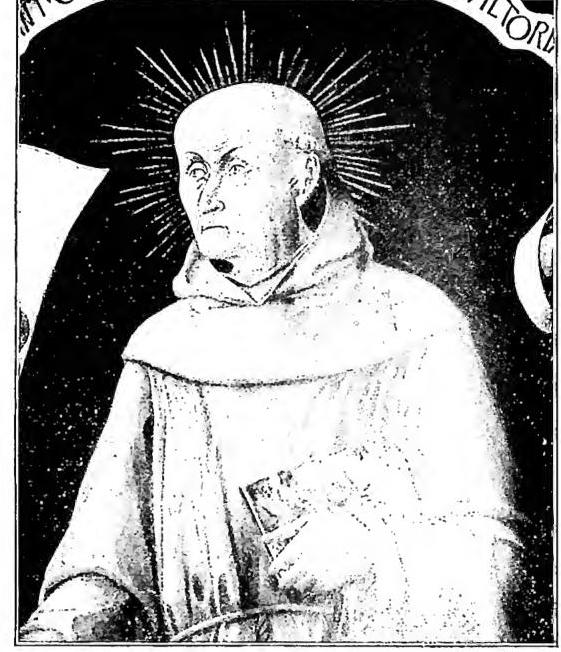
JOHN OF CAPESTRANO, Saint. - B. probably on June 24, 1386 at Capestrano (Aquila), d. at Villach (Vijlak [Slavonia]) on Oct. 23, 1456. He studied at Perugia, becoming a celebrated jurist, and was made governor of the city by Ladislaus of Durazzo. Having fallen prisoner to the Malatesta, he underwent a religious crisis and in 1416 entered the Friars Minor; having become a close associate of Bernardino of Siena, he worked hard for the spread of the Observance and was also several times vicar general; in '30 he proposed the Martinian Constitutions, which are a middle way between laxism and rigorism, hoping in this way to maintain the unity of the Franciscan family, but in vain.
He was appointed inquisitor against the Fraticelli and the Jews, but his principal activity consisted in preaching and in the apostolate in defense of Christendom threatened by the Turks and by heretics; to this end he traveled tirelessly throughout Europe, and had contacts with various personalities both in Italy and abroad. One may recall a legation of his to Austria, Bavaria and Poland against the Hussites in 1451, an embassy to the Holy Land to promote the union of the Armenians with Rome, his participation in the military campaign of John Hunyadi and finally the command he assumed of the left wing of the array of Christian forces that led to the great victory of Belgrade on July 21, 1456. He disciplined militarily his ranks of tertiaries and Crusaders in the name of Jesus, according to the devotion dear to St. Bernardino and defended by G. himself with much energy against detractors. He was canonized by Alexander VIII in 1690 (the promulgation of the bull is from June 1724 by Benedict XIII); Leo XIII introduced his feast into the calendar of the universal Church. Feast on Oct. 23.
Despite his intense activity he wrote a great deal, and Father Antonio Sessa da Palermo, at the beginning of the 18th century, collected 17 manuscript volumes of his works in order to publish them, but his death prevented him from doing so; among the most interesting works one may cite the Tractatus de cupiditate, the Speculum conscientiae, the De papae et concilii auctoritate
(important, given the very heated discussions on that subject existing in his time), the De iudicio universali, and many others, as well as Letters, Sermons, etc. He was essentially a moralist and polemicist.
Bibliography6 works
Paolo Brezzi