
GALLIPOLI, DIOCESE of. – In the province of Lecce, it extends over 84 sq km and has a population of 36,000 inhabitants, all Catholics, divided among 8 parishes with 31 diocesan priests and 6 religious priests, 2 male and 9 female religious communities (1949). It is suffragan to Otranto.
HISTORY. – The oldest sources concerning the Church of Gallipoli do not go beyond the sixth century. Domenico (551) signed the condemnation of the Three Chapters at the Ecumenical Council of Constantinople (553); Giovanni is mentioned in an epistle (Jaffé - Wattenbach, 1250) of St. Gregorio (June 593), with the task of correcting Andrea, bishop of Taranto. In 595, again from a letter of Gregorio I (ibid., 1400), we learn that the diocese was vacant and that Bishop Pietro of Otranto was ordered to visit II. A few years later (599), from two further letters of the same Pontiff (ibid., 1732-33), the name of the third prelate, Sabiniano, is known; while of the fourth, Giovanni, it is known that he took part in the Lateran Council under Martino I (649). Finally, mention must be made of the last bishop of the Latin rite, Melchisedach, who took part, under Adriano I, in the Council of Nicaea (787), after which the increasingly predominant influence of the Eastern Empire succeeded in subjecting the Church to the patriarch of Constantinople. Until the eleventh century, the bishops were all of the Greek rite; only under the Normans did the diocese return to Roman jurisdiction. But the Basilian community, whose stronghold was in nearby Nardò, resisted for centuries the persistent work of Latinization undertaken by the Church of Rome, so that G., despite having bishops of both rites, retained the Greek liturgy until 1513.
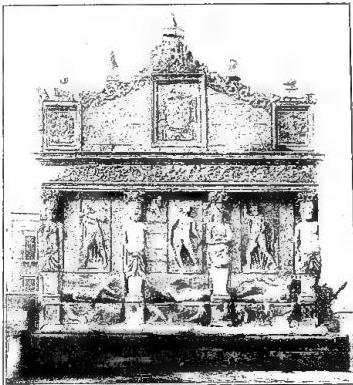
MONUMENTS. — The new Cathedral, dedicated, like the old one, to s. Agata, the work of the architect G. B. Genuino, was begun in 1629 through the generosity of Bishop D. Consalvo De Ruenda (1622–50) and restored at the beginning of this century. The façade dates from 1696; the choir and the pulpit (the work of the German Giorgio Aver) belong to the first half of the eighteenth century, under Bishop Oronzo Filomarini, who decorated the entire church. Of considerable artistic value are the large frescoes on the side walls, the ceiling of the main nave, the dome, and the inner part of the façade, executed by two local artists, G. A. Coppola and G. D. Catalano, as well as by Malinconico and Luca Giordano. Other paintings are found in the churches of the Purità, S. Francesco d'Assisi, S. Chiara, and B. Domenico.
There were also numerous monasteries, among which may be mentioned the former Dominican monastery, built over the ruins of the great Basilian cenobium of S. Maria delle Servine, and the former monastery of the Riformari (1217–20), which was destroyed and rebuilt a century later.