
OTRANTO, ARCHDIOCESE OF. – City and archdiocese in the province of Lecce. It has a population of 187,941 inhabitants, almost all Catholics, distributed among 59 parishes served by 142 diocesan priests and 30 religious priests, one minor seminary, 7 male and 35 female religious communities (Ann. Pont., 1952, p. 305). Its suffragan sees are Lecce, Gallipoli, and Ugento. The Cathedral is dedicated to the Annunciation of the Virgin Mary.
I. HISTORY
The revival of O., after its decline during the Roman period at the hands of nearby Brindisi, was due to the desperate political circumstances of Byzantium, which, reduced to the extreme promontory of Salento, elevated the city to the political, military, and religious capital of the region bearing the same name. The diocese of Hydruntum, however, predates the Byzantine age and could be assigned to the end of the fourth or the beginning of the fifth century, if one considers the great authority with which its first historically known bishop appears to have been invested: that Pietro (595; Jaffé-Wattenbach, 1400), whom Gregory the Great entrusted with visiting the vacant dioceses of Brindisi, Lecce, and Gallipoli (595 and 601; op. cit., 1696; 1727; 1849) and with assisting in the election of their respective prelates. He was followed by Andrea (649), who took part in the Lateran Council of Martino I, and Giovanni I (680), who was present at the Third Council of Agatone I, held in Constantinople. In the ninth century, as has been said, the Hydruntine Church entered the orbit of Constantinople, and its see counted schismatic bishops, of whom scarcely a few names are known. It is certain, however, that during this period O. acquired decisive pre-eminence over all the neighboring sees and accumulated rights and privileges that no one would thereafter dare revoke. It was certainly the patriarch of Constantinople who conferred archiepiscopal dignity upon the Hydruntine see, but it is doubtful that Marco (870), the most learned author of the Greek Lenten Office, was the first to receive II. It seems more probable that this should be attributed, leaving aside the names of any prelates, to the emperor Niceforo Foca, on whose orders, in the tenth century, the patriarch Poliutto declared the see metropolitan, with jurisdiction over the neighboring cities and over the dioceses of Acerenza, Gravina, Matera, Tricarico, and Tursi. The archbishop of O. thus acquired the title primas Salentinorum, the patriarchal Cross, the style of most serene, and the right to prebends from feudatories and barons. Only in the eleventh century did O. return to the Church of Rome, but the Greek rite remained tenaciously alive for a long time. Among the most eminent prelates in these events were Pietro II (956), who bound his Church to Byzantium; Ugone (1068), who took part in the Council of bishops held at Salerno by Alessandro II; Guglielmo, who consecrated the Cathedral (1088); and Gionata (1163), the first archbishop of the Latin rite and the patron of the pavement mosaic of the Duomo.Once it had returned to the orbit of Rome, the pontiffs confirmed O. in the pre-eminence it had acquired, detached the dioceses granted by Byzantium, assigning to it instead those of Lecce, Gallipoli, and Ugento, and granted its prelates the privilege of the pallium. In 1480 the Hydruntine Church also had its martyrs for the Faith: when the city fell into the hands of Maometto II, the Saracens carried off women and children as slaves and savagely slaughtered all 800 men who, together with the archbishop Stefano Pendinelli, had taken refuge in the Cathedral (v. ANTONIO PRIMALDO E COMP. B. M). From then on, the city, although laden with glory, fell miserably into decline. Of the prelates who from that year onward served the Hydruntine Cathedral, only the following will be mentioned: Pietro Antonio De Capua (1536–79), who took part in the Council of Trent; Michele Orsi (1722–52), who founded the Seminary and adorned the Duomo with marble; and Vincenzo M. Morelli (1792–1812), declared venerable by the Church. In 1818 Pio VII united Alessano to Ugento as well, and permanently united the church of Castro to O.
II. MONUMENTI
La Cattedrale, iniziata nel 1080 per la munificenza del normanno duca Ruggiero, fu consacrata 8 anni dopo dall'arcivescovo Guglielmo. Danneggiata dall'assalto saraceno, l'anno dopo fu restaurata dall'arcivescovo Serafino da Squillace - che riposa nel monumento di M. Ferrando di Galatina (1481), autore forse del portale sul fianco sinistro della chiesa - e poi rifatta ancora malamente in forme barocche nel 1674 e nel 1764. Dopo i recenti lavori di ripristino, è riapparsa la sua linea romanica, col bel rosone della facciata costruita a lievi spioventi, gli archi a ghiera sulle 14 colonne di granito, le basi e i capitelli di classica fattura (sorgeva lì presso un tempio a Minerva), e le tre ampie luminose navate. La cripta imponente, triabsidata con cinque navatelle, appartiene al sec. XII ed è sorretta da 68 colonnine ornate di pregevoli capitelli, in cui si avvertono influenze bizantine, indigene e oltramontane. Il superbo musaico, che compose il prete Pantaleone (1163-66) per decorare l'ampia superficie del pavimento della Cattedrale, ha molto sofferto per i guasti del tempo e dei restauri. Perdute le composizioni delle navatelle e dell'abside, restano i riquadri della navata maggiore, nei quali è figurato un albero enorme che allunga i suoi rami per abbracciare scene di ogni genere, audaci e selvatiche nel disegno e nell'esecuzione. Sono mostri ed animali di tutte le specie, scene di caccia e di trionfo (Alessandro che sale al cielo), fatti biblici (Noè nell'arca, Giona, ecc.) e allegorici (i mesi), episodi del Nuovo Testamento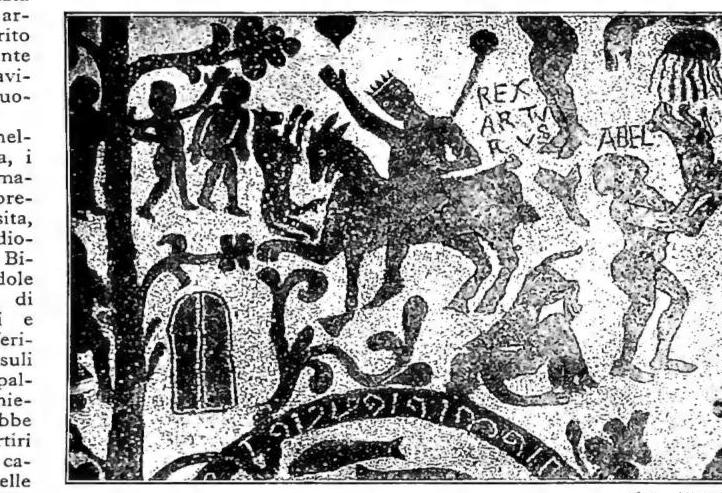
La chiesa di S. Pietro (sec. XII), a croce greca con cupola cilindrica, conserva affreschi romanici e un'architettura pesante con archi fortemente curvi su rozze colonne. Nei dintorni, a sud della città, sorgono gli
avanzì dell'antica abbazia di S. Nicola, eretta dai basiliani tra i secc. vii-viii e rimaneggiata in forme romaniche e gotiche assai eleganti. Distrutta dai Saraceni, benché fosse restaurata, perdette definitivamente il suo prestigio e andò in continua rovina. Altra superba Basilica, oggi ridotta ad un cumulo di ruderi cadenti, fu quella cosiddetta delle Centoporte, dal numero dei suoi ingress
i. Non resta che qualche arco, qualche finestra e la cripta sotterrata dalle rovine
Vedi tav. XXXI.(fot. Alinari)
OTRANTO, ARCIDIOCESI di - Cattedrale. Particolare del musaico pavimentale (1166).
pp. 51-67; X, pp. 269-
270; P.B. Gams, Series episcop., Ratisbona 1872, pp. 910-11; Moroni, L, pp. 61-65; Lanzoni, I, pp. 310-17; Eubci, I, pp. 279-80; II, 166; III, 212; D. Vendola, Rationes decimarum (Studi e testi, 84), Città del Vaticano 1939, pp. 107-10 e 372; Cottineau, II, col. 2154. - Opere particolari: W. Schultz, Denkmäler der Kunst in Unteritalien, I, Dresda 1860, pp. 260-67; S. Castromediano, La Commiss. conservatrice dei monum. stor. e di belle arti di Terra d'O., Lecce 1876, pp. 30-37; E. Aar, Gli studi storici in Terra d'O., Firenze 1888, p. 121 sgg.; L. G. De Simone, Terra d'O., Torino s. d.; anon., Illustraz. dei principali monum. di Terra d'O., Lecce 1889, pp. 19-23; L. Maggiulli, O., ivi 1893; Ch. Dichl, L'art byzantin dans l'Italie mérid., Parigi 1894, p. 170; A. Avena, Monum. dell'Italia merid., Roma 1907, p. 237; E. Bertaux, L'art dans l'Italie mérid., Parigi 1904, p. 448 sgg.; C. A. Garoli, Il pavimento a mosaico della cattedr. di O., in Studi medievali, 2 (1907), pp. 505-14; G. Gigli, Il tallone d'Italia, II, Gallipoli, O. e dintorni, Bergamo 1912, pp. 82-118; L. Maroccia, La cattedr. di O., Maglie 1912; P. Toesca, Stor. dell'arte it., II, Torino 1927, pp. 604, 1083 e passim; H. Teodoru, Eglises cruciformes dans l'Italie mérid. (S. Pietro d'O.), in Ephem. Ducoromana, 5 (1932), pp. 22-34. Pasquale Testini