
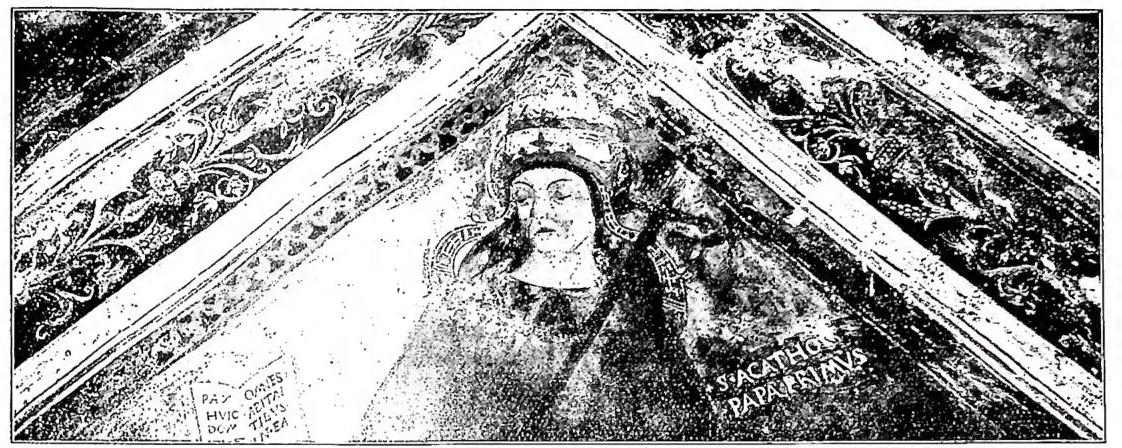
The archbishop Maurus (648–71), followed in this by his successor Reparatus (671–77), had proclaimed himself autocephalous, refusing to be recognized and consecrated, according to ancient custom, by the Pope; but the new archbishop Theodore came in person to Rome to regularize his position and pay homage to Agatho (Easter 680). Agatho also intervened resolutely in a matter concerning the distant Church of England. Theodore of Canterbury had divided the diocese of York into four others. The incumbent of that Church, Wilfrid, reduced to the see of Lindisfarne, protested. Theodore then deprived him even of that see. Wilfrid came to Rome, where envoys of Theodore also arrived. Agatho entrusted the resolution of the matter to the Roman synod (October 679), which decided to restore the see of Lindisfarne to Wilfrid and furthermore recognized his right to appoint the other bishops.
The most important affairs of Agatho’s brief pontificate were the condemnation of Monothelitism and reconciliation with the Eastern Church. Constantine IV Pogonatus had written to Pope Donus on 12 August 678; but since Donus had already died on 11 April 678, the imperial letter was received by Agatho. On a matter of such importance he wished to hear the opinion of the entire Western Church and therefore sought the convocation of local synods. Having received their responses, he convened a council in Rome for Easter, attended by 125 bishops. There a profession of faith was drawn up on the doctrine of the two wills in Christ, and delegates of the Pope and the council were chosen for the conference to be held in Constantinople. This met on 7 November 680 in the hall of the imperial palace called the Trullo (cupola); it constituted the Sixth Ecumenical Council (Constantinople III, 7 November 680–17 September 681). It condemned Monothelitism and its partisans; instead it received “faithfully with open arms” the doctrine of the two wills in Christ, as set forth in Agatho’s letter. Moreover, in the address to the emperor it declared: “A confession written by the finger of God was given to us from ancient Rome; the splendid light of the faith shone upon us from the West. Here we see a written page; but it is Peter who has spoken through the mouth of Agatho.” On that occasion the emperor abolished the tax demanded by the court for papal confirmation; but not the confirmation itself, which ceased with Benedict II (684–85). Indeed, the latest formula preserved to us in the Liber Diurnus for requesting imperial confirmation is not later than 685. At his death, Agatho was buried in St Peter’s. The text of the epitaph that sings his great praise has been preserved to us (G. B. de Rossi, Inscriptiones christianae urbis Romae, II, 52, 129, 157). He is celebrated as a saint by the Roman Church on 10 January and by the Greek Church on 10 or 20 February.