
AGAUNO (Agaunum or Acaunum). — Present-day Saint-Maurice in Valais, a city of the Tarnade (Tarnaiae or Tarnades in the Roman itineraries), capital of the Nantuates, situated on the shortest route of communication between Italy and Germany, via the Great St Bernard (Mons Jovis) and Aosta.
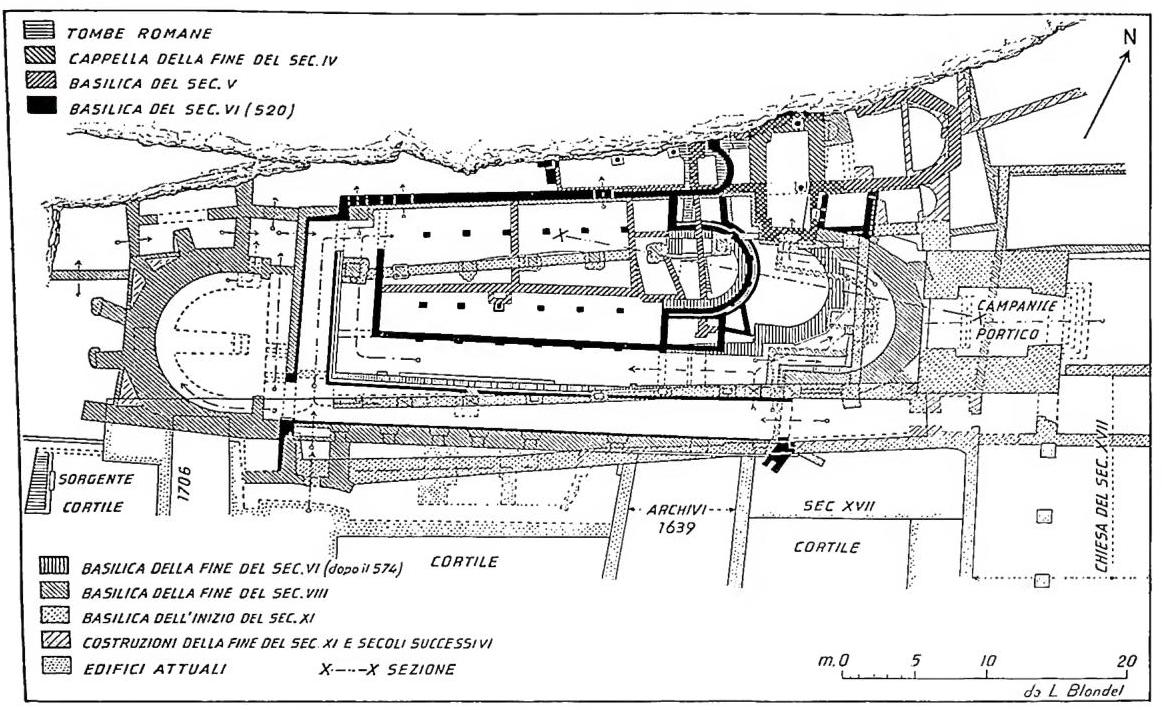
St. Eucherius (d. 449), author of the Passio sanctorum Mauricii ac sociorum eius martyrum (Acta SS. Septembris, VI, Paris 1867, p. 343), relates that St. Theodore, bishop of Octodurus (Martigny), had erected over the tombs of the martyrs of the Theban Legion—Maurice (v.), Candidus, Exuperius, and Victor—a chapel covered by a single-pitched roof resting against the rock; excavations have confirmed this account. Toward the end of the fifth century, we find there a hospice of which St. Severinus was abbot (BHL 7643–7646). The small basilica with a polygonal apse adjoining the rock also belongs to the same century.
(from Valleson, III, 1948)
The abbey of S. Maurice, situated above one of the most frequently travelled medieval passes for descending into Italy, became a place of residence for the most illustrious religious and military figures, especially after the house of Savoy succeeded the kings of Burgundy. For example, Pope Stephen III stayed there for several days in 753. Sacked around 940 by the Saracens, it was rebuilt by Abbot Burcard I in the first half of the 11th century; the burned Basilica was restored and consecrated in 1148 by Pope Eugenius III. It suffered new fires in 1345 and 1560; rebuilt in 1571, it was destroyed by the earthquake of 1611. It was reconstructed beside the ruins, but with a changed orientation. Damaged by falling rocks in 1942, especially in the 11th-century bell tower, it is now being rebuilt. Until the beginning of the 9th century, the monastic community provided service at the
Sanctuary; it was then replaced by canons, as is shown by a Bull of Eugenius I (824-27), who in 1128 adopted the rule of s. Augustine. The abbot of Agaune was often also bishop of Sion (v. AGAUNO).
The archaeological explorations begun in 1896 at the “Martolet” have brought to light not only the remains of the aforementioned basilicas, with their crypts, but also the ruins of a large Merovingian cemetery, numerous epigraphic fragments, including the epitaph of s. Vultcherius, and two baptisteries: the first seems to be identifiable in a room near the Basilica adjoining the rock; the second was found in February 1948 at the center of a square building near the present Basilica.
Of great importance is the treasure owned by the abbey; it is the most precious in all Switzerland for the artistic relics it contains, mostly gifts from the distinguished figures who visited II. These include: a sardonyx vase known as that of s. Martin; a pitcher from the 8th century, a product of Byzantine goldsmithery with Oriental enamels, reportedly offered by Charlemagne; a reliquary casket donated by the presbyter Theuderic (8th century); two large silver chests of Romanesque art, one for s. Maurice and the other for s. Sigismund; a richly decorated Gospel-book cover; a silver bust of s. Candidus, etc.
cene, there 1913; N. Peissard, La découverte du tombeau de St-Maurice martyr d’Agaune à St-Maurice en Valais, St-Maurice 1922; L. Blondel, Les boutiques d’Agaune, in Vallesia, 3 (1948), 9-57. Enrico Josi