
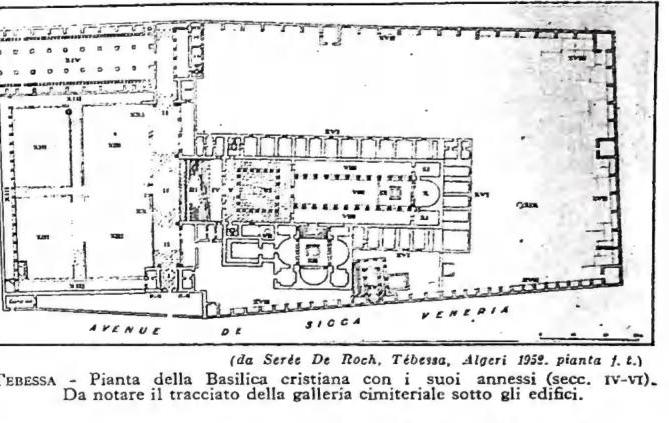
TEBEI, Saints, Martyrs. - Under this designation are included: 1) the martyrs of Agaunum, presented as belonging to the Theban legion by Eucherius of Lyon; 2) a large group of martyrs of Gaul and of Italy, especially northern Italy, attached without any foundation, by medieval and modern hagiographers, to the glorious Agaunensian heroes.
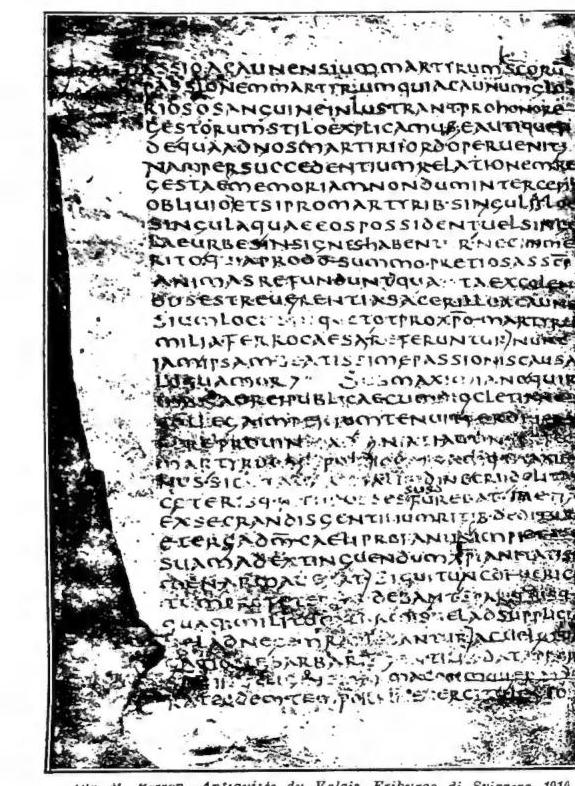
(ou. al. oseum, Antiquità du Valais, Fribourg, Switzerland 1915, fasc. 82)
I. THE THEBAN MARTYRS
Properly so called are the martyrs of Agaunum (v.) in Valais, whose martyrdom is described in the Passio Acaunensium Martyrum, written by Eucherius, bishop of Lyon (434-50 ca.), on the basis of local traditions. This Passio (ed. B. Krusch, MGH, Script. rer. Meroving., III [1896], pp. 32-39) is preserved in codices ranging from the 7th to the 14th century: the first, of the 7th century, and one of the 10th are without interpolations, while the others are variously interpolated in the final paragraphs (VII-VIII of the edition of Th. Ruinart [PL 50, 827-32]; 16-19 of the critical edition). To which of the two Theban legions, of the Diocletianic era: the tertia Diocletiana Thebaeorum or the prima Maximiana Thebaeorum, mentioned in the Notitia dignitatum (ed. O. Seeck, Berlin 1876, p. 25, cf. also p. 64) St. Maurice (v.) and his companions (22 September) belonged, it is not possible to know, even if they did belong to one of them. In any case the historicity of the martyrs of Agaunum, even if it is a vain effort to try to determine their number precisely, is beyond doubt, especially after the confirmation given by the systematic explorations of the archaeological zone of exceptional value that is the Agaunum "martolet" (v. the archaeological plan at the entry AGAUNO and the photograph at the entry MAURIZIO).
II. THE PSEUDO-TEBEI MARTYRS
The heroic conduct of the Theban legion, enthusiastically called "angelica legio" (St. Eucherius, § 12), "felix exercitus" (St. Avitus, bishop of Vienne, sermon delivered at Agaunum in 515: ed. R. Peiper, in MGH, Auctores antiquiss., VI, 2 [1883], p. 145), "legio felix Agaunensis" (Venantius Fortunatus, Carm., VIII, 3, 172: ed. F. Lico in MGH, ibid., IV 1 [1881], p. 185), besides transforming Agaunum into one of the most popular sanctuaries beyond the Alps, induced more than one hagiographer to aggregate to it very numerous other martyrs. Although in the 5th century the total annihilation of the legion was believed ("interfecta est illa plane angelica legio", Eucherius § 12; "nullus exsati", Avitus, loc. cit.), the first to enlarge its ranks was Eucherius himself, who numbered among the T., albeit with a "dicuntur", the martyrs Ursus (v.) and Victor of Solothurn (30 Oct.). His example was then followed in the 6th century by Gregory of Tours, who placed among the T.: the 50 martyrs of Cologne, called the "golden saints", because of the gleaming mosaics of the Basilica erected in their honor (cf. In gloria martyrum, 62: PL 71, 761-62: v. GERDONZ). From then on the unbridled fancy of several devotees peopled Gaul and northern Italy with pseudo-T. martyrs, whether by creating displacements of T. soldiers, or by organizing escapes from the massacre of Agaunum. Cologne boasted of having 318 of them (or 392 depending on the sources) headed by St. Gereon (10 Oct.), to whom the pseudo-Helinand of the 10th century (BHL 3464) associated 360 (others say 350 or 500) soldiers from Mauretania (15 Oct.), Sts. Cassius and Florentius, martyrs of Verona (= Bonn), and St. Victor, martyr of Xanten. The feast of these three martyrs falls on 10 Oct. and their primitive sanctuaries came to light not long ago (cf. G. P. Kirsch, in Riv. di arch. crist., 9 [1932], pp. 151-58; 11 [1934], pp. 363-71). Trier (v.) believed it possessed 300 of them headed by Tirsus, Secundus and Boniface (feast 4 Oct.: BHL 8282-85, cf. also 3949). After the Rhineland, which became in the Middle Ages the radiating center of the cult of the pseudo-T. martyrs, the region that numbers the greatest number of them is Piedmont, where the "bad habit of calling T. all the saints whose deeds are unknown" was followed and unfortunately still is followed, as Father F. Savio has rightly observed (Gli antichi vescovi d'Italia, Il Piemonte, Turin 1898, p. 419). F. Alessio has listed 58 Piedmontese pseudo-T., and he did not succeed in giving a complete list of them. It is worth saying at once that several names listed there are nothing but supposed martyrs, as, for example, George, Maurice and Tiberius, pseudo-T. of the diocese of Pinerolo, Eventius pseudo-T. of the diocese of Aosta and others. Often the origin of the cult of a Piedmontese pseudo-T. martyr is due to the chance discovery of a tomb believed to be that of a martyr (a fact which, moreover, lies at the origin of the cult of not a few martyrs), as happened for St. Chiaffredo, venerated in the diocese of Saluzzo. Sometimes, on the other hand, they are historical local martyrs, such as Adventor, Octavius and Solutor (20 Nov.), authentic martyrs of Turin in whose honor St. Maximus delivered a homily (PL 57, 427-30), transformed into pseudo-T. only in the 6th-7th century by the author of their Passio (BHL 85). Outside Piedmont, the best-known pseudo-T. martyrs, still considered as such by the Roman Martyrology, are: St. Secundus at Ventimiglia (26 Aug.), probably a martyr of the Turin or Vercelli region, attributed to Ventimiglia following an erroneous interpretation of the name of the place of martyrdom mentioned in the Passio of the 6th century (BHL, 7568); St. Alexander (26 Aug.), martyr of Bergamo, transformed into a pseudo-T. in the third redaction of the Passio (BHL, 277), earlier than the 9th century; St. Antoninus (30 Sept.), the famous martyr of Piacenza, declared a T. by the author of the account of the discovery of his body, not later than the 9th-10th century (BHL, 280).
Bibliography8 works
Bollond., 68 (1950), pp. 362-68; Lanzoni, pp. 814-15, 843, 971, 1044-45; Martyr. Hieronymianum, pp. 522, 534, 547-51, 557, 611; Martyr. Romanum, pp. 361, 410, 426, 445, 455, 535. Sugli scavi del «martolet» e delle zone vicine, oltre le opere cit. alla v. AGAUNO, cf. L. Blondel, Le baptistère et les anciens édifices conventuels de l'Abb. d'Agaune, in Vallesia, 4 (1949), pp. 15-28; id., La reconstruction du choeur orient. de la basil. d'Agaune au Xe siècle, ibid., 5 (1950), pp. 167-84; id., Le caveau funéraire du cimet. d'Agaune et la basil. du XIe siècle, ibid., 6 (1951), pp. 1-17; id., La Chapelle Notre-Dame sous-le-Bourg à St-Maurice d'Agaune, ibid., 8 (1953), pp. 5-18.
A.
Pietro Frutaz