
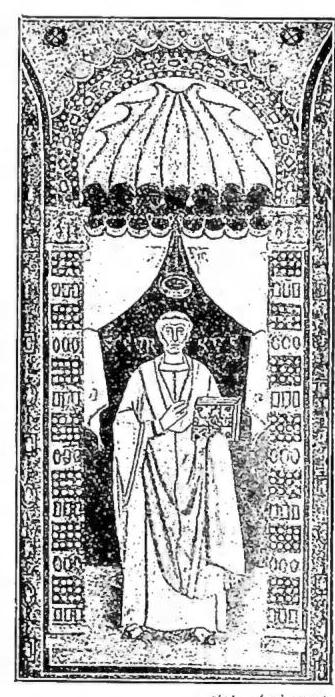
ORSO, saint. - In the Roman Martyrology, three saints of this name are commemorated: 1) St. O., companion of St. Victor, martyrs of Solothurn (Switzerland), numbered among the martyrs of the so-called Theban Legion. Feast on 30 October (BHL, 8584-85; H. Quentin, Les martyrologes historiques du moyen âge, Paris 1908, pp. 280-82; Martyr. Romanum, p. 426). 2) St. O., bishop of Ravenna (d. between 424 and 429), builder and consecrator of the Cathedral, the Anastasis, later called the Basilica Ursiana. Feast on 13 April (BHL, 8455; Lanzoni, p. 749; C. Ricci, Guida di Ravenna, Bologna [1923], pp. 37-45; Martyr. Romanum, p. 137); 3) St. O., bishop of Auxerre between the end of the 5th century and the beginning of the 6th. Feast on 30 July (L. Duchesne, Fastes épiscopaux de l'ancienne Gaule, II, Paris 1910, p. 445; Martyr. Romanum, p. 314).
Among the other saints of this name, St. O. of Aosta deserves mention, greatly venerated in the regions of the Western Alps as protector of the countryside: he is invoked in the danger of floods; to obtain rain, against fever and diseases of livestock, etc. Little is known of his life, apart from certain edifying episodes that constitute the plot of the brief Vita s. Ursi, preserved in two almost identical versions: the first in 9th–10th-century and later manuscripts, unpublished (BHL, Suppl. p. 301; M. Coens, in Anal. Bolland., 52 [1934], p. 259; the undersigned has its edition ready); the second, in 11th-century and later manuscripts, published (BHL, 8453, interpolated; anon., L'Insigne Collégiale d'Aoste, Ivrea 1929, pp. 9-23, not interpolated). Here St. O. appears as the priest officiating at the church of St. Peter extra moenia (a cemetery church, later becoming the collegiate church of SS. Peter and O.) in the time of the unworthy bishop of Aosta, Plocanus, who is not known from any other sources and is said to have lived in the 6th century. The Irish origin of St. O. of Aosta does not seem to be attested before the Liber anniversariorum... (1554) of the Chapter of Aosta Cathedral (ed. A. Gal, in Mon. Historiae Patriae. Scriptores, III, Turin 1848, p. 618); in fact, the manuscript liturgical books of Aosta and even the Breviarium ad Alme Augusten.
(phot. Anderson)