
OBLATI and OBLATE. — This was the name given to children consecrated to God in a monastery by their parents, and to those adults who, in the late Middle Ages, offered themselves, their services, and their possessions for ascetic purposes to a monastery, a hospital, or a church.
1. The oblation of children
The custom, established among Christian parents at least since the 4th century, of offering their children to God in order to dedicate them perpetually to his service, besides being supported by the example of the typical offering of the young Samuel (I Sam. 1, 28), was in conformity with the rights that the Roman « patria potestas » and, subsequently, the Germanic « mundio » recognized parents as having over their children. S. Gregorio di Nazianzo mentions with pleasure that he had been offered to God immediately after birth (cf. Carm. de seipso, vv. 424-34: PG 37, 1001-1002); s. Girolamo reminds Leta that her daughter Paola is « oblata » to God (Epist., 107, ad Laetam, 6: PL 27, 874); Salviano speaks of a « monachus ab incunabulis » (Ad ecclesiam, II, 4: PL 53, 192) and of the disinheritance of children offered to God: « indigni iudicantur haereditate, qui digni fuerunt consecciatione » (op. cit., III, 4: ibid., col. 209), a concept also found in the Regula Magistri (cap. 91: PL 88, 1044) and later taken up and codified by s. Benedetto. But already in his time s. Girolamo refers to the abuse of « miseri parentes »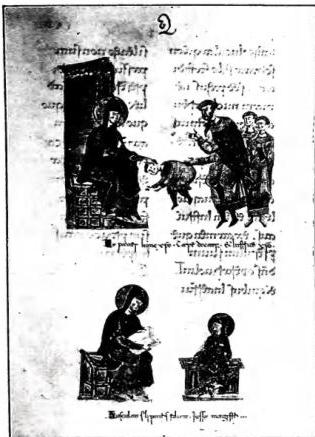
OBLATI AND OBLATE - The young Mauro offered to St. Benedict by his parents and instructed by the Saint. Miniature from cod. Vat. lat. 1202, f. 114' (second half of the 11th century), containing the Vita s. Benedicti, s. Mauri et s. Scholasticae in lectionary form.
who offered deformed children to God (Epist., 130, ad Demetriadem, 6: PL 22, 1111), an abuse that became entrenched over the centuries, as is shown by the letter prefixed by Abbot Ulrich (or Udalrich) of Cluny (d. 1093) to his Consuetudines Cluniacenses (PL 149, 635-36).
The offering of children of both sexes to monasteries was soon regulated by the monastic rules of the 4th–6th centuries: a) In the East, St. Basil first provided for this in the so-called Great Rule: orphaned children were to be received without any further formality, whereas the others were to be offered in the presence of witnesses; they could be admitted to the « castitatis professio » only once they had reached « aetas rationis complementum », that is, not before the age of 16 or 17, and the profession was to be made in the presence of witnesses. It was subsequently prescribed that they be housed and educated in dwellings separate from the monastery, namely in the « metochia » situated outside the monastic enclosure. Byzantine law would prove extremely strict in observing this precautionary rule (cf. Reg. fusias tract., resp. ad interrog. XV: PG 31, 951, 955; Epist., 199 ad Amphilochium, 18: PG 32, 719: for later canonical provisions on the matter, cf. F. de Meester, De monachico statu iuxta disciplinam byzantinam, Vatican City 1942, pp. 164-65, 167-68, 172-73, 352-53). References to the presence of « pueri » in Egyptian monasteries are found in §§ 166 and 172 of the Rule of St. Pachomius (ed. A. Boon, Pachomiana latina, Leuven 1932, pp. 66, 68). From the Coptic monastery of Apa Phoebammon on the Gêmeh (Thebes) come several interesting records of the offering of children, intended principally for the monastery’s domestic and agricultural services (late 8th–early 9th century): the donation was irrevocable, and the document, drawn up by a notary and signed by the donor and witnesses, was kept in the monastery’s archive (cf. F. de Villenoisy, Les donations d'enfants à l'époque copte, in
Rev. égyptologique, 6 [1891], pp. 30-35, 150-53; 7 [1892], pp. 199-200, 146-49, an article summarized by H. Leclercq, Oblats, in DACL, XII, II, 1867-71).
b) In the West. The presence of children in monasteries and their deed of offering, which they would ratify when they reached the appropriate age, is addressed both in the Statuta Sanctarum Virginum of St. Caesarius of Arles (§§ 6-7: ed. G. Morin, S. Caesarii opera omnia, II, Maredsous 1942, pp. 103-104) and in the Regula ad monachos of St. Aurelian of Arles (§§ 17, 22: PL 68, 390, 392). The Regula Magistri (cap. 91: PL 88, 2042-45) likewise deals with noble youths who wished to enter the monastery and who were to be offered by their parents and disinherited by them. The rules governing the offering of « pueri » throughout the Middle Ages, however, were laid down by St. Benedict (Regula, cap. 59): the donor was to present the « petitio » and offer the child at the altar; if the oblator was noble or wealthy, he was to disinherit the o.; if poor, the offering was to be made in the presence of witnesses. The rite of offering was subsequently established as follows: after the Gospel at the abbot’s Mass, the child was accompanied to the altar holding the host, the cruet of wine, and the « petitio », all wrapped in the corporal or altar cloth (cf. the commentary on the Rule attributed to Paul the Deacon, cap. 59: Biblioth. Casinensis, IV, Monte Cassino 1880, Florilegium, pp. 151-52; B. Albers, Consuetudines monasticae, II, Stuttgart 1900, p. 157; III, Monte Cassino 1907, pp. 180, 185). The offering was regarded as irrevocable both in Benedictine circles (Riepenhoff, cited in the bibliography, denies that this was so for St. Benedict) and outside them (cf., for example, in the case of girls, canon 19 [irrevocable after one year or three years, depending on the circumstances] of the Council of Orléans of 549 and canon 12 [stricter than the preceding one] of the Council of Mâcon of 583: Mansi, IX, 133, 934); and for a large part of the Middle Ages (up to the 13th century), the rule laid down in canon 49 of the Fourth Council of Toledo of 633 was repeated in this regard: « monachum aut paterna devotio aut propria professio facit: quidquid horum fuerit, alligatum tenebit. Proinde his ad mundum reverti intercludimus aditum et omnem ad saeculum interdicimus regressum » (Mansi, X, 631; cf. Decretum Gratiani: causa XX, q. 1). Yet, from as early as the 7th century, attempts to temper this severe discipline can be observed here and there, as is shown, for example, by canon 6 of the Tenth Council of Toledo of 656 (Mansi, XI, 36-37), by the Capitular of Aachen of 817, drawn up under the influence of St. Benedict of Aniane (§ 36: ed. A. Boretius, in MGH, Capitularia, I [1883], p. 346), and by the Council of Mainz of 820, which discussed and resolved affirmatively the case of the forced profession of the young monk Gottescalco (ed. A. Werminghoff, in MGH, Concilia aevi Karolini, II [1906-1908], p. 205). Abbot Rabanus Maurus, struck by the conciliar decision, vigorously protested against it in his opusculum Contra eos qui repugnant institutis beati Patris Benedicti (PL 107, 419-40). Only toward the end of the 12th century did certain papal decisions, later incorporated into the Decretals of Gregory IX [1234], mitigate the preceding legislative severity and guarantee the personal freedom of the young o., raising the age of profession to 12 for women and 14 completed years for men (X, III, 31 de regul.); this rule in practice helped accelerate the disappearance of the offering, which had already been rejected by certain monastic reforms of the 11th–12th centuries, such as those of Cluny (at a later stage), Hirsau, the Grande Chartreuse, and others. The o., who normally constituted the intellectual element of the monastery, often formed within it a group opposed to that of the « conversi », who had entered the monastery as adults and were for the most part « illitterati ». The little that is known about the life led by young o. in monasteries during the early Middle Ages is contained in the Commentary on the Benedictine Rule attributed to Paul the Deacon (cf., for example, the commentary on cap. 37: cited ed., p. 124).
The institution of offering was also in force among the Canons Regular and among the Mendicants, Dominicans and Franciscans. With the decree of the Council of Trent declaring profession made before the age of 16 null, the last vestiges of the offering of children disappeared (cf. sess. XXV, de regularibus, cap. 15).
2. The offering of adults
From as early as the 7th century and throughout the Middle Ages, there are examples of pious women (« Deo dedicatæ, Deo sacratae, Deo devotæ ») who offered themselves not only to women’s monasteries but also to men’s. At St. Gall, for example, in the 10th century, the o. wove, worked on the binding of codices, and made hosts for the abbey (cf. G. de Valous, cited in the bibliography, I, 46). Their dwelling was situated outside the monastic enclosure, and the abbots Ulrich and Peter the Venerable of Cluny (d. 1156) strongly insisted that this precautionary rule be strictly observed (cf. PL. 149, 637 [letter of Ulrich]; ibid., 189, 1038 [Statuta Congreg. Cluniac., 47]).The oblation of men who donated themselves, their work, and their possessions to a monastery assumed greater importance, whether by entering it or by living in the world, sometimes retaining the usufruct of the goods offered. Sporadic examples of this oblation are found as early as the eighth century; at that time these were « hospites » who asked to be allowed to work at their « conversio morum » in the monastery, without undertaking monastic obligations. The oblation of adults, which took the most varied forms in the implementation of the donation, nevertheless first achieved a strong affirmation in the eleventh century, a period in which among monks there was an intensifying tendency to abandon manual labor in order to devote more time to liturgical prayer and intellectual culture. It began to flourish at Cluny, Camaldoli, and Vallombrosa, then, toward the end of the century and at the beginning of the twelfth century, developed more broadly at Hirsau, through the work of Abbot Guglielmo, at Cîteaux, the Grande Chartreuse, and Prémontré; but in each of these centers it acquired its own regulations and character. In addition to individual oblation, there were also cases of the oblation of entire families whose members became servants of the monastery. As for the rite of oblation, it was similar to that in use for the oblation of children: the oblation took place in the hands of the abbot, and great care was taken to wrap the hand of the o. holding the document of oblation, signed by the person concerned and by witnesses, with the altar cloth. With these adult o., called in the documents by the most varied names (« donati, devoti, commissi, offerti, monaci laici, conversi », etc.) and recruited, at first, from among the « famuli », the « hospites », the « nutriti », and the « monaci ad succurrendum », the monastic congregations of the eleventh and twelfth centuries were able to free themselves to a considerable extent from the mercenary « famuli » whom the abbot of Cluny, Pietro il Venerabile, rightly called « quorundam monasteriorum pessimi destructores » (Statuta Congr. Cluniacensis, 48: PL. 189, 1038).
At Camaldoli, Vallombrosa, the Grande Chartreuse, and Cîteaux, the canonical status of the o., who entered the monastery and were later commonly called « conversi », became increasingly well defined: they became true religious (cf. canon 7 of the Second Lateran Council, of 1139, where mention is made of « conversi professi »; Mansi, XXI, 527), while remaining separate from the monks whom they served through their humble labors. At Cluny this development appears complete in the already mentioned Statuta of Pietro il Venerabile. By the end of the twelfth century, those who, while offering themselves and their possessions to a monastery and promising obedience to the abbot, retained a certain freedom of action were preferably called o., « donati », « recepti », etc. (the nomenclature varies according to the Orders) (cf. the concept of o. in canon 57 of the Lateran Council of 1215: Mansi, XXII, 1046; and Umberto di Romans’s concept of « donati »: Creytens, art. cit. in bibl., p. 12). The present-day « regular » o., priests or laymen, received into certain monasteries after merely promising to live according to the rule, can be traced back to these o. For the present-day « secular » Benedictine o., who nevertheless have nothing in common with the ancient o.: V. BENEDETTINI, V. Oblati.
Besides the monastic orders, adult o., belonging to the two great categories mentioned above, are found in hospitals, charitable hospices, Chapters, parish churches, and the Mendicant Orders; and just as men’s monasteries had their o., so women’s monasteries possessed theirs.