
BIZANTINA, MUSICA. — This is the general name given to the musical system of the Churches of the Byzantine rite whose principal center was Byzantium.
FIRST PERIOD. — With the Gospel, the Apostles also brought their traditions among the Gentiles. Hymns and psalms resounded in the first Christian assemblies as in the synagogue, perhaps in the same Hebrew melodies. Gradually, however, as the Hellenic masses were won over to the faith, those melodies were no longer satisfactory, since the Greek people possessed too keen a sense of art. It is therefore easy to suppose that, after the Constantinian peace, the new and magnificent temples of the Greek Christian communities must have resounded with hymns and psalms performed in the ancient Dorian, Lydian, Phrygian, etc., melodies. Throughout the entire period extending from the 1st to the 8th centuries, however, we are still very far from having a single system of chant. Clement of Alexandria, in the Paedagogus (PG 8, 445), recommends abandoning the chromatic mode, because it arouses passion. And in Alexandria, singing was nothing more than a more or less modulated recitation. At Caesarea in Cappadocia, St. Basil, who more than anyone else sought to reconcile the classical spirit with the new faith, formed, according to what Michael Psellos tells us, strong choirs for his church, as among the ancient Greeks; he composed new hymns and new melodies and entrusted certain parts of the singing also to female performers. This was done to combat the Arians, who, with their theatrical music, attracted many simple people to their churches. For the same reason, several Fathers even tolerated the introduction of instruments (Nicephorus, Historia, IX, 16), whose use—or rather abuse—was forbidden once the cause had ceased. The Council of Laodicea (can. 55) prohibited in churches the singing of individuals who had not received ordination to the cantorate, and also forbade the performance of non-canonical psalms (can. 49). In time, however, many new hymns and new melodies were officially accepted; Sophronius of Jerusalem, Romanos the Melodist, and many others left profound traces in hymnology and in music which, from its propelling centre, could by then be called Byzantine.
Throughout this period, musical writing, or semiography, was alphabetical, as had already been used by the classical authors.
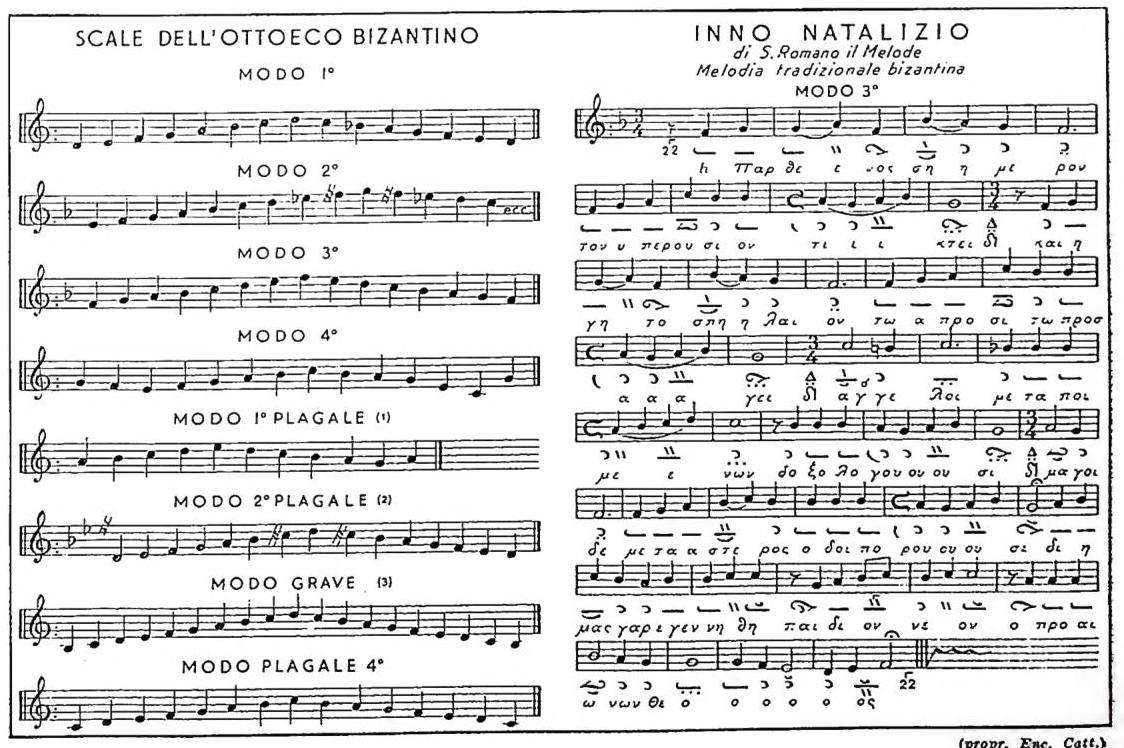
BYZANTINE MUSICAL SYSTEM
Ascending and descending notes
| Πεταστή | υ | = 1 | Γοργόν | τ | δδ |
| Κεντήματα | υ | = 1 | Ἀργόν | τ | δδ |
| Κέντημα | υ | = 2 | Βαρεῖα | υ | δ |
| Ὀψηλή | δ | = 4 | Ὁμαλόν | γ | δ |
| Ἀπόστροφος | γ | = 1 | Ἀντικένωμα | γ | δ |
| Ὠπορροή | γ | = 2 | Ψηφιστόν | γ | δ |
| Ἐλαφρόν | ο | = 2 | Ἕτερον | ο | δ |
| Χαμηλή | υ | = 4 | Ἐνδόφωνον | ο | δ |
KEYS
| γ | do | π | re | δ | mi | τ | fa | δ | sol | κ | la | ζ | si |
|---|
(propr. Enc. Catt.)
The documents are extremely rare, and the whole corpus is reduced to a few papyri of great value, whose interpretation presents insurmountable difficulties.
In the second half of this period, a new semeiography called econetic, that is, declamatory, arose. Apparently, according to the documents that have come down to us, it was used only for the recitation of the prophetic, apostolic, and Gospel readings. There are 14 signs. The manuscripts known to date (about twenty) belong to the eighth to thirteenth centuries; afterward they disappear. Their interpretation is difficult, because the keys are lacking and the exact value of the individual signs is unknown.
II PERIOD (eighth–thirteenth centuries). — This is the golden age of hymnography and Byzantine music. The liturgy is enriched with poetic-musical compositions of the highest artistic and literary value. The composers of the Greek churches of southern Italy are not inferior to those of the East; among the many Italo-Greeks, Marco di Otranto, Giuseppe di Siracusa, Nilo di Rossano, founder of the famous monastery of Grottaferrata, and his disciple Bartolomeo deserve mention. Above all, however, the two supreme masters stand out, Cosma di Maiuma and Giovanni Damasceno. Tradition attributes to these two, and especially to the latter, the musical reform that began in the eighth century.
The musical system is divided into eight modes: 4 authentic and 4 plagal. These retain the old designations—Dorian, Lydian, Phrygian, and Mixolydian—but are also simply called first, second, plagal of the first, and so forth. New diastematic signs are created to indicate the various intervals or groups of notes. It should be noted at once, however, that these signs do not indicate a single precise interval of 2, 5, etc., but rather a group of successive notes governed by established rules, though with differing movement according to whether the same sign occurs in one “mode” or another, in one position or another. These signs were therefore, above all, mnemonic aids for the cantor, who, in order to perform his office worthily, had to possess a strong musical memory. To facilitate his task still further, other signs called χειρουμία (the law of the movement of the hands) were created; placed below or above the diastematic signs, they indicated more clearly to the cantor the various movements of the musical phrase contained in that sign. Expert masters, through the movement of their hands (whence the name χειρουμία), made the choir’s task easier still. The diastematic signs number 14, of which 11 are still in use today. The chironomic signs also number 14, though in time they increased in number. At the beginning of every melody, the “mode” to which it belongs and the μαρτυρία, or key, are indicated. The manuscripts of this period known to date number little more than 50, a considerable number of them being in the abbey of Grottaferrata. Taking into account the still-living tradition and the manuscripts of the following period, it is nevertheless possible, although the task remains arduous, to reconstruct these ancient melodies.
III PERIOD (thirteenth–nineteenth centuries). — During the eighth to eleventh centuries, Byzantine hymnography reached its apogee. Poetic-musical compositions now abound throughout the entire liturgical cycle. From the eleventh century onward, the great masters set themselves the principal task of teaching, through the laws of “chironomy,” the faithful interpretation of the compositions of the great hymnographers. The system invented by them was not easy: the stenographic meaning not only of the chironomic signs but also of many diastematic signs gave rise to no small number of divergences. A new reform was proposed, and this took place in the thirteenth century. It is attributed to Giovanni Kukusélia, master of the imperial chapel and subsequently a monk in the Great Lavra of Athos. Probably, however, he was no more than the expo-
In this system, nearly all the diastematic signs are assigned a precise value (interval of 2, 3, etc.). The melody, however, is still not written out in full. To indicate the development of the melody (which, as they expressed it, is contained in the diastematic sign as the ear of grain in the seed), the cheironomic signs are still used; their rules are more clearly determined, and the number of these signs has greatly increased. It should also be noted that the same sign changed in value according to its position, and even according to whether it was written in red or black. The μαρτυραι, or keys, are indicated not only at the beginning of the melody but also after each musical period, indicating the last note sung. No one can fail to see the great benefit of this innovation. The φθοραί, or accidentals, proper to each «mode», are generally marked, whereas previously this too had been entrusted to the singer’s memory. Many grammars were also written, some of which have come down to us (v. L. Tardo, L'antica melurgia bizantina, Grottaferrata 1938, pp. 145-260). These too, however, require the interpretation of the master, since they are neither clear nor complete.
With time, the cheironomic signs continued to increase, in an effort to commit to writing ever more exactly what tradition had transmitted. Among the many famous masters of this period were Giovanni Kladas, Manuele il Vecchio (sec. xv), Manuele il Giovane, and Balasios (sec. xvi). The latter in particular began to address the problem of writing melodies more exactly with diastematic signs, without too many implicit assumptions. He initiated his system by interpreting many of the cheironomic signs. Other masters followed him, down to Pietro del Peloponneso, lambadharios (head of the left choir) of the Great Church (sec. xviii). Having reduced the ancient, synthetic semeiography to a few phrases for each «mode», which were easy to remember and were still written with the old cheironomic signs, he analyzed almost everything else. It was Balasios’s method, but carried considerably further. He taught his method to a group of disciples. Having done this, he undertook a work that was to immortalize him in the annals of Byzantine music: the transcription of all the sacred melodies transmitted by tradition up to his time, including those of the andante type, which had never previously been written down but had only been transmitted orally. No one could have undertaken this work better than he, endowed as he was with an incomparable musical memory, enabling him to transcribe any melody after hearing it only once. The intelligent lambadharios had thus cleared the way for a radical reform. By then, with the advent of printing, stenographic semeiography no longer had any reason to exist.
IV PERIOD (sec. xix). — Following in Pietro’s footsteps, at the end of the 1700s, three learned and courageous masters—Crisanto, bishop of Prusse, Gregorio lambadharios, and Curmusio cartofilace—undertook to deliver the final blows to the old system. In 1815 they presented the fruits of their work to the ecumenical patriarch, who, after much hesitation, finally approved II. Blind attachment to tradition caused this system to be opposed by many, including the protopsaltis (first cantor) of the Great Church, Costantino; indeed, it is interesting to know (as proof of the accuracy of the transcription of the melodies) that while the latter sang from books using the old system, the lambadharios Gregorio simultaneously sang from books using the new system.
Thus reformed, the Byzantine musical system assumed its definitive form, and it is still today the official system of the Byzantine Church.
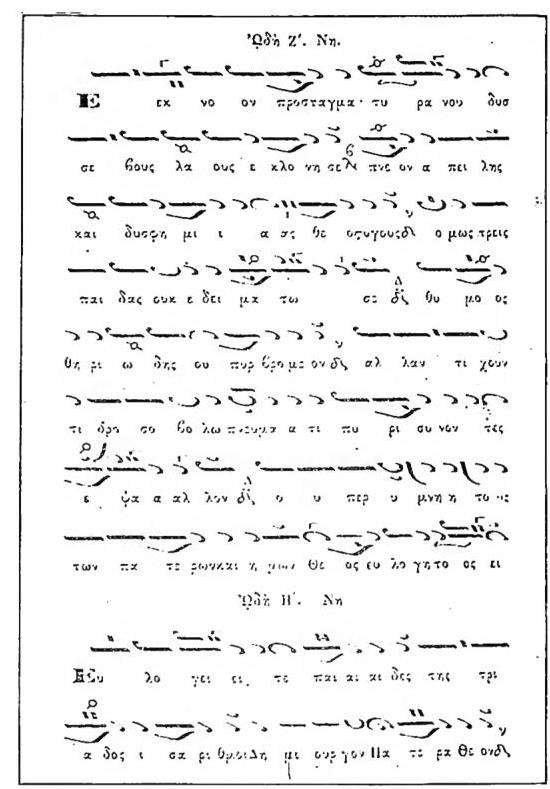
BIZANTINA, MUSICA — Chrysanthine semiography. A page from the χρηστομαδία ἐκκλησιαστικῆς of Giovanni Sakellaridis, Athens 1886.
4) Almost all the cheironomic signs, by now rendered useless, were also abolished. Those that remained were assigned only expressive value. 5) Solfège, which the ancient masters taught using the monosyllables Na, Ne, Te, To, Ru, Rem, etc., is now taught using musical notes, seven in number, taken from the alphabet: πΑ (re) — Βω (mi) — Γα (fa) — Δι (sol) — πΕ (la) — Ζω (si) — νΗ (do). In almost all other respects, fidelity to tradition is maintained. The modes are likewise eight and retain the old designations and the old scales. The same applies to the μαρτυραι, or keys, and the φθοραί, or accidentals. Finally, it should be noted that the three reformers transcribed, in the new system, all the ancient melodies of the liturgical year.
CONCLUSION. — After what has been said, a question arises spontaneously: are the melodies currently in use in the Byzantine Church the same as those that came from the pens of the ancient hymnographers? It must be answered that many of them bear the names of their composers, especially from the 14th century onward; they are therefore not the melodies of the hymnographers. Others are original melodies, but embellished by later authors, whose names are reported in the manuscripts. Then there are all the other traditional melodies, transcribed, as was said above, by Pietro lambadharios; these should go back to the original authors. Sound criticism, however, opposes this view. After so many centuries, one cannot speak of identity between the melodies of today and those of that time. Nevertheless, considering that the tradition has always remained alive and has not only been transmitted by genuine schools directed by excellent teachers, but has also been placed under the direct supervision of the high clergy of the Church of Constantinople, it must be concluded that, even allowing for a necessary evolution, these melodies contain much that is original, and that the reconstruction of the ancient melodies is possible only on the basis of these.
For several years, many European musicologists have studied the ancient Byzantine musical system. But some of them completely disregard the tradition. As a result, they have arrived at the most divergent conclusions. Some even deny the scales and the value of the diastematic signs. In compensation, they invent systems of their own. Still others deny the existence of any kind of stenography and interpret the cheironomic signs as signs of expression, forgetting that expression is called ἔχωρας by the Greeks, and not χειρονημία.
In Italy, the study of Byzantine music received a major impetus from Fr. Lorenzo Tardo of the monastery of Grottaferrata, who has made it possible for everyone to pursue more deeply the study of the subject.
BIBLI: L. A. Bourgault Ducoudray, Etudes sur la musique ecclésiastique grecque, Paris 1877; G. Papadopoulos, Συμβολιεῖς τὴν ἱστορίαν καὶ ἡμῖν Ἐκολ. μονοκῆς, Athens 1890; H. Gaiser, Le système musical de l'Église grecque d'après la tradition, ibid. 1905; J. B. Robours, Traité de poétique, théorie et pratique du chant dans l'Église grecque, ibid. 1905; U. Riemann, Die byzantinische Nationalistik zu X-XV. Jahrb., Leipzig 1909; J. Tillyard, Byzantine music and hymnography, London 1913; K. Fachoi, Ἡ παρασπαστικὴ τῆς βυζαντινῆς μονοκῆς, Athens 1917; J. Thibaut, Manuscrits de la notation ephénistique et hagiopolite de l'Église grecque, Paris 1923; J. Tillyard, Handbook of the riddle byzantine musical notation, London 1933; E. Wellesz, Studien zur byzantinischen Musik, in Zeitschrift für Musikwissenschaft, 16 (1934), pp. 313-28 and 414-22; L. Tardo, L'antica melangie bizantina, Grottaferrata 1938; O. Tiby, La musica bizantina, teoria e storia, Milan 1938. Giuseppe Ferrari