
GIOVANNI DAMASCENO, saint. — Doctor of the Church.
SUMMARY:
I. Life
II. Works
III. Doctrine
IV. Influence.I. LIFE
It is known only in its broad outlines, given the brevity of the earliest sources and the uncertainties of the later biographies, as well as the almost total lack of biographical indications in the works, numerous though they are, of G.Concerning G., there is the Vita araba, written by the Antiochene hieromonk Michele in 1085, discovered and published by C. Basa in 1912. The patriarch Giovanni, not more precisely identified but apparently belonging to the beginning of the twelfth century, depends upon it in his Vita greca, which is repeated in the Damascene editions; this, in turn, is the source of the Encomio of Costantino Acropolita and of two other Greek Vite, one anonymous, the other by the patriarch Giovanni Merkuropo, edited by Papadopulo-Kerameus. To these documents there was added in 1926 a shorter account of G.’s life, attributable to the tenth century; from it derive the notices in the oldest Synaxaries.
From these sources it is learned with certainty that G. was born in Damascus, sometime after the middle of the seventh century, into the noble and wealthy Manşur family, and that he held the office of Prefect of the dīwān during the early period of Islamic rule, until approximately 705. G.’s father was Manşur b. Sarğun, a friend of Prince Jazid, at whose court G. spent his early years. But, renouncing honors, probably already at the beginning of the eighth century, he embraced monastic life in the laura of S. Saba, near Jerusalem, where his companions were Cosma, the future bishop of Maiuma, and his own nephew, St. Stefano innior. In Jerusalem he enjoyed the esteem of the patriarch Giovanni (d. 735) and acquired great fame for his eloquence and writings, chiefly polemical, against the Christological heresies widespread in Syria and Palestine and against the iconoclasts of Byzantium. Other details concerning his studies in Damascus, acts of humility and obedience in the Jerusalemite laura, and so forth, cannot be verified, or are to be regarded as false.
Among the latter belongs the episode of the hand severed at the caliph’s command and miraculously restored to him. He died in
(phot. Alinari)
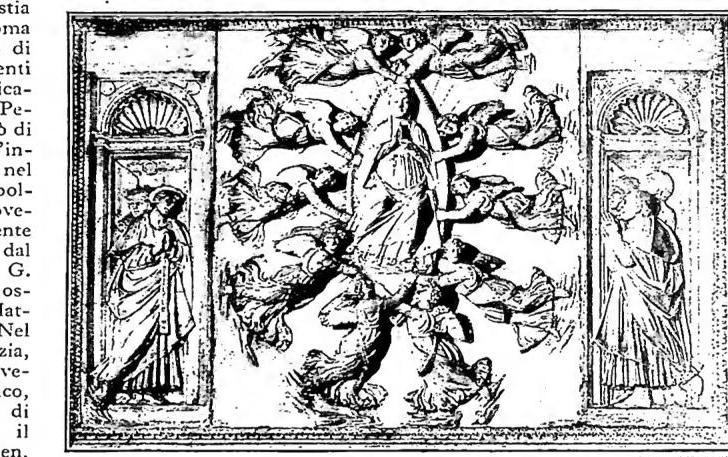
GIOVANNI DALMATA - The Assumption of the Virgin. Relief in the basilica of S. Maria Maggiore.
II. WORKS. — G. transmitted numerous dogmatic, polemical, ascetic, exegetical, homiletic, and poetic works, collected in the editions produced in the West, to be supplemented by others that have so far remained unpublished.
Leaving aside the first Latin editions of Giacomo Fabro (Paris 1507), of Clictoveo (there 1512), and the Greek edition of Donato Veronese (Verona 1531), which are limited to the treatise De fide orthodoxa, the oration De iis qui in fide dormierunt, and the Historia Barlaum et Ioasaph, the first more complete edition was produced by Henricus Gavius (Cologne 1546). This was followed by the Greek-Latin edition of Matteo Hopper (Basel 1548) and the new Latin translation of Giacomo Billy (Paris 1577), enlarged in 1603 by Frontone le Duc. Finally, the Dominican Michele Lequien (Paris 1712) published his Greek-Latin edition, reproduced by Migne (PG 94-96). At present the Benedictine Fathers of the Abbey of Scheiern in Bavaria are working on a new critical edition.
I. Dogmatic works. — G.’s fame rests upon the so-called Fons cognitionis, divided into three parts: Dialectica, De haeresibus, De fide orthodoxa (PG 94, 525-2128), although the titles used by G. are: Capita philosophica, De haeresibus, Capita theologica. A considerable number of critical questions concerning the work remain to be resolved.
The manuscripts present a twofold recension of the work. The Dialectica sometimes has 50 chapters and sometimes 68. The De fide orthodoxa repeats chapter 12, and although it always contains 100 chapters in the manuscripts, the last ones, 81-100, are often found in the older manuscripts between chapters 18-19. Moreover, Elias, the Jacobite patriarch, refers to G.’s chapters around the year 728; and G. himself dedicates the work to the bishop of Maiuma, Cosmas, who was consecrated in 742. It may therefore be assumed that the first recension, with the longer Dialectica and the shorter De fide orthodoxa, was composed before the iconoclastic controversies; the other, with the shorter Dialectica and the De fide orthodoxa enlarged by the final chapters, after 742.
Other short dogmatic treatises must be added to this work, namely: Liber de recta sententia, intended for Peter, bishop of Damascus, written before 730 (PG 94, 1421-32); Expositio fidei (PG 95, 417-36); Introductio elementaris ad dogmata (PG 95, 100-12). It is not certain that the Libellus orthodoxiae (Orientalia Christiana, 8 [1926], pp. 82-103) belongs to G.
2. Polemical works. — Two treatises against the Nestorians are preserved: Contra haecissim nestorianorum (PG 95, 187-224), of doubtful authenticity, and Sermo de fide contra Nestorium, published by F. Diekamp (Theel. Quartalsch., 83 [1901], pp. 555-95), a genuine work of G.
Against the Monophysites he wrote: Tractatus contra Jacobina (PG 94, 1436-1501), probably addressed to Ella, patriarch of Antioch (d. in 728); Tractatus contra acephalos (PG 95, 112-26); and the letter to the archimandrite Giornades, De hymno Trisagio (PG 95, 21-62).
Against the Monothelites he composed: De duabus in Christo voluntatibus (PG 95, 128-85). The manuscripts, for example Vat. gr. 1075, give another unpublished treatise, Contra monophysitas et monotelitas.
Against the Manichaeans, or Paulicians, there are: S. Ioannis Damasceni dialogus contra manichae (PG 94, 1505-84) and Disputatio Ioannis orthodoxi cum manichae (PG 96, 1320-33), attributed to G. by Mai without arguments of any kind.
But the controversy that made G. best known was that against the iconoclasts, whom he defeated in his three Orationes de sanctis imaginibus (PG 94, 1232-1429), whose manuscript tradition presents a considerable number of problems.
In reality, there are only two, since the third is nothing other than a literal transcription of the first and second (cols. 1317-24 and 1329-33 are taken from the second; cols. 1324-29 from the first).
Other writings on images are not by G., namely: Oratio contra Constantinum Cabalinum (PG 95, 309-44), later than the Iconoclastic Synod of 753; Dialogus stilienticus de sanctis imaginibus (PG 96, 1347-66), composed in 771; and the Epistula ad Theophilum (PG 95, 345-85), who became emperor almost a century after G.’s death.
3. Ascetic works. — The principal work in this group is the one entitled by Lequien Sacra parallela (PG 95, 1309-1588; 96, 9-442), although the ancient manuscripts call it simply Sacra, and other, more recent ones simply Parallela: a collection of testimonies from Holy Scripture and the Fathers concerning the moral virtues. He also wrote: De octo spiritibus nequitiae (PG 95, 79-84); De virtutibus et vitiis (PG 95, 85-98); De sacris ieiunii (PG 95, 63-78).
4. Exegesis. — In this field, nothing is preserved apart from a commentary on the Epistles of St. Paul (PG 95, 441-1034).
5. Homilies. — The manuscripts contain quite a number of homilies by G. (Gordillo has collected 39), of which only 13 have been published in PG 96, 545-814. Among them,
the first and second In Annuntiationem, the second In Nativitatem B. M. V., and the one De Cruce et Parasceve are of doubtful authenticity. The most celebrated are the three homilies In dormitionem, delivered in the basilica of the Tomb of the Madonna, around 740.
Seven others, De mundi opificio and De Noe, published by K. Dyobouniotis (Ἐκκλησιαστικὴ Φάσις, 13 [1914], pp. 53-69, 119-49), belong among the spurious works of St. John Chrysostom (PG 56, 429-500), and probably belong to Severian of Gabala.
6. Poetic compositions. — G. must be numbered among the great Byzantine hymnographers. Lequien reproduced numerous hymns and prayers (PG 96, 817-56, 1363-68). Migne included six other hymns (PG 96, 1372-1408), attributed to G. by Mai, but now regarded as the work of Giovanni Mauropos.
7. Other works. — The homily De iis qui in fide dormierunt (PG 95, 247-78), contained in an infinite number of manuscripts and thus far read in the Byzantine liturgy, is considered doubtful on stylistic grounds; but perhaps this reason is insufficient to outweigh the force of the manuscript tradition, unanimous in placing it under G.’s name.
On the other hand, the Historia Barlaam et Ioanaph (PG 96, 859-1240) must be totally excluded: it was translated into Arabic, Coptic, Armenian, Georgian, Latin, French, Italian, German, Spanish, Irish, Polish, Hebrew, etc. The first to make it a work of G. was Trithemius. It is currently held that this legend, related to the story of Buddha, was first written in Georgian, and then in Greek by St. Euthymius the Iberian in the tenth century.
III. DOCTRINE
G. is often called the “St Thomas of the East,” although he differs from Aquinas both in the greater narrowness of his doctrinal synthesis and in the originality of his ideas, since, as he expressly declares (PG 94, 525 A), his purpose is to gather together the teachings of the Fathers and ancient writers.Thus the Sacra parallela, with their 6,000 citations, are drawn from earlier florilegia, chiefly from the Pandects of Antiochus, a monk of S. Sabba. The Dialectica depends on Ammonius and Leontius of Byzantium. The latter, s. Maximus the Confessor, pseudo-Cyril, and the Doctrina Patrum de Incarnatione Verbi are reproduced verbatim in the Christological treatises. And in the other treatises there are continuous passages from the Fathers, chiefly from the three Cappadocians, s. Epiphanius, Nemesius of Emesa, and pseudo-Dionysius.
From this, and from the absence of the Latin Fathers, comes the fact that G. uses formulas that do not correspond to one another and that cause particular difficulty for Westerners. A classic example is his manner of speaking about the Procession of the Holy Spirit: at times he attributes it also to the Son (PG 94, 848 D, 849 A, B, 1512 B), at times he denies that it can be said that the Spirit is from the Son (PG 94, 832 B; 95, 60 C-D; 96, 605 B), which occasioned the censures of the scholastics and the interminable Byzantine disputes inaugurated in the 13th century between Giovanni Beccos and Giorgio Ciprio. The same may be said of the nature of the fire of Hell, concerning which it is uncertain whether G. regarded it as real or metaphorical (PG 94, 1228 A,
1541 C-D, 1573 C). Following his source as well, s. Epiphanius, G. accepts for the Old Testament only the Hebrew canon (PG 94, 1176-80), but then cites the so-called “deuterocanonical” books as inspired books.
These and a few other reservations do not detract from the solidity of G.’s doctrine concerning the Most Holy Trinity, the work of creation, the economy of Redemption, the Eucharist, and other parts of Catholic dogma. His teaching on Mariology and on the veneration of sacred images is especially noteworthy.
Among the privileges of the Madonna, he principally develops her divine Motherhood, beautifully summarized in the De fide orthodoxa (PG 94, 985 B, cf. 1008 C, 1028 B, 1160 C), and her bodily Assumption, which he demonstrates from Tradition and from the analogy of faith in the three homilies on this subject (PG 96, 700-61). With equal piety and doctrinal solidity he treats of her perpetual Virginity, the absence of every stain of sin, and the other Marian prerogatives, although the terms relating to Coredemption and the Immaculate Conception are not so precise. Regarding the latter, a phrase of G. taken from Giovanni di Nazianzo (PG 94, 985 B; 96, 704 A; cf. PG 36, 325 B, 633 D) concerning the purification of the Madonna through the descent of the Holy Spirit on the day of the Annunciation is interpreted by dissident Byzantines in support of their erroneous opinion that the Most Holy Virgin was freed from original sin only at the moment of the Incarnation.
G.’s doctrine on the veneration of sacred images was extolled in session VI of the Second Council of Nicaea (a. 787). The Council was unable to produce any testimony taken from his writings, which were unknown to the Byzantines; but in reality it is G. who best explains the legitimacy and nature of the veneration of images in his three orations (PG 94, 1232-1429). In them he destroys the position of the iconoclasts, who relied on the authority of the Emperor (PG 94, 1233 A, 1281 A-B), on the precepts of the ancient Law (PG 94, 1237 B, 1244 D, 1248 A), and on false writings of s. Epiphanius (PG 94, 1257 B-C, 1304 C); naturally, the appeal to the Council is absent, since these orations were composed before the iconoclast Synod of Hieria in 753. Then, having clarified the state of the question—that is, that the matter concerns relative veneration, simple dulia directed toward images, which are apprehended not materially but in their sacred significance (PG 94, 1240 C, 1288 A, 1239 D)—he adduces in its favor the testimony of Tradition (PG 94, 1303 A) and of the Liturgy (PG 94, 1245 B), corroborated by theological reason (PG 94, 1252 D, 1239 C) and by the fruit that veneration of images produces in the Christian people (PG 94, 1249 D, 1269 A, 1300 D).