
BUDDHA. – The historical reality of B., challenged by E. Senart, who understood him to be a solar god, ceased to be called into question when archaeological discoveries confirmed the data of the Pāli tradition concerning his birth and death.
In 1896 the column erected by the emperor Aśoka at Lummini (now Rummin-dei, in the Nepalese Tarāī) around 244 B.C. was brought to light, commemorating the fact that B. had been born there; and in 1898 the urn containing part of his relics was discovered at Piprāva. Birth and death are the two extremes of a long life (ca. 557–477 B.C.), of which we know only the most salient episodes. We shall follow the Pāli canon, which, although it cannot be regarded as a historical document, represents the oldest tradition (prior to the 3rd century B.C.) and, even where it gives way to the marvellous, makes it possible to distinguish reality from fable. No account will instead be taken of the later legendary biographies, which are of purely literary interest. The miraculous conception of Māyā, B.’s mother, who sees in a dream the future saviour of the world, descended from the Tuṣita heaven, enter her right side in the form of a white elephant, belongs to the amplifications of the supernaturalist sects, which considered B. a «supramundane (lokottara)» being. And when the Mahāvastu (ca. 4th–5th century A.D.) completes the episode with the detail of Māyā’s virginity, it is legitimate to wonder whether this addition derives from Christianity.
B. belonged to a noble and wealthy family called the Sakya, «the powerful». When B. was born, his father Suddhodana was the elected and temporary head of an aristocratic republic situated on the slopes of the Nepalese Himālaya, near present-day Tilaurā Koṭ. The small state comprised eight cities in addition to its capital, Kapilavatthu, and may have had approximately one million inhabitants. Suddhodana was therefore not a king in the modern sense of the word, as the title of rājā, rex, conferred on him in the introduction to the Jātaka, might suggest. From his name, «he who has white rice», it was thought possible to infer that he was also a substantial owner of rice fields. He had two wives, sisters and daughters of a magnate of Koli, the elder of whom, Māyā, was B.’s mother.
When the time of the birth drew near, Māyā set out to reach her father’s family, but labour overtook her a short distance from Kapilavatthu, in the Lummini grove, where B. was born. The circumstance is in itself nothing extraordinary, but the legendary sources transformed it into a miraculous birth. The episode of B. emerging from his mother’s right side while she, standing beneath a sāl tree, grasps one of its branches, is a favourite subject of Buddhist iconography. Māyā died a week later, and the child was entrusted to the care of his aunt and stepmother Mahāpajāpati. He was named Siddhattha, but the texts ordinarily call him Gotama (Sanskrit Gautama), «descendant of Gotama», probably the founder of the family. He grew up in luxury and ease and, at nineteen, married a cousin of his, whom the Pāli texts call Rāhulamātā, «the mother of Rāhula», B.’s only son, who later entered the monastic Order. At the age of twenty-nine he was assailed by disgust with a comfortable and idle life, and abandoned his family and home. He was led to this by meditation on the suffering of existence in its principal manifestations of illness, old age and death. He donned the yellow robe of the mendicant ascetic, and after a brief stay with two Brahman teachers of Yoga, whose doctrines did not satisfy him, withdrew to the forests of Uruvelā, today Urel near Gayā, submitting himself to fasting and ascetic exercises. After six years of fruitless mortification, during which he did not attain the longed-for clairvoyance, he understood the futility of the effort and returned to the life of the mendicant ascetic and to food obtained by almsgiving.
The mental concentration learned from the Yoga teachers finally led him to his goal, and one night, seated beneath a fig tree, he attained clairvoyance; he discovered the causes of the world’s suffering and the path leading to liberation from rebirth. From that moment he was B., the Awakened One, the Enlightened One. The di-
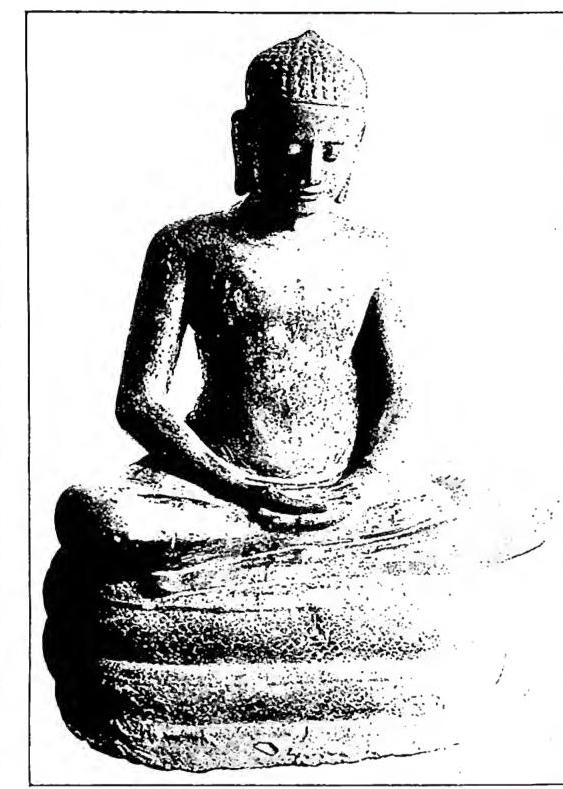
At Uruvelā, working miracles, he converted a thousand Brahman hermits, and from then on the monastic community continued to grow. Returning to Kapilavatthu at Suddhodana’s request to visit his family, he found among his relatives his dearest and most faithful disciple, Ānanda, and also the Judas of the Buddhist community, Devadatta, founder of a more rigidly ascetic sect. In the fifth year of the B.’s apostolate, Suddhodana died, and Mahāpajāpati, left a widow, requested admission to the Order for herself and for other noblewomen of the Sakya, among them Rāhulamātā. Only with great difficulty, and through Ānanda’s intercession, did the B. agree to establish the women’s monastic community, to which he imposed special rules.
The pāli texts contain little information about the final twenty-four years of the Enlightened One’s life, which must have passed in tranquil regularity. Accompanied by the most eminent monks, he went from one village to another proclaiming his teachings, interrupting his wanderings only during the rainy season, which he spent in one of the vihāra, or retreats, donated to the community by generous benefactors. The account concerning the final three months of the Enlightened One’s life is instead rich in detail, having been transmitted by the “Discourse on the Great Extinction” (Dīghanikāya, 16). On the road to Kuṣināgara, the B. accepted the invitation of the goldsmith or smith Gunda, who gave him fatty pork to eat, according to some, or mushrooms, according to others. The indigestible food caused the B.’s death.
In sight of Kutināgara, he lay down in a grove of sāl trees, never to rise again, assisted by Ānanda. At the order of the Malla, lords of the city, the corpse was cremated with the honours due to a universal ruler, and over part of his ashes the Sakya erected the nūpa (tumulus with relics) found and opened by Peppé after almost twenty-four centuries.