
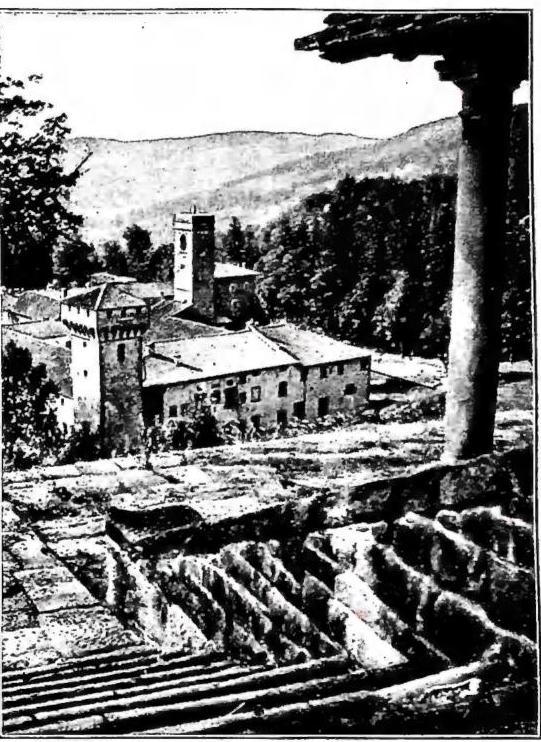
VALLOMBROSA. – Abbey of S. Maria Assunta di V., belonging to the Vallombrosan Benedictine monks (v.). It is situated at approximately 1,000 m above sea level in the municipality of Reggello, province of Florence, on the slopes of Pratomagno, on the incline of Mount Secchiata in the Tuscan Sub-Apennines.
The abbess of S. Ilario in Alfiano (S. Ellero) granted a plot of land in the locality of Acquabella to s. Giovanni Gualberto, who withdrew there with some companions in 1030; and only after the reclamation of the site, carried out by the monks, who planted fir, beech, and other woods there, did it change its name to V.
It began as a hermitage protected by palisades, with isolated wooden cells arranged around a small church likewise made of wood and branches; but it grew so rapidly that Cardinal Umberto, on 9 July 1051, consecrated the tri-
The abbey progressed rapidly, was enriched by donations, and expanded through the establishment of other monasteries, as is learned from the privilege granted by Urban II on 6 April 1090 to the Universae Congregationi Vallis Umbrosanae, in which, besides the coenobium of S. Maria, there are recalled the monasteries «eiusdem religionis», namely those of S. Fedele de Strumis in the diocese of Arezzo, and those in the dioceses of Fiesole, Lucca, Florence, Pistoia, Faenza, and Bologna. The privilege of Paschal II of 9 February 1115 recalls monasteries at Parma, Piacenza, and Brescia; those of Anastasius IV of 22 November 1153 and of Adrian IV of 5 December 1156 mention those of Siena, Volterra, Chiusi, Sardinia, Cremona, Reggio, Novara, Vercelli, Verona, Bergamo, Milan, and Asti. Other monasteries are mentioned in the privilege of Alexander III of 14 February 1169, and again on 12 May 1186 by Pope Urban III under Abbot Terzo. It also possessed S. Mustiola di Turri, under Abbot Lotterio, in the time of Celestine III, on 14 April 1195 (Jaffé-Wattenbach, 17218).
In the fifteenth century its decline began. In 1530 it was set on fire by the troops of Charles V, but it succeeded in recovering during the second half of that century and in the following one, as is demonstrated by the reconstructions undertaken at that time and by the additions carried out between 1578 and 1590 and in 1609–10, after the fire, by F. Mazzaranga and Tonna of Via dei Bardi. The façade is the work of G. Silvani, begun in 1637; to him is also owed the sacristy, with its sacred furnishings, on the upper floor. Further enlargements belong to the eighteenth century. The abbey was suppressed during the Napoleonic period; the monks then returned and remained until 1866, when it was suppressed again and occupied by the Forestry Institute.
Recently the monks have regained possession of part of the monastery. The central part of the abbey consists of the cloister, or major court, with four corridors having groined vaults; one door leads into the transept of the church, whose façade is the work of Abbot T. Davanzati, from 1644. Above the triumphal arch is the statue of the Blessed Virgin; in a niche between the two doors is the statue of S. Giovanni Gualberto. The interior has a single nave with a ceiling of depressed arches; the decorative paintings are by G. Fabbrini (1750). In the presbytery, eight columns support the dome, frescoed by the same painter in 1780. The fifteenth-century choir stalls, transferred from the abbey of S. Pancrazio in Florence, are the work of Francesco da Poggibonsi. On the rear wall, above the altar, is the Assumption of the Blessed Virgin, the work of Volterrano. In the transept is the chapel of S. Giovanni Gualberto, from 1697; on the altar is the tabernacle containing the silver reliquary with enamels and precious stones, the work of F. Soliano from 1500. The chapel known as that of the Ten Blessed, erected in 1757, with atrium and choir, was built on the site where in 1600 the tombs of the first ten blessed members of the Order were discovered. From here come the great altarpiece by Perugino (1500), now in the Uffizi in Florence, depicting above the Assumption and below s. Bernardo degli Uberti, s. Giovanni Gualberto, s. Michele Arcangelo, and s. Antonio, as well as the two small panels with portraits of the patron, Abbot Milanesi, and the monk Baldassarre. By an apostolic letter of 18 November 1950, Pope Pius XII conferred the title and privileges of a minor basilica upon the church of S. Maria Assunta (AAS, 43 [1951], pp. 426–28).
To the north-east of the corridor of the major court is the abbot’s quarter. The great corridor of the monks’ dormitory was built in 1609–10. The library was constructed by A. Parigi in 1584, but its manuscripts and books were removed at the time of the suppression. It contains the large painting depicting the donation made by Matilde di Canossa to s. Bernardo degli Uberti, executed by A. Mascagni in 1609. The fountain of S. Giovanni Gualberto is a Baroque construction of 1629, as is the adjoining chapel. The forest was created and maintained by the monks until 1866, when it passed to the state property and the forestry administration, which occupies part of the present monastery; it was mentioned by Ariosto and Lamartine. The former guesthouse inside the monastery has now been converted into a hotel. The hermitage of the cells, or Paradisino, uphill to the left of the monastery, is the site occupied in the eleventh century by some monks who withdrew there to live an eremitical life in small cells excavated in the mountain. At present, only an oratory remains, erected in the seventeenth century in memory of the Blessed Migliore da Valgiano of the twelfth century. An inscription on the façade recalls Milton’s stay there and his mention of V. in Paradise Lost. From the oratory come the two panels with s. Michele arcangelo and s. Giovanni Gualberto, s. Giovanni Battista, and s. Bernardo degli Uberti, by Andrea del Sarto, now in the Uffizi Galleries in Florence.
The abbey archive, not only at V. but also, owing to the residence of the abbots in various other monasteries, remained partly at those of S. Michele di Passignano, Ripoli, S. Trinita in Florence, S. Michele di Forcoli in Pistoia, S. Mercuriale di Forlì, and S. Lorenzo di Cutuboni, and partly, in the nineteenth century as well, in Rome at S. Prassede, officiated by the same Vallombrosan monks, where the Registrum was nevertheless destroyed. Part is now in the State Archive in Florence (cf. Arch. stor. ital., 5th series, 32 [1903]); part is in the National Library and part in the Laurentian Library.