
BERGAMO, DIOCESI di. — The city consists of two nuclei: the upper city, which is the ancient one and contains the most significant monuments, and the lower city, which has developed recently on level ground. It is the capital of a prosperous and active province (2,759 sq km) and an episcopal see, suffragan to Milan. The diocese has 391 parishes, of which 27 follow the Ambrosian Rite, and five autonomous vicariates, 1,073 diocesan priests, and 560,000 faithful (1948).
I. HISTORY
The city of B., which originated with the Ligurian peoples, the Orobi, and subsequently passed to the Etruscans, the Cenomani Gauls, and, around 200, to the Romans, encountered Christianity at the end of the 3rd century. There is a record of a Bergamo martyr, Alessandro, concerning whom legend has worked extensively; he became the patron of the diocese, and a basilica was erected over his tomb, perhaps as early as the 4th century.The diocese arose in the first half of the 4th century. Indeed, according to the testimony of the bishop s. Ramperto of Brescia, the funerary inscription placed by the fourth bishop of B. over his predecessor recalled that the latter had been ordained deacon by s. Filastri (d. before 397) and consecrated bishop by s. Ambrogio (374–97); hence the first bishop of B. should be placed around 340. According to tradition, this was s. Narno, who was succeeded by s. Viatore; their tombs were discovered in 1561 when the ancient Cathedral was demolished. As for the other eight bishops whom tradition places in succession up to the end of the 6th century, definite information is available for only four: Dominatore and Stefano, easily identifiable with the third and fourth bishops mentioned above; Prestanzio, who attended the Milanese Council of 451 against Eutyches; and Lorenzo, present at the Roman Council of 501. Here the list breaks off, to resume in the middle of the 7th century with Giovanni, who signed the acts of the Roman Council of 679. His work was connected with the apostolate among the Arians of B., then the seat of a Lombard duchy. At this time the church of S. Vincenzo appears, perhaps the seat of the Arian bishop (later a cathedral with its own Chapter until 1667). At the beginning of Frankish rule, the first rural parish churches appeared, including Telgate, Almenno, Caleppio, etc. Among the bishops of this period, Adalberto (891–935) should be remembered: he rebuilt the basilica of S. Alessandro and the city devastated by Arnulf, king of Germany. Under him the bishop’s civil jurisdiction over the city began; it was enlarged under Ambrogio I (971–75), chancellor of Ottone I in Italy, and under Ambrogio II (1023–1057).
During the Gregorian reform, the religious life of B., which suffered from the defection of Bishop Arnolfo (1077–96), was wholly illuminated by the Cluniac monasteries of S. Egidio at Fontanella and S. Giacomo at Pontida, by the Cassinese monastery of S. Paolo d’Argon, by the Vallombrosan monastery of the Holy Sepulchre at Astino, and by the Cistercian monastery at Vallalta, in whose origins s. Bernardo played a part. The communal period, which left in the traditions of B. the memory of a celebrated pact (Pontida), witnessed painful uncertainties in the life of the Church under Bishop Gerardo (1146–67), but also recorded the wise government of Gregorio (1133–46), author of the pamphlet De veritate corporis Christi contra Berengarianos; of Guala (1168–86); of Giov. Tornielli, who welcomed the Dominicans (1218) and Franciscans (1230) to B.; and of Giovanni Scanzo (1295–1309), whose Synod of 1304 is the first to have truly remained in the history of B. This work was continued by the bishops of the Visconti period (1332–1428), among whom Francesco Regazzi distinguished himself at the Councils of Constance and Basel as an admirable peacemaker among the factions. Under him began in B. the providential work of s. Bernardino da Siena. During Venetian rule over B. (1428–1798), Pietro Lippomani (1517–44), who anticipated the reform work of the Council of Trent, inaugurated a splendid succession of bishops. Among them, Federico Corner (1561–77) took part in the Council of Trent, received the apostolic visitation of s. Carlo, and founded the seminary; his successors G. Regazzoni, G. B. Milani, G. Emo, F. Corner, and L. Grimani followed the Council’s directives during the years 1577–1656, culminating in the work of b. Gregorio Barbarigo (1657–64) and Daniele Giustiniani (1664–97). Of all these bishops, the episcopal archive preserves the rich series of pastoral visitations, documents of great value for the history of the diocese.
During the political upheavals of the last century, three bishops distinguished themselves particularly: Gian Paolo Dolfin (1777–1819), learned and zealous but somewhat yielding in the face of the Revolution; Pier Luigi Speranza (1854–1879), who lived through the difficulties of the Risorgimento with austere steadfastness and witnessed the birth of numerous religious congregations from Bergamo; and Camillo Guindani (1879–1904), under whom B. experienced one of its finest periods, especially because of the splendid development of all the institutions connected with the emerging Catholic Action.
II. ART
The most interesting and ancient monuments are found in the upper part of the city. The Romanesque church of S. Maria Maggiore, built in 1137 according to a design by the Comacine master Fredi, was enlarged and renovated until the arrangement of the seventeenth century, which has not since been altered: the rich marble portal facing the Piazza del Duomo, erected in 1353 by the Comacine Campilioni, is surmounted by two tabernacles with figures of saints, one of which, facing south, was by Campilioni’s son (1360), and is completed by a small temple and spire by Antonio di Alemagna (fifteenth century). Inside, where the Renaissance and Baroque have left their profound mark, noteworthy are the frescoes by Cavagna, with the help of Talpino and Zucca, in the octagonal cupola (1614); the fifteenth- and sixteenth-century tapestries based on cartoons by Allori and Luca van Schoor; the figurative woodcarvings of the choir, based on designs by Andrea Previtali and Alessandro Bonvicino; the balustrades by Camillo Capi; the bronze candelabra by Rizzetto da Brescia (1597); the fourteenth-century mausoleum of Cardinal Longo by Campilioni; the Baroque confessional by Fantoni (1706); and the monument to Donizetti by Vela. Adjoining it is the superb Colleoni Chapel, ASMODEO (v.) built between 1470 and 1476: its façade, repeatedly altered and enriched, is adorned with precious marble and sculptures. Inside, where the octagonal cupola contains frescoes by Tiepolo, are the monument to Colleoni, in pure Lombard Renaissance lines with rich sculptures and bas-reliefs, surmounted by the gilded wooden equestrian statue by Sisto Siry of Nuremberg (1501), and that of Medea Colleoni, of Tuscan inspiration; the Baroque altar by Andrea Manni (1676); and the small fourteenth-century octagonal baptistery with interesting sculptures by Campilioni (1340), reassembled here in 1898.The Duomo was built on the site of a sixth-century temple through the initiative of Filarete (second half of the fifteenth century) and was profoundly modified in 1680 by Fontana: the interior, in the form of a Latin cross and with a single nave, surmounted by Crivelli’s cupola (1853), is rich in decorations and Baroque altars, among them the grand one by Filippo Alessandri; pulpits in alabaster and precious marble; a ciborium by Cesare Targoni (1558); and valuable paintings.
Among the many churches, noteworthy are S. Pancrazio, dating from before the tenth century but restored several times and possessing a fine portal; «S. Grata inter vites» (eighth century), renovated by Achille Alessandri (1750); the very ancient S. Alessandro della Croce, rebuilt in Baroque style (1630); S. Michele, surnamed dell’Arco because it was erected upon a Roman arch dedicated to Nero; S. Spirito, dating from before 1500 but rebuilt in 1521; S. Agostino, built in the fifteenth century in Gothic forms; «S. Grata in via», Baroque; and the ancient basilica of S. Andrea, rebuilt according to Neoclassical taste (1840). The oldest church in the lower city is S. Alessandro in Colonna, reconstructed in 1447.
Outside this center, the churches of particular artistic interest are: S. Michele al Pozzo Bianco, both for Lotto’s frescoes and for those recently discovered, dating back as far as the thirteenth century; S. Agostino (used for military purposes), for its majestic Lombard pointed-arch façade; and S. Spirito, for the nobility of its design (Renaissance) and for its rich collection of valuable paintings by Lotto, Previtali, Borgognone, G. Carpioni, and others. Beside it stood the monastery of the Celestines, which passed in 1475 to the Lateran Canons Regular and was subsequently suppressed; it owed its origin to Cardinal G. Longo (1240–1319), who also founded the abbey of the Celestines of S. Niccolò, likewise suppressed. After these, the churches of S. Alessandro della Croce and S. Alessandro in Colonna are distinguished by their numerous valuable paintings, which are also found in other churches, such as a panel by Moretto in S. Andrea and the altarpiece of the high altar of S. Bartolomeo, originating from the distinguished Dominican monastery of S. Stefano, destroyed in 1561.
Among the churches built recently, noteworthy are the Temple to the Fallen of the Great War (Arch. Galizzi) and that of Victory (Arch. Angelini).
In the diocese, the following stand out for their historical and artistic importance: at Gandino, the monumental basilica by Bertera and the precious vestments gathered in a dedicated museum; at Alzano, the sculptural and carving works of Grazioso and Andrea Fantoni and the inlays by G. B. Caniana; at Fontanella, the ba-
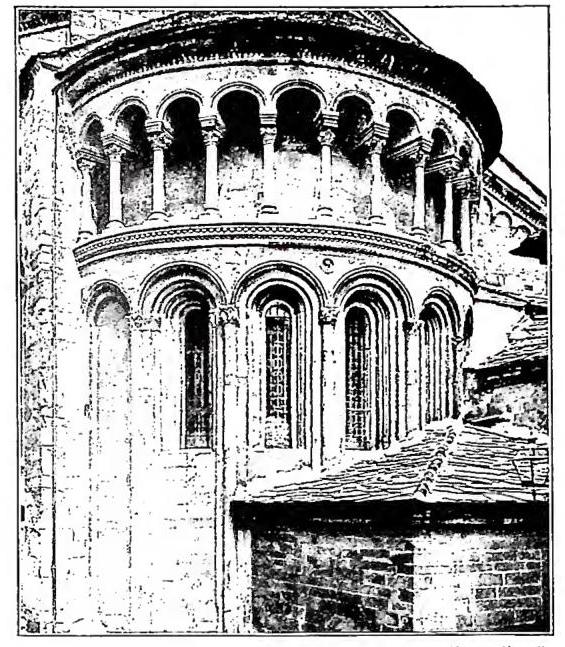
The Accademia Carrara, with the exceptionally rich collections of its picture gallery, completes the artistic heritage of sacred B.
Among the cultural resources, alongside the Civic Library begun by Cardinal G. Alessandro Furietti (1685-1764) and enriched by the libraries of the Chapter of the Cathedral and of suppressed monasteries, the diocese possesses the library of the clergy of S. Alessandro and that of the seminary, as well as the archives of the Chapter of the Cathedral and of the episcopal curia, containing documents dating from 976. A museum of sacred art is being established alongside the city museums of Bergamasque antiquities, the Risorgimento, Donizetti, and natural history.
The musical tradition of B. also achieved a noteworthy affirmation in sacred music in the chapel of S. Maria, whose maestros have included such renowned figures as S. Moyr, A. Ponchielli, G. Mattioli, and A. Donini. The Catholic newspaper L'Eco di Bergamo bears witness to the manifold activity of the Catholic organization, which was among the pioneers in Italy and flourished in the social field.
Art: M. Mattioni, B., Milano s. d.; G. Secco Suardo, Il Palazzo della Ragione in B. ed edifici ad esso adiacenti, Bergamo 1901; A. Pinetti, La decorazione pittorica secentesca di S. Maria Maggiore, there 1916; V. E. Gasdia, S. Alessandro della Croce, there 1924; A. Pinetti, Il Teorico della basilica di S. Maria Maggiore, there 1925; id., Il confessionale di Andrea Fantoni in S. Maria Maggiore, there 1926; id., La collaborazione di un oralo piacentino in una Croce del Duomo di B., Piacenza 1926; R. Papini, B. rinnovata, Bergamo 1929; A. Morassi, La Galleria dell'Accademia Carrara in B., Roma 1934; P. Pesenti, La basilica di S. Maria Maggiore in B., Bergamo 1936; B. L. Angelini, Il Chiostro di S. Maria in B., there 1936; G. Antonucci, Per la cronistoria della chiesa di S. Stefano, in Bergomum, 3 (1936), pp. 198-99; G. Giovannoni, Il Chiostro di S. Maria a B., in Rass. di Archit., 8, 9 (1936), p. 331; A. Selvelli, L'antico convento francescano di B., Bergamo 1938; A. Levi, Il museo romano nella Rocca di B., there 1938; I. Negrisoli, B. romana, in Bergomum, 4 (1938), pp. 151-185; L. Angelini, Recenti restauri di edifici monumentali berg., in Atti del III Conv. naz. di st. dell'archit., 1938, pp. 383-90; id., Vicende e restauri della chiesa e convento di S. Nicolò ai Celestini, Bergamo 1939; S. Locatelli, B. vecchia e nuova, there 1941; N. Degrassi, Scoperta di una strada romana. Il reticolato stradale di B., in Not. degli Scavi, 66 (1941), pp. 311-18; G. Locatelli, Per lo studio della cappella di Bartolomeo Colleoni, Bergamo 1943. Antonio Giuliani - Fabia Borroni
III. S. PAOLO D'ARGON. — An ancient Cluniac priory, founded around 1081 by the count of Bergamo Gialberto, first in Sarnico and then at its present site, now in the municipality of Cenate d'Argon, 11 km from B. The church was consecrated in 1198. In 1493 Alexander VI united the monastery with the Congregation of S. Giustina, which restored and embellished II. Suppressed during the Napoleonic period, the beautiful Basilica, now a parish church, was stripped of its most precious objects, and the monastery, with its two charming cloisters, changed hands several times. It currently belongs to the diocese of B. — Vedi Tav. LXXXIII.