
PULPITO. –
I. ARCHAEOLOGY
The pulpit, also called tribunal, pyrgus, or analogius, was introduced very early into places of worship, after the model of the orator’s platform in Roman civil buildings and in the forum, whence also its designation tribunal.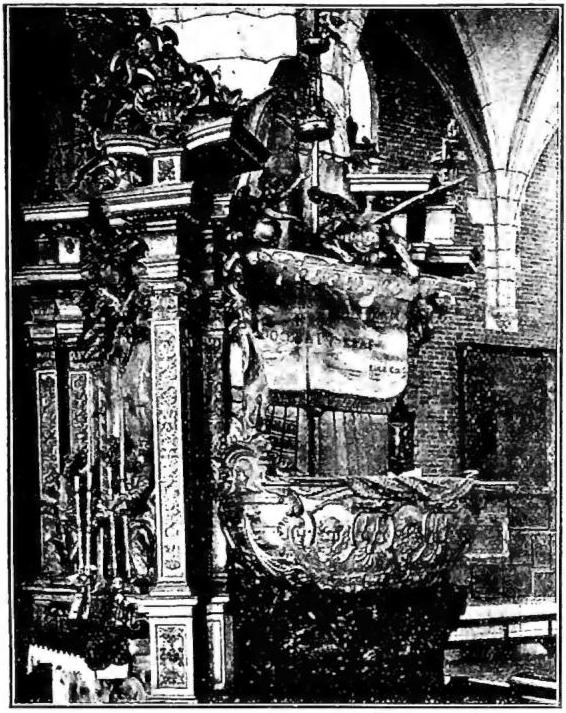
(courtesy of Msgr. A. P. Frutac)
PULPITO – P. of the church of the Canons Regular of S. Agostino
(18th century) – Krakow.
who had also astonished the same persecutor by the testimony of his faith, because no one more than he «deserved to be made to ascend the p., that is, the “tribunal” of the church» (Ep., 34, 4: PL. 4, 332). In the one erected in the cathedral of Ravenna by Bishop Agnello (553–68), the p. is called pyrgus (from the Greek πύργος), as though it were a tower («Servus ΧΡΠ Agnellus episc. hunc pyrgum fecit»).
The p. was generally situated in the central nave and had one or two access stairways. There was always only one in the ancient basilicas, as attested by that of Thessalonica, decorated with historical scenes, and that of Thebes (G. De Jerphanion, L'ambon de Salonique, l'arc de Galère et l'ambon de Thèbes, in Atti della Pont. Accad. rom. di arch., 3rd series, Memorie, 3 [1932], pp. 107–32). Fragments of that of S. Sofia in Constantinople are preserved in the Ottoman Museum. In Rome, in S. Pietro in Vaticano, there was the one placed by Pope Pelagius I (556–61), mentioned in Lib. Pont. I, p. 203, and bearing the inscription: «Scandite cantantes Domino Dominumque legentes ex alto populis verba superna sonent» (G. B. De Rossi, Inscr. chr., II, 1, Rome 1888, p. 78), as well as one in the cemetery basilica of S. Alessandro; in Ravenna, besides that of the Cathedral, there are p. in S. Apollinare Nuovo and at SS. Giovanni e Paolo; in addition, there is that of Gregory IV at Castel S. Elia; that of S. Ambrogio in Milan; those of the cathedral of Canosa and of the sanctuary of the Garghino, all dating from the 11th century, and the later one in S. Marco in Venice. Gregory of Tours mentions that of the basilica of S. Cipriano, which he calls analogius and pulpitus; it was made of marble, entirely carved, accessed by four steps, and surrounded by screens (De gloria martyrum, I, 94). In Constantinople there is the p. of S. Sofia. For Syria V. J. Lassus e G. Tchalenko, Ambons syriens, in Cahiers archéologiques, V (1951), pp. 75–95. That of S. Maria Antiqua, bearing the inscription of Giovanni VII (705–707) in Greek and Latin, is also well known. In Switzerland there are p. in the churches of St. Maurice, Romainmôtier, and Baulmes (M. Besson, L'art barbare dans l'ancien diocèse de Lausanne, Lausanne 1909, p. 22, fig. 4 and pl. 4; id., Antiquités du Valais, Fribourg 1910, pp. 65–68, pls. 30–31).
Only at a later period were two ambons placed in the basilicas, for the reading of the Gospel and the Epistle.
Enrico Josi
II. ART
The Roman Cosmatesque pulpits (v. COSMATI) likewise have solid bases and belong to two different types: one with a square loggia and a single staircase, the other with a double staircase and a slightly projecting, curved, polygonal loggia. The decoration in porphyry, serpentine, and ornamental mosaics gives these works a distinctive character; they all belong to the 12th–13th centuries. Among the most important are the pulpits of S. Lorenzo fuori le Mura, S. Clemente, and S. Maria in Araceli. schola cantorum (v.), they assume different forms according to the function for which they were intended. The pulpits of southern Italy from the Romanesque period are generally of the type consisting of a quadrangular box supported by columns. Those of Salerno, Cava dei Tirreni, etc., are extraordinarily rich in colour; the mosaic inlays, predominant in the area to be decorated, give them a character different from that of the Roman pulpits. Subtly measured in the polychrome richness of its marble is the pulpit of the Cappella Palatina in Palermo. In the Apulian examples, from Canosa to Troia, carved ornament predominates. The pulpit of the old cathedral of Ravello, characterised by a staircase enclosed between polychrome marble walls, should be attributed to the Apulian sculptor Nicola da Foggia.A separate group, distinguished by the luxuriance of its plastic decoration, is formed by the Romanesque pulpits of Abruzzo. These include that of S. Maria in Valle Porclaneta near Rosciolo, by the sculptors Roggero and Nicodemo (1150); that of S. Maria del Lago at Moscuo, by Nicodemo himself (1159); and those of S. Pelino at Pentima and S. Clemente at Casauria, dating from the second half of the 12th century.
In Tuscany, strong plastic decoration also began to predominate on the fronts of marble boxes supported by columns, whether free-standing, set against the walls, or resting on the screens of the presbytery. Worthy of mention are those of the collegiate church of Barga (13th century), of S. Giovanni Maggiore near Borgo S. Lorenzo (12th century), and of S. Miniato al Monte (13th century), as Nicola Pisano (v.), for the baptistery of Pisa (1260) and the cathedral of Siena (1265–69), Giovanni (v.) for the church of S. Jacopo in Pistoia and the cathedral of Pisa. In the latter, the influence of Gothic taste begins to predominate, although in the other regions of Europe the most characteristic and beautiful examples reflecting such a taste date only from the 15th century. Such is the splendid pulpit of Strasbourg Cathedral, densely covered with carving, openwork, and statues. As with the French pulpits, there are many examples in Germany, Spain, and Portugal as well.
At that time, the Italian Renaissance developed the theme of the pulpit independently, keeping the architectural framework—which serves to frame reliefs and niches with statues—extremely simple, while sometimes echoing ancient forms in structures that are free-standing or set against walls and supported by pilasters or columns (Cremona Cathedral, by Geremia da Cremona; S. Lorenzo in Florence, by Donatello). At the same time, the balcony or nest-like type, set against columns or pilasters, was becoming increasingly widespread.
Characteristic examples of this type are the pulpit of Prato Cathedral, by Donatello and Michelozzo, and that in S. Maria Novella in Florence, designed by Brunelleschi and executed by Andrea di Lazzaro Cavalcanti. It was precisely this type, generally attached by highly ornate brackets to the pilasters or walls of churches, that became most widespread during the 16th, 17th, and 18th centuries. It was almost always made of wood, but was also frequently embellished with polychrome decoration and stucco. Notable examples from the period of the Catholic Reform are found in the collegiate church of Manduria, the church of S. Maria at Mosso, and the church of the SS. Martyrs in Turin, etc. In the 17th century, noteworthy examples include the pulpit constructed by B. Cavalieri and G. Neri for the parish church of Chioggia, and that of Asso near Como, made entirely of walnut and supported by massive caryatids.
During the 18th century, when decoration became more theatrical and sumptuous and sometimes inclined toward the affectations of the Rococo, the most characteristic examples of this taste are to be sought in the pulpits of Germany and Austria. Almost always made of painted stucco or decorated with polychrome inlays, they are supported by groups and figures and have roofs and canopies with tall finials, where flying angels and religious symbols appear amid clouds and rays. The pulpits of the church at Ottobeuren (1760) and of the Marienkirche in Berlin, the work of Andrea Schluter, are characteristic examples.
In the 19th century, there was generally a return to Renaissance forms, but with great simplicity of decoration, while in the modern period a taste for a certain architectural rationalism at times seems to seek agreement with the requirements imposed by the laws of acoustics.
In this connection, the pulpit of the church of S. Ignazio in Rome should be remembered. Other characteristic pulpits of our age are found in other Roman churches: in S. Paolo, the wooden one by A. Foschini; in the church of Cristo Re, the marble one by M. Piacentini; and finally, those in the church of S. Maria Mediatrice, designed by the architect G. Muzio.
Guglielmo Matthiae – Emilio Lavagnino
III. LITURGY
As has been said, the p. in the presbytery was originally used for the sacred readings; in the Middle Ages there were two, one for the Gospel and the Exultet, the other for the Epistle.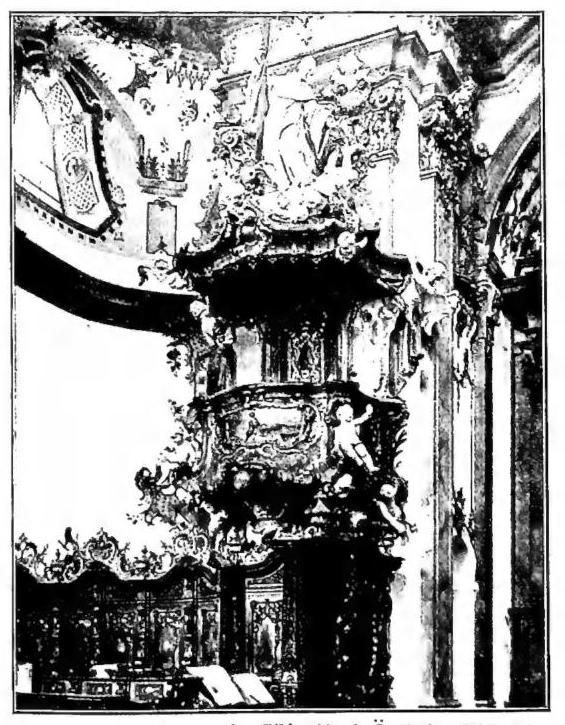
Pietro Siffrin
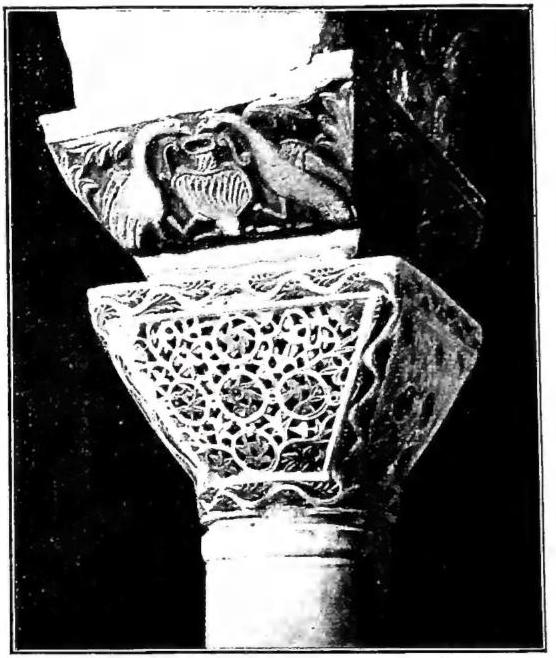
(Alinari photograph) PULVINO – P. with confronting peacocks (6th century) – Ravenna, church of S. Vitale.